


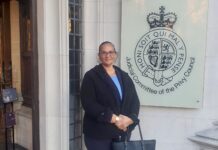
The Privy Council has ruled that a legal impediment to a Pines Retirement Home worker challenging her sacking did not breach human rights.
Shelliann Bush lost her job as an assistant day care coordinator during the pandemic after she refused to get vaccinated against COVID-19, which was mandatory at the facility, and after The Pines alleged she attended work while unwell and infected others in the home.
She subsequently took the attorney general of the Cayman Islands to court on the grounds that, under Cayman law, she, as an employee of a charity, was prevented from having her unfair dismissal case heard by the Department of Labour and Pensions.
Charities, like The Pines, are excluded from the Labour Acts, so the department had refused to investigate her case.
The matter wound its way through the local court system, before being appealed to the Judicial Committee of the Privy Council in London, which is the highest court of appeal for the jurisdiction. The case was heard on 24 June.
Bush, who had been employed by The Pines for 10 years before she lost her job, had claimed that the refusal to hear her unfair-dismissal complaint deprived her of her right to a fair and public court hearing, contrary to Section 7(1) of the Bill of Rights.
On Monday, 18 Aug., the court published its judgment, finding that Bush’s inability to advance her claim of unfair dismissal against The Pines did not breach her right to a fair hearing under the Bill of Rights.
The judges found that even though the Labour Act specifies that the legislation excludes charitable organisations, employees of charities did have other civil recourses open to them to challenging unfair dismissals. Therefore, it did not breach the Bill of Rights.
Attorney General Samuel Bulgin on Monday issued a statement in response to the Privy Council’s ruling, saying he welcomed the decision.
“The government’s defence of this case has always been about ensuring that the law on the meaning of section 7, section 9, and section 16 of the Bill of Rights develops in a coherent and principled way and is so understood,” he said. “Therefore, the ruling provides helpful clarification as to the circumstances in which the right to a fair hearing will apply and how the Labour Act interfaces with section 9 of our Bill of Rights.”
Bulgin added that the Privy Council ruling did not mean that Bush was without recourse.
“Indeed, as the Privy Council observed in its judgment,” he said, “in the event that her dismissal involved a breach of contract on the part of her employer, she would, of course, enjoy at common law rights arising on a wrongful dismissal, which can be vindicated in the common law courts. That is, she enjoys a right, not to be wrongfully dismissed, and if she were wrongfully dismissed, would be entitled to sue her employer in breach of contract.
“However, given the ruling, it would be a policy decision as to whether it would be worthwhile taking another look at the application of section 3 of the Labour Act. But for now, its scope and implications are quite clear.”
Read the full Privy Council ruling here.
Related Videos











Given the facts it seems this lady was dismissed for due cause. Who paid for all this legal process?.