


A fake press release circulating online recently claimed that Cayman would begin charging residents and visitors to use its beaches. The Cayman Islands Department of Tourism has dismissed the claim as false and reiterated that beach access remains free.
The fraudulent statement, dated 12 Oct. and titled ‘Introduction of the Proposed ‘Sea Fee’ Programme,’ alleged that a new policy would take effect on 1 Jan. 2026, requiring everyone to pay to access Cayman’s public beaches and coastal waters. The Department of Tourism quickly shut it down, stating that it did not issue the press release, there is no such thing as a ‘sea fee’ in Cayman and that no such plan exists.
“This message does not represent official government policy,” the department said. “Beach access in the Cayman Islands remains public and free for all visitors and residents.”
Officials urged people to ignore the false release, avoid responding to any payment requests and report suspicious messages to the RCIPS. They also encouraged residents to visit government’s official misinformation page for guidance on spotting false information and to rely on verified channels or the official website for accurate tourism updates.
Cayman beaches: free by law
There are 57 public beaches on Grand Cayman, 14 on Cayman Brac and 6 on Little Cayman – each protected under the The Public Lands Act, which guarantees that every beach in the Cayman Islands remains open to the public up to the high-water mark.
The stretch of sand between the high- and low-tide lines is held by the Crown in trust for public use, a principle enforced by the Public Lands Commission, which safeguards beach access points and pathways that cross private property.
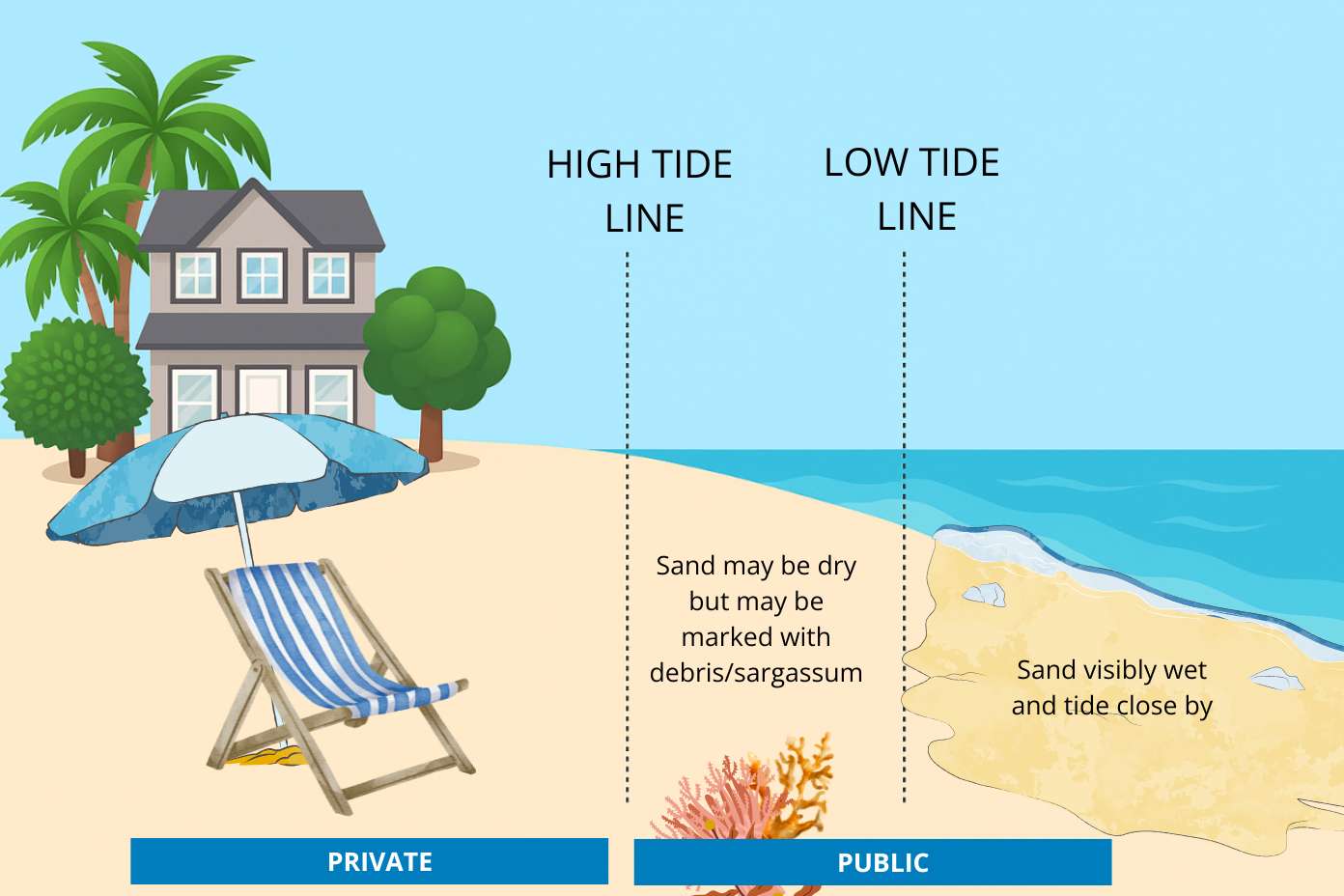
Across the three islands, more than 300 shoreline access points are mapped – 252 on Grand Cayman, 28 on Cayman Brac and 40 on Little Cayman – each providing a public right of way to the sea. These can be viewed on the government’s interactive Shoreline IMAP tool.
Once at the water, anyone may swim, fish or relax anywhere below the high-water mark, except in marine park zones where restrictions apply. Blocked or obstructed access points can be reported to the Public Lands Inspectorate.
Land above the high-water mark may be private, meaning beachfront owners can manage their property and place chairs or amenities there but they cannot claim ownership of the shoreline or restrict public access to the sea. The law is clear: no one can fence off the ocean.
Beyond this, Cayman’s Prescription Law helps to protect long-used pathways and beach areas that the public has accessed for generations. The law states that when a beach or access road “has been used by the public… for bathing or recreation… without interruption for twenty years,” the public gains an “absolute and indefeasible right” to continue using it. In simple terms, if people have freely used a beach or pathway to the sea for at least two decades, that use can become a permanent public right under the law.
Elsewhere in the Caribbean: free vs. sea fees
While Cayman has reaffirmed that its beaches remain free and open to all, access elsewhere in the region varies widely.
In Jamaica, estimates suggest that only about 1% of beaches are freely accessible, with many managed by resorts or surrounded by private developments – an issue that was raised during the country’s 2025 general elections. Of Jamaica’s 74 public beaches, many remain difficult to reach or charge an entry fee.
The government has recently moved to improve access by requiring new hotel developments to include public pathways to the sea. Still, several popular beaches continue to operate with admission charges – Ocho Rios Bay Beach now costs J$400 for locals and US$10 for visitors, Doctor’s Cave Beach charges US$8 and Burwood Beach is free for locals but J$750 for tourists – just a few among many that require paid entry.
In the Bahamas, beaches are legally public, but enforcement of access rights is uneven, and some resorts have been criticised for discouraging entry. Turks and Caicos also recognises beaches as public, but a 2023 Crown Land Review described the framework as inadequate and recommended clearer legislation to ensure open and consistent public use.
Cayman’s laws make clear that its beaches belong to everyone, but questions of access and enforcement mirror a wider regional debate over public rights to the sea. While other Caribbean nations grapple with resort barriers, sea fees and unclear laws, Cayman’s focus remains on public awareness and countering misinformation.
Related Videos










At the rate we are going “beach access” will become pointless.