

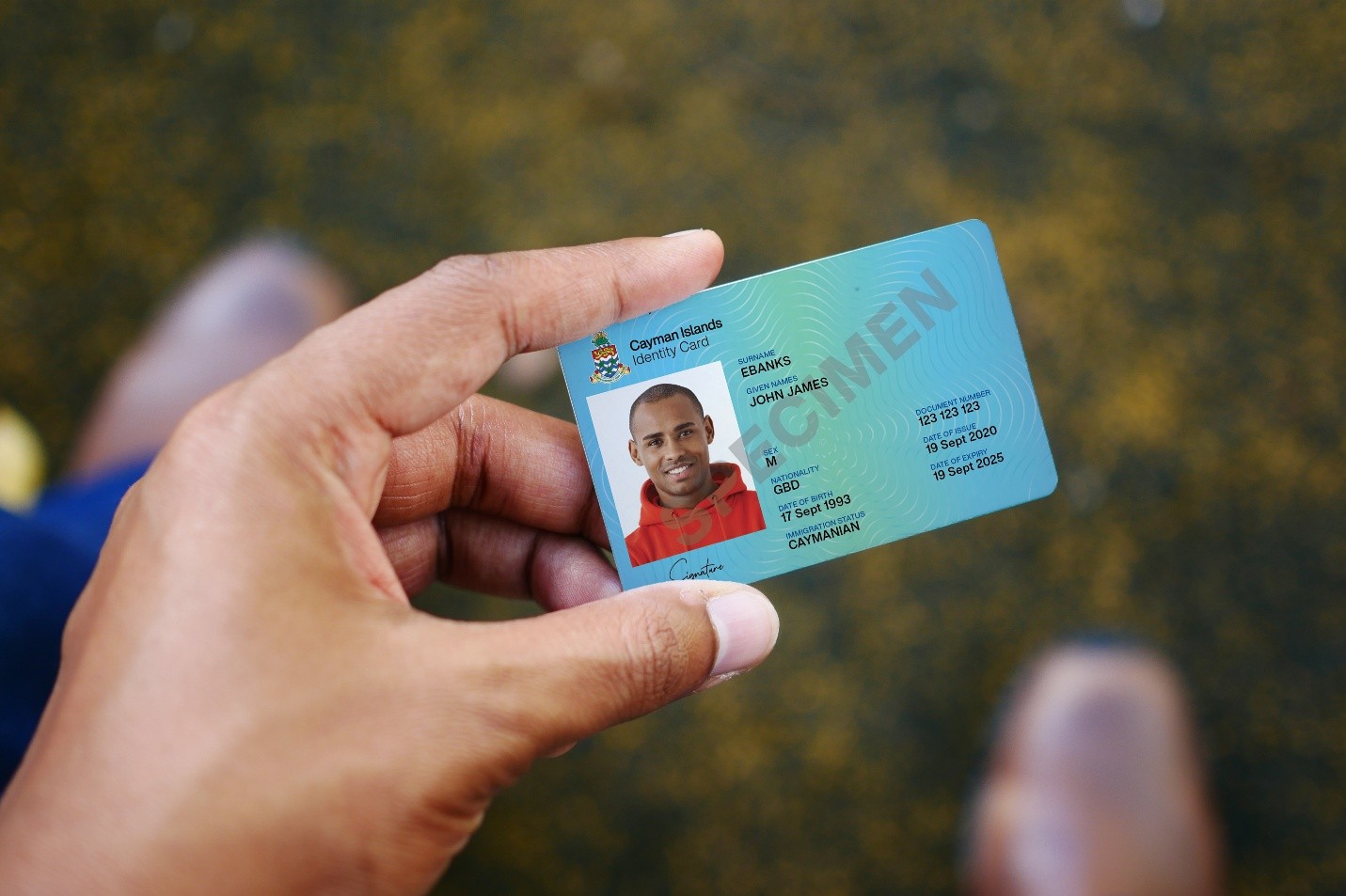
The Ministry of Social Development and Innovation has launched ‘My eID’, a physical identity card with digital features.
The card is currently available to Caymanians, who are encouraged to apply and people in key public positions, such as MPs and senior civil servants. Non-Caymanians living and working on the island can register their interest in the card, which will eventually be rolled out to non-Caymanians.
The card itself is physical, although it has a QR code and NFC chip that allow it to be read by phones, computers and scanners It is also linked to a portal and a unique PIN for each user. The idea is that the card, portal and PIN will allow Caymanians – and eventually all people resident on the island – to confirm their identity and complete government processes more efficiently.
The card can be used as an ID, for example to pass through Cayman airports for a domestic flight or obtain a driving licence. Combined with the unique PIN it will allow people to access government services and sign official documents digitally, while the ‘My Info Portal’ allows users to manage the data on their profile.
The launch of the initiative was announced by Minister for Social Development and Innovation Isaac Rankine at the 2026 Cayman Chamber Economic Forum, which was held at Kimpton Seafire Resort + Spa on 23 Jan. A digital ID has been long mooted but Rankine said: “We’re launching it now because we feel this is the right time to get people engaged in their digital identity online.”
“Being able to prove your immigration status on a card is a first-time thing for many Caymanians – so that’s a big win,” said Charles Brown, deputy chief officer at the ministry.
On the sidelines of the conference, Brown said the plan is “to bring on additional digital services one by one” in the coming years.
Civil service’s efficiency expected to improve
Although the eID card is a Ministry of Social Development and Innovation project, the technical aspects were delivered by the Department of eGovernment. With rising concerns about the growing cost of Cayman’s civil service, the launch offers a potential example of how technology can reduce public-sector costs.
“This development is key to Cayman’s future,” said immigration attorney Nick Joseph, whose team deals with multiple government processes on behalf of their clients. “It carries with it the promise of greatly reduced bureaucracy, and significantly reduced burdens on our civil service.”
“It will be critical to helping us to manage our immigration systems and to assist local persons and other qualified individuals in accessing benefits and services with hitherto unimaginable efficiency,” said Joseph.
The eventual impact of the scheme depends on the extent to which the ID is rolled out and adopted.
“The key driver here, is that the civil service also has to become sensitised to use of the card [and] sensitised to the use of digital signatures,” said Brown. “A lot of us, both public and private, still operate in a very paper-based world. So, it’s going to take time to understand this new paradigm and become sensitised to it before we can really quantify next steps and full understanding of that.”
Another potential risk is that sensitive data is hacked. Indeed, during the conference, Rankine noted that Latin America and the Caribbean is suffering from a faster rise in cybercrime than any other part of the world. Yet Rankine is confident user data will be protected. “We have the best cybersecurity team in the region,” said Rankine.
Brown agreed. “Cybersecurity is everybody’s responsibility, from the data controller all the way down, but government has a team dedicated to investigating and understanding [potential threats]”.
Related Videos












Maybe the Government should just line us up and tattoo a serial number on our arm.
Stupidest thing in 2025 when they already have $600 drivers license for expats. Just more paperwork and money for a plastic card. Yet another tax.
I am concerned that the local banks were not mandated to accept the new ID card. I was once asked to sign my name 5 times in a local bank because the drivers license that I produced had a signature that looked different to the one I wrote. I was also required by another bank to produce two 2 forms of Government ID when doing a transaction. Most of the time wasters are the Banks and the same Government that boasts of a world class civil Service. I was required at one of the dvdl offices to produce my drivers license twice in one visit just to transfer a vehicle. They are the same people who gave me the license in the first place. When collecting a copy of my firearm license one is require to bring a CI passport not any other Government issued ID such as a Drivers license. It seems that different departments make up their own rules depending on where you go.
Caymanians I plead with you, please pause. This isn’t just about convenience.
We’re being told a national e-ID will make life easier. Faster services. Better security. Modern government.
But look at what’s happened elsewhere before we walk this path blindly.
India (Aadhaar)
– Over 800 million records exposed
– Access to personal data reportedly sold for as little as a few dollars
– People denied food, healthcare, and wages due to system failures
This isn’t theory. It’s reality.
When identity becomes digital and centralized:
One breach = everyone affected
One system failure = people locked out of life
One policy shift = your access can change overnight
And here’s the part we’re not talking about:
Cayman isn’t built on systems.
It’s built on trust, Christianity, simplicity, and fairness.
An e-ID changes that.
It turns identity into a number
It turns access into a permission
It turns community into a database
Yes, technology can help us.
But not everything that improves efficiency protects freedom.
Once a system like this is embedded:
– It won’t stay optional
– It won’t stay limited
– And it won’t be easy to reverse
This isn’t fear. This is stewardship.
We owe it to ourselves and our children to ask:
Are we improving these Islands … or quietly replacing what made it special?