

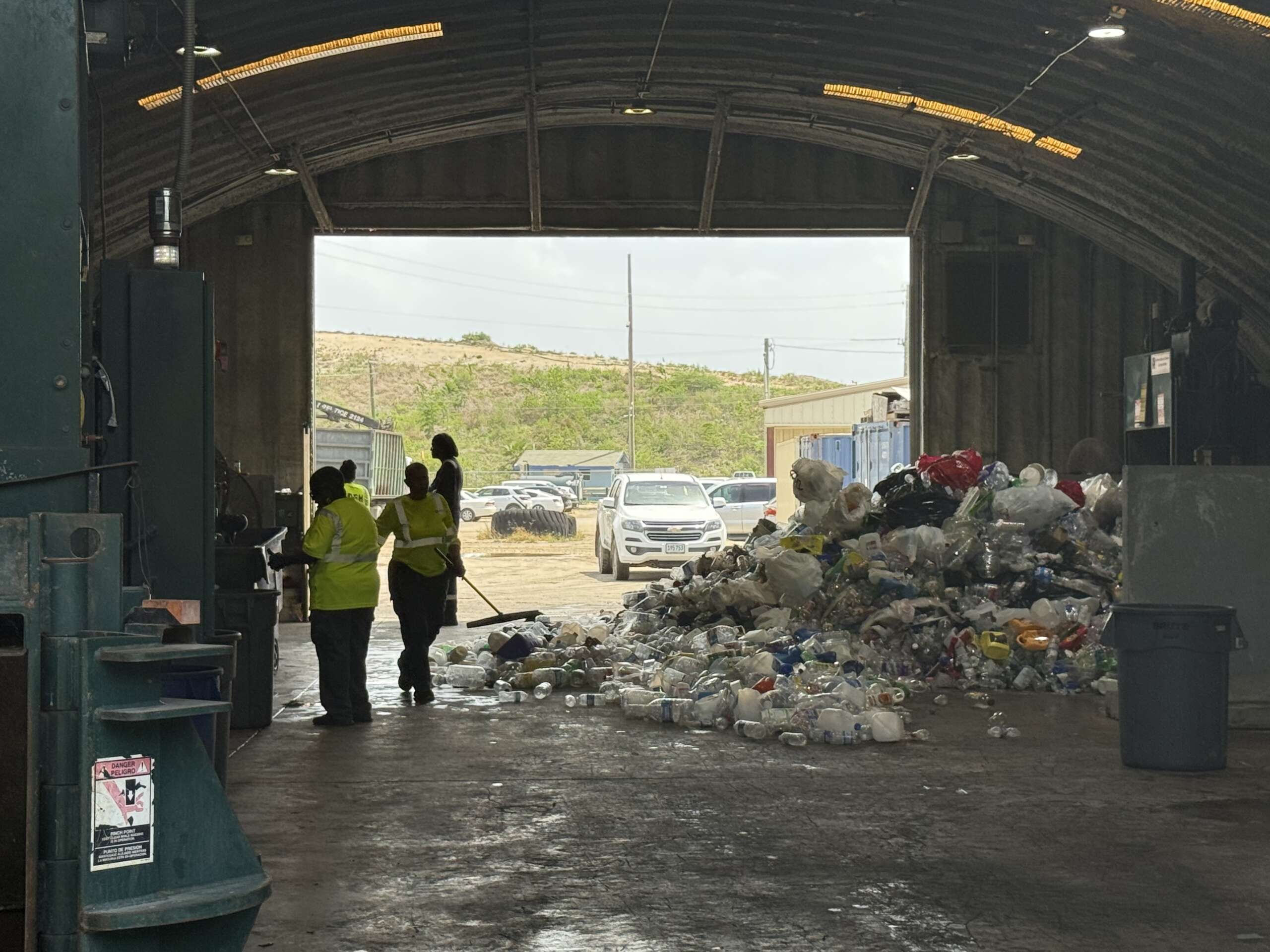
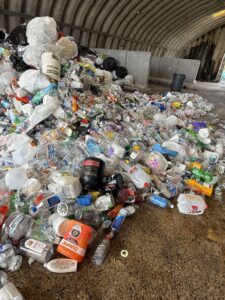
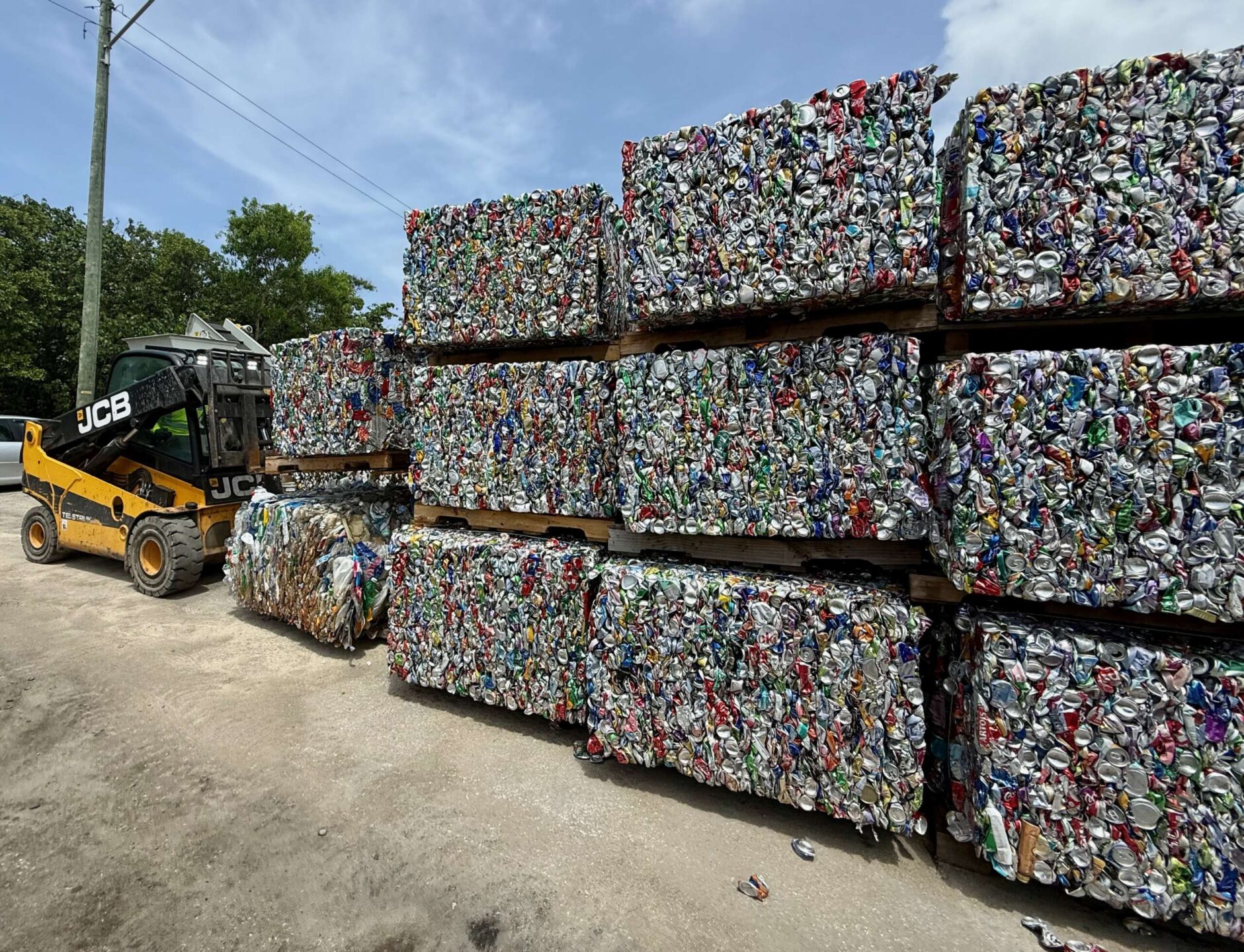
In a shed in a corner of the George Town landfill, staff sift through piles of cans and bottles separating out what can be shipped overseas for recycling.
There is not much. Milk jugs, coffee cartons and empty tubs of detergent spill from bin liners spread out on the floor, ready to be sorted, baled and crammed into a waiting shipping container.
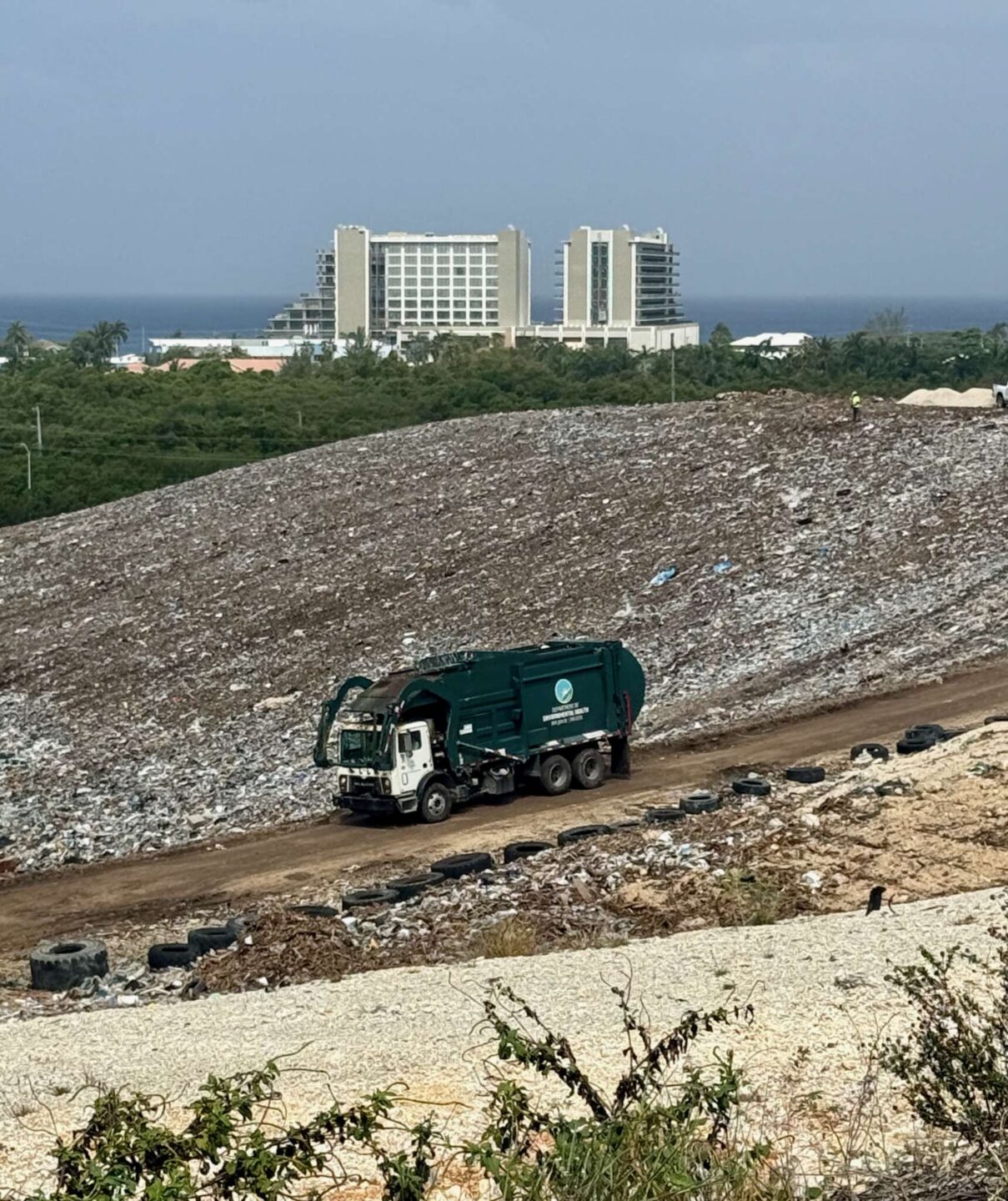
Along a marl path that climbs from a base camp of mobile offices and processing facilities, a truck, one of around 300 that pass through the site on any given day, winds its way towards the upper slopes of the dump.
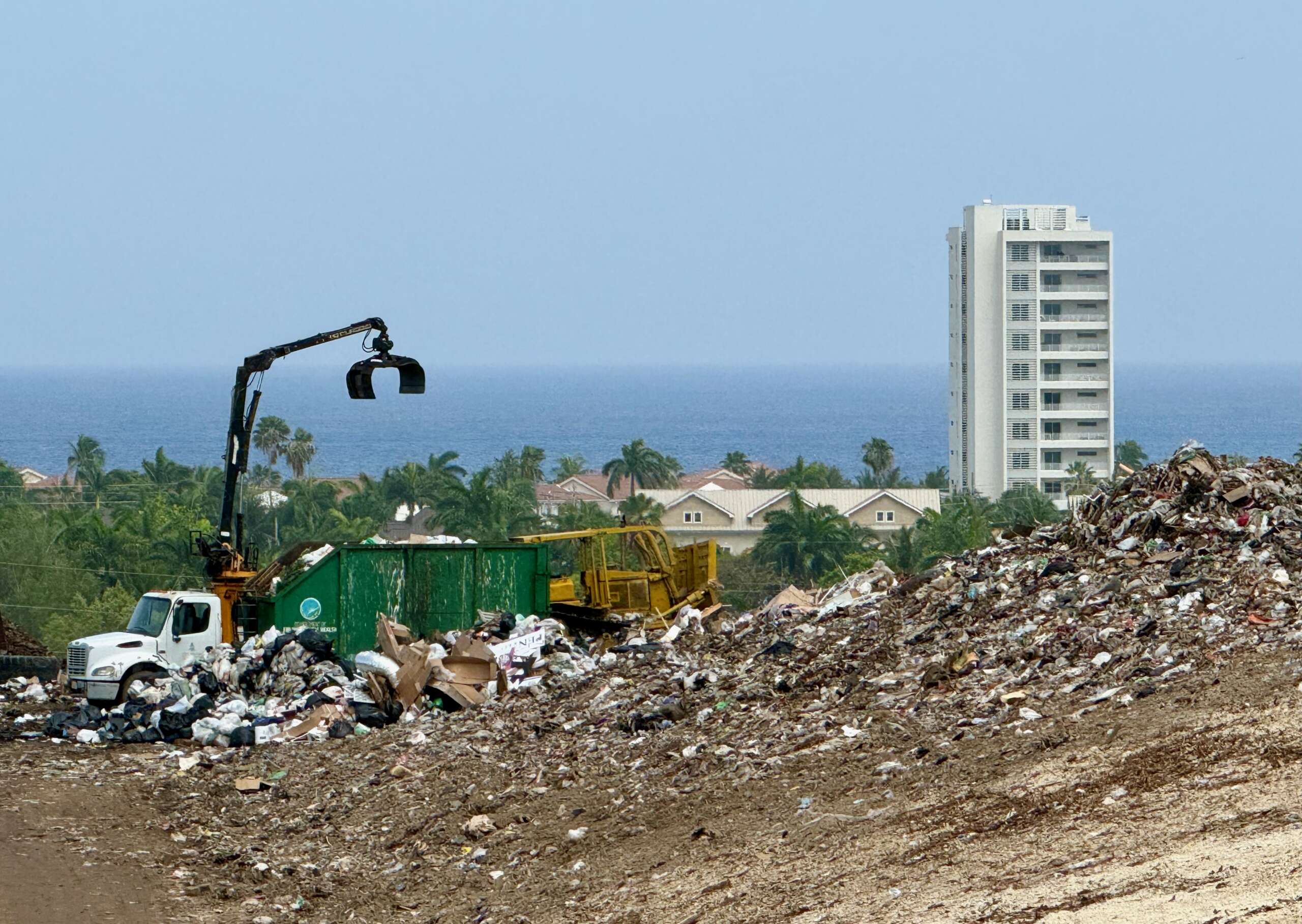
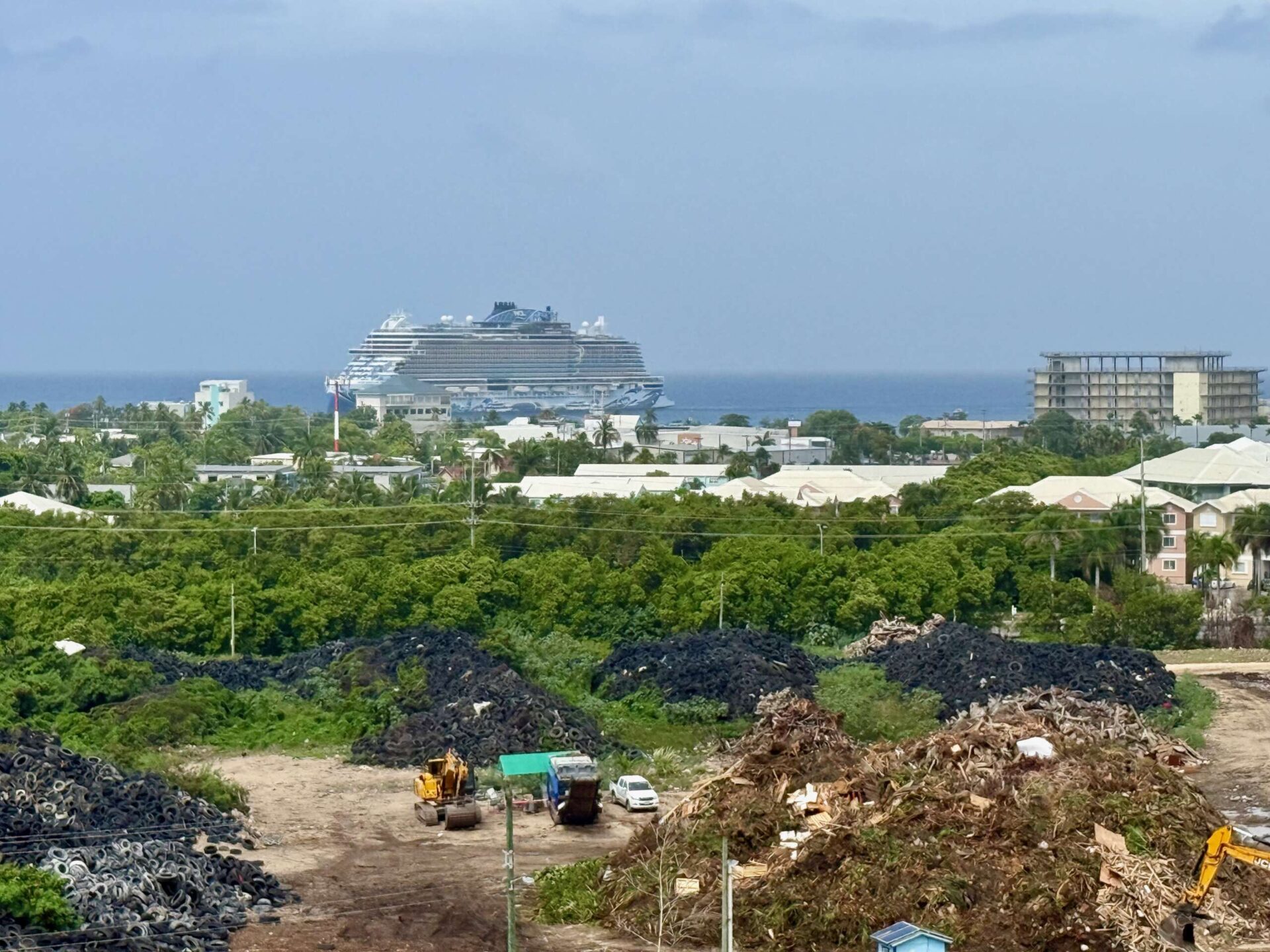
From the top, you can see beyond acres of open layers of garbage to the hotels and condominiums along West Bay Road. A cruise ship is anchored in the harbour beyond.
The difference in scale between Mount Trashmore – the humourous name given to the George Town landfill by many Grand Cayman residents – and the small recycling centre is borne out in the data.
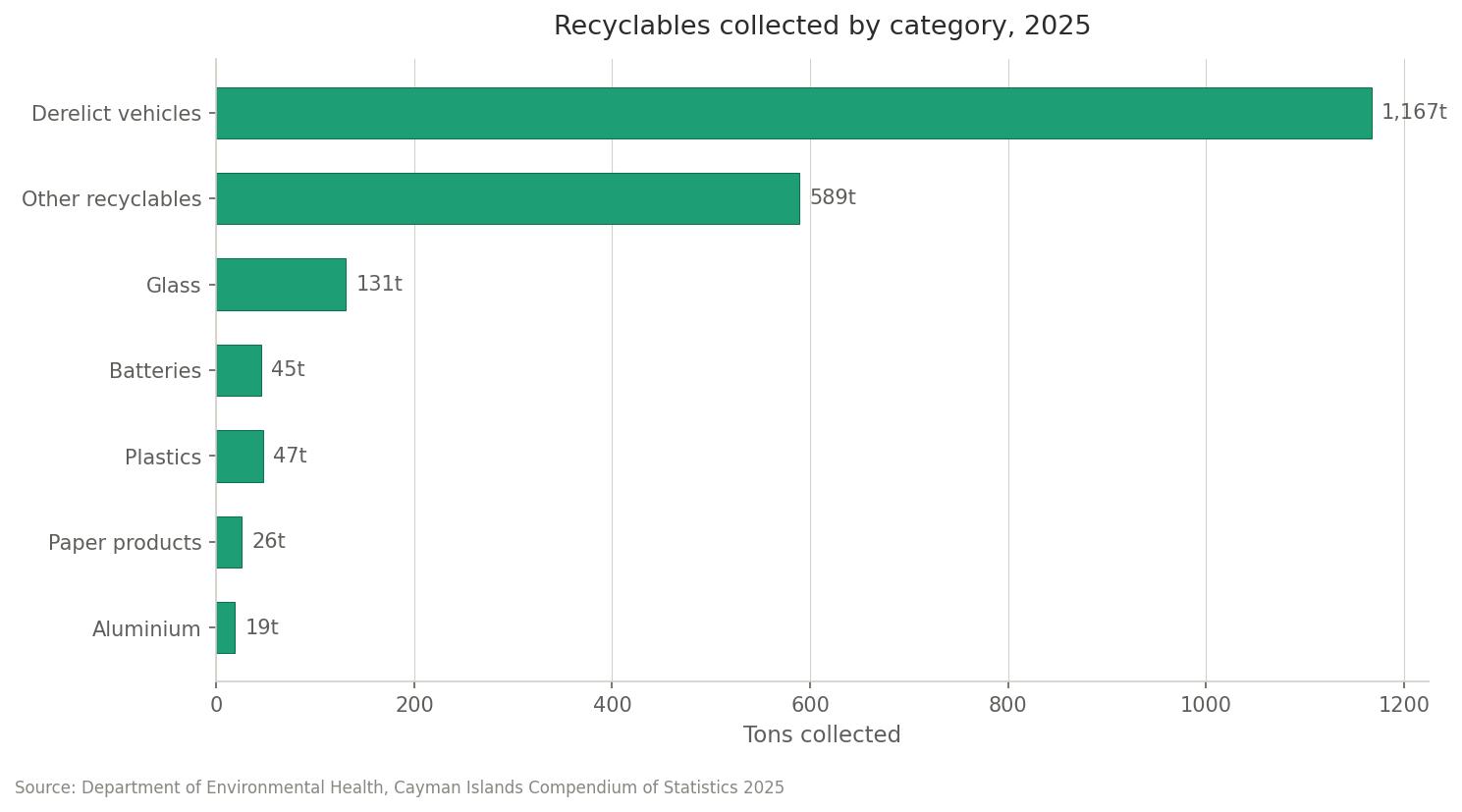
Around 130,000 tons of waste were processed at the site last year. Less than 3% was diverted for recycling or reuse, a figure that makes Cayman an extreme outlier globally, with many developed countries now diverting more than half of their waste from landfill, and some jurisdictions exceeding 80%.
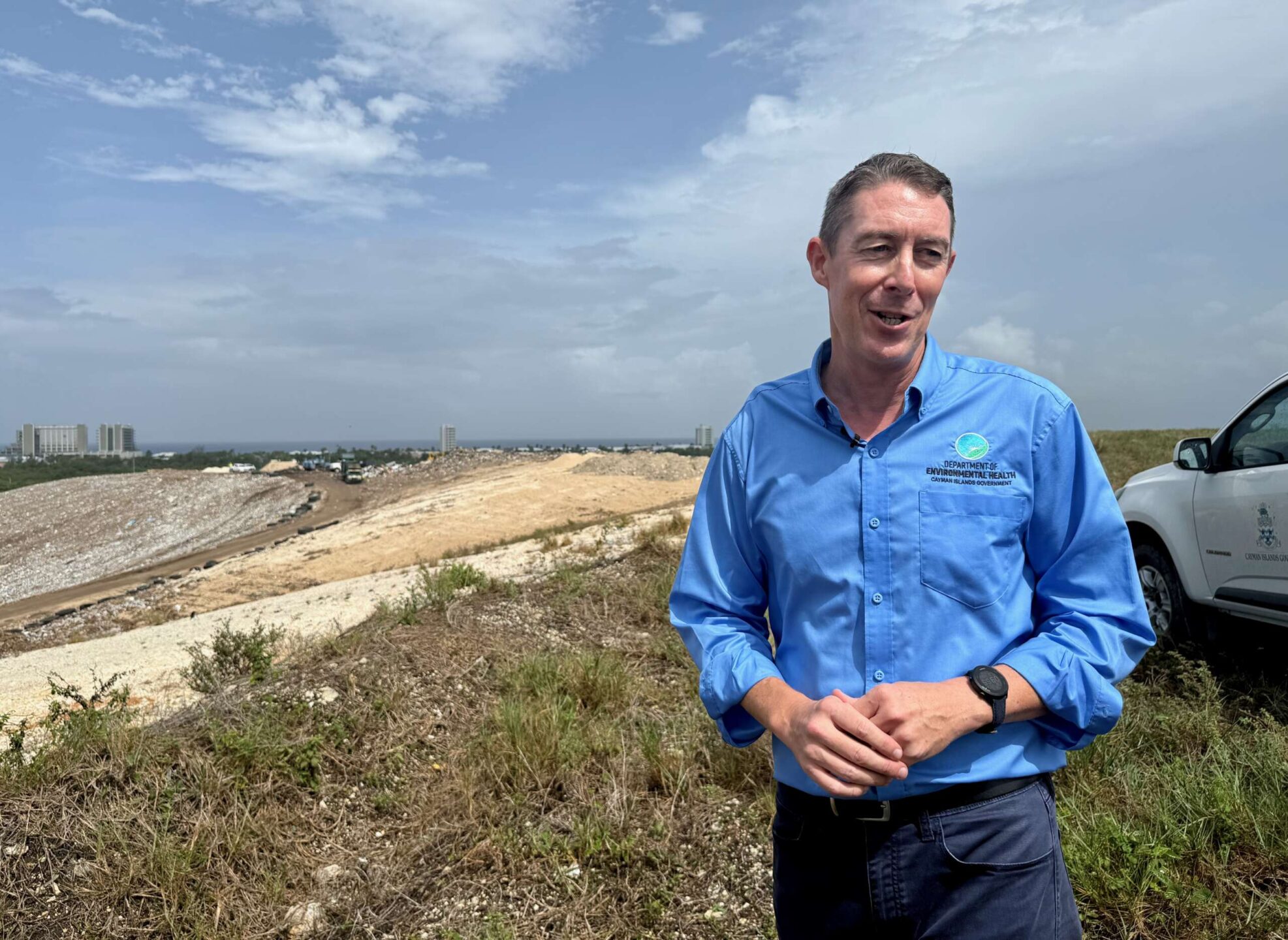
“We all own a piece of this,” said Michael Haworth, assistant director for solid waste at the Department of Environmental Health.
Each person on the island disposes of around seven pounds of waste every day. That means every resident is contributing between 10 and 20 times their own bodyweight to the growing mountain of trash every year.
But without the necessary infrastructure, the landfill, Haworth emphasises, is a solution, albeit an imperfect one, to the problem of waste that would otherwise be discarded in the community.
A 60-year problem
It is not a new issue. As the population approaches 100,000, Grand Cayman is still disposing trash in the same place it did since the mid-1960s, when swampland on the edge of George Town developed from an informal dumping ground into the island’s landfill.
The need for a new site has been evident almost since inception.
As far back as 1989, legislator Ezzard Miller, now the veteran speaker of the House, was sounding the alarm, calling the dump “a methane bomb” on the outskirts of George Town – a prescient warning, given the hundreds of fires that followed and continue to blight the capital today.
At that time, the landfill was processing around 300 tons of waste every week. Miller warned the problem was “getting out of hand” and recommended a waste-to-energy solution. Almost four decades later, 10 times the volume of waste is going into the same site in more or less the same way.
The timeline to find a solution can now only be stretched so far.
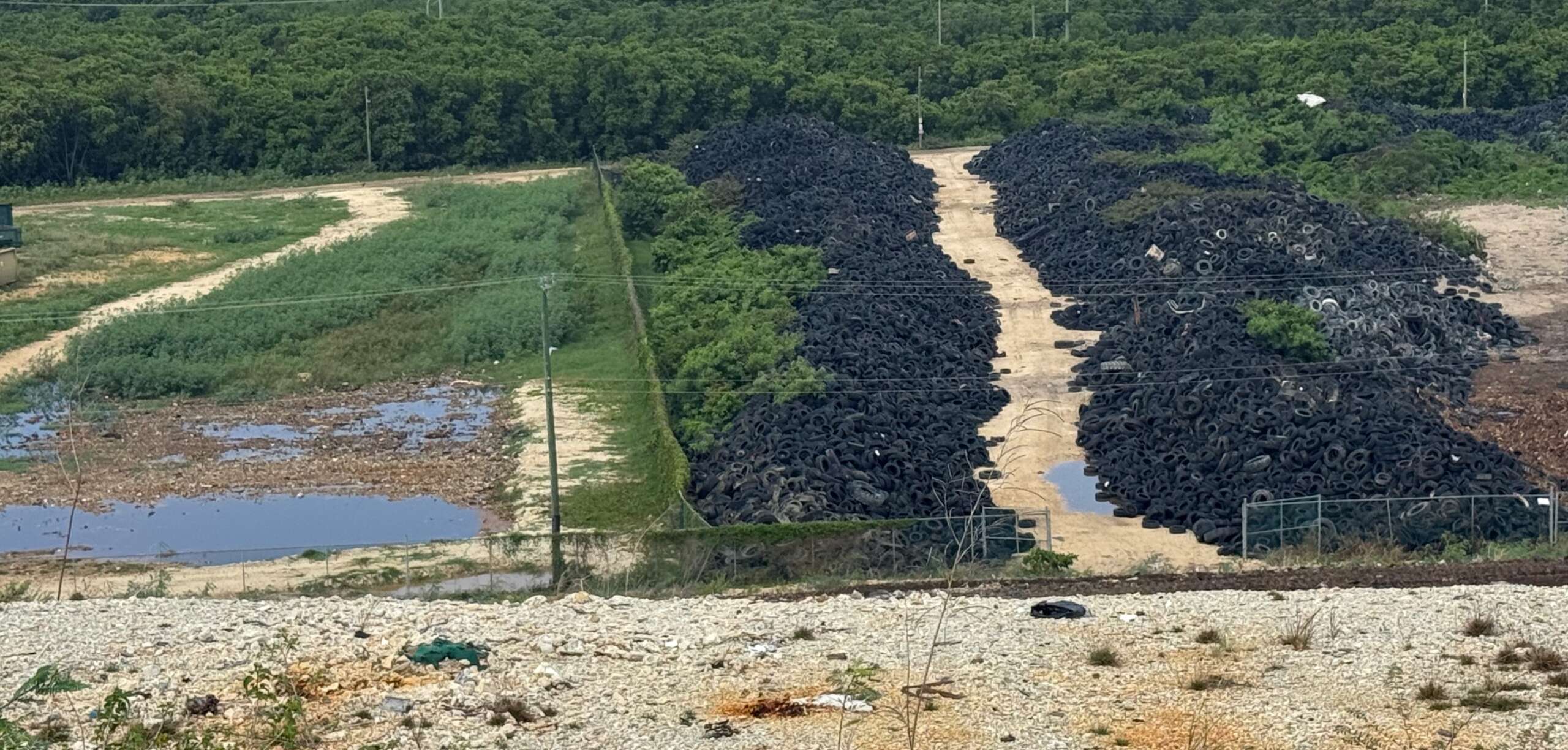
From his vantage point on the grassy slopes of a capped and covered waste mound, Haworth points out a field of tyres stacked in piles.
A contract is about to be signed to ship those off island, clearing enough space to expand the current fill site through 2030.
On the other side of that fence, a field littered with junked vehicles, initially earmarked to dispose of ash from a planned waste-to-energy facility, will now be cleared to install a lined landfill and buy another six years to come up with a longer-term solution.
Cayman Islands residents have heard similar deadlines before. The National Solid Waste Management Strategy, produced in 2015, projected 2021 as the point at which the George Town site would be functionally full.
Haworth acknowledged there have been shifting deadlines over the years and Cayman’s landfill management staff have manoeuvred to create more room.
A drone surveys the site regularly, measuring the height of the waste against the proposed maximum fill shape – currently modelled to around 130 feet – equivalent to the maximum building height in Grand Cayman.
Within a decade at the outside, the space will run out. Even with enhanced recycling facilities, some form of landfill will be necessary.
“The solution for most of the residual waste in the Cayman Islands is this landfill,” Haworth said.
“Regardless of how people feel about it, we are still managing all the island’s waste, putting it in one place where it will stay until the end of time. And, one day, this will be restored green space.”
The long-term goal is to cover the landfill and allow it to become green space. Two previous fill sites have been retired and are already covered in grass.
The land can only be used for open space or parks because it is not sufficiently stable for construction.
“Perhaps people will be zip-lining down here at some point,” Department of Environmental Health director Richard Simms said.
There is a lot of work to be done first.
Back to the drawing board
Since the ReGen deal to replace landfilling with composting, recycling and waste-to-energy was cancelled in 2024, government has gone back to the drawing board.
Katherine Ebanks-Wilks, the minister with responsibility for sustainability, including the landfill, declined to be interviewed for this article.
Speaking in Parliament in May, she announced an interim infrastructure plan and floated the idea of introducing mandatory commercial recycling to extend the life of the site for a decade.
She said a new outline business case would be developed for a longer-term solution. The documents and research in the previous studies could still potentially be repurposed to speed that process, however.
The ReGen deal collapsed after government decided it had become too expensive.
The Compass understands that while costs escalated as negotiations dragged on and inflation rose, the absence of adequate revenue mechanisms, either from waste collection or from energy recovery, was equally damaging to the economic model. Both income streams were considered fundamental to the success of the project.
Opposition Leader Joey Hew has been critical of what he sees as failure on the part of government to revive any aspect of the ReGen negotiation or to have an alternative proposal.
“They don’t have a plan. They don’t even have the beginnings of a plan,” he told the Compass.
‘Polluter pays’ concept critical
While there are cheaper solutions that will now be contemplated, including establishing a new lined landfill elsewhere, the issue of fees is likely to resurface.
Many jurisdictions charge gate fees on households, businesses or contractors depositing waste at a landfill site.
That ‘polluter pays’ concept was a critical part of the National Solid Waste Management Strategy, with every major policy document pointing to the absence of fees as a key concern.
“There is limited revenue from recycling and no tipping fees are charged for landfill disposal,” the 2015 outline business case states.
Commercial operators currently pay a collection fee to have their waste picked up and transported to the landfill. Residential waste is collected at no charge.
“At the moment, there’s no fee to tip in any of our landfills, and that’s unusual in the world,” Haworth said. “Landfills usually operate as a going concern, and it’s that gate fee that makes it viable.”
Gate fees are just one possible revenue stream, he said, citing numerous examples of how other jurisdictions use fees to manage waste and incentivise recycling.
A deposit return scheme, adding a few cents to the price of every bottle imported that is then refunded on return, could generate significant revenue from the estimated 20 million bottles consumed in Cayman annually.
Import levies on single-use plastics, licensing fees for waste operators and reduced duties on environmentally friendly materials are among the options under consideration.
“We’re looking at the whole gamut,” he said.
Minister Ebanks-Wilks identified new recycling infrastructure as a key plank of the government’s plan, including a new green/yard waste facility for organic, biodegradable materials to increase sorting and processing capacity by 2029.
Some of that could have been introduced already, but the projects were all rolled into the ReGen contract and were delayed as negotiations for the deal dragged on.
A design and operations plan, along with a full environmental impact assessment, was already completed for a proper recycling centre on a plot of land adjacent to the dump. That remains a viable option for any future plan, though the extent to which elements of the cancelled deal can be revived have not been explained by government at this point.
Household collections critical
Cayman’s acknowledged diversion rate of less than 3% places it far outside the mainstream of modern waste management, at a time when many countries are actively working to reduce the amount of waste sent to landfill to below 10%.
Across Europe, landfill use has steadily declined through a combination of landfill taxes, recycling infrastructure, waste separation programmes and long-term policy commitments. Even some island jurisdictions have demonstrated diversion rates approaching 90% or higher despite facing a lot of the same geographic constraints as Cayman.
Mauritius, another island state that has historically recorded diversion rates in the low single digits, was the subject of international studies warning that landfill dependence was “no longer a sustainable approach” and highlighting an “urgency to review the whole waste management system” as it pursued major reforms.
Jurisdictions that have dramatically reduced landfill reliance have generally done so through a mix of policy, infrastructure investment, economic incentives, public education and sustained political will.
The UK, which lagged behind Europe for years, moved from landfilling almost everything to diverting around half its waste in two decades.
Doug Simpson, principal consultant on waste strategy for Resource Futures, spent much of his career developing waste policy for the Greater London Authority as that transition took place.
The essence of the policy, he said, was to make it cheap and easy to recycle, and more expensive to throw things away.
Simpson believes the landfill tax escalator, introduced in 1996 at £8 ($9) per tonne on any waste going to landfill and now almost £130 per tonne, was the most critical element. The charge passes through the system and lands ultimately with the producer and the consumer.
“That has essentially driven a 90% diversion from landfill into other activities, like recycling and incineration. It has been a huge financial incentive to move waste away from landfill,” he said.
The introduction of standardised curbside collections as a legal requirement for local councils along with strategic use of the collection schedule, is also helping to change behaviour across the wider community.
“Increasingly local authorities have moved to fortnightly or even three-weekly collections for general waste while running weekly collections for food and for recycling.”
Together these levers are helping to cut general waste and increase recycling rates.
The UK’s household recycling rate has stagnated at around 44% over the last few years.
Far higher rates are achievable, as seen in Wales where successful adoption of standardised collections and a system-wide long-term policy approach combining investment, support, and statutory targets has been credited with driving diversion rates towards 70%.
Simpson cautions that a system that depends on the goodwill of people to bring their own recyclables to the supermarket will never move the needle far enough.
“You can’t rely solely on people to do the right things,” he warns, “You also need to put the infrastructure in place to facilitate making the right choice.”
Curbside collection is the goal for Cayman, but it requires legislation that does not yet exist.
Simms said, “We want to move the depots from the district to your home. That is certainly possible. That’s our dream. We have to change behaviours. We have to put legislation in place.”
Even if Cayman were to hit those kinds of targets, it would still need a solution for the stubborn residual waste that cannot be repurposed, composted or shipped off in a container.
“We live on an island,” Simms said. “There’s only three possible solutions for managing all this… It’s waste-to-energy or continued landfilling, whether it be here or somewhere else, or export. That’s it. Those are the only three options available. We have to look at which one of those is feasible for the government.”
Related Videos







1. Maladministration
Under the Cayman Islands Complaints (formerly Maladministration Law) Act*, failure to address the George Town landfill crisis over decades could absolutely be classified as maladministration. This law was originally enacted in 2003, with subsequent revisions and overseen by the Office of the Ombudsman.
The legal definition encompasses inefficient, bad, or improper administration, explicitly including unreasonable conduct, undue delay, and unjust or oppressive actions by public authorities. So a multi-decade inability or unwillingness to resolve a systemic public service issue like waste management can LEGALLY and CONCEPTUALLY classify as maladministration.
The powers and responsibilities outlined in the Act are executed exclusively by the Cayman Islands Ombudsman.
By law, if poor government decisions or inaction harm the public, the Cayman Islands Ombudsman can investigate to see if state systems have fundamentally failed.
2. Construction and Demolition (C&D) Debris.
The Department of Environmental Health historically allowed all entities to dump waste FREE OF CHARGE, PRIVATE DEVELOPERS HAVE HAD ZERO ECONOMIC INCENTIVE to sort, reuse, or recycle building materials. Instead, hundreds of tons of concrete, rebar, glass, and wood go straight into the landfill mix daily.
The sheer volume of construction and demolition debris from private redevelopment is compounding an environmental emergency. This unregulated dumping of heavy debris is unsustainable.
There must be permitting requirements that force commercial developers to segregate C&D debris (clean concrete and block from metals, wood, and hazardous materials, timber, etc.) before it ever leaves the construction zone or reaches the landfill
Significant increase of dumping costs for mixed, unsorted debris is OVERDUE.
Requirement for builders to post a waste-management bond when pulling permits. is overdue. Make the bond refundable only upon proof that demolition waste was properly handled, recycled, or diverted, rather than dumped into the general landfill mix
The accelerated development of specialized C&D processing facilities to crush concrete for aggregate and reuse, diverting this heavy waste from the landfill altogether is OVERDUE.
Japan for example manages its construction and demolition waste through a highly sophisticated, legally mandated framework that achieves recycling rates exceeding 90% for primary materials. Demolition contractors must be officially registered, and project plans must be submitted to local authorities BEFORE any work begins.
3. The cost of luxury.
The environmental footprint of luxury resorts and spas is disproportionately high, driven by the intense demand for high-end guest comfort and specialized amenities. While the hospitality industry contributes roughly 1% of global carbon emissions, luxury and five-star properties consume up to THREE to FOUR TIMES MORE ENERGY and water per guest than standard accommodations.**
The high volume of waste generated by luxury island resorts and spas also stems from the premium packaging of luxury goods to meet high guest expectations.
Should a hefty flat waste disposal fee be imposed on the luxury facilities in Grand Cayman because they generate disproportionate waste per capita? Academics, practitioners, and government entities should evaluate the feasibility of an ecotax based on the principle that polluters—rather than taxpayers—should pay for the environmental damage they cause. ***
I have mentioned only a couple of issues related to the ever-growing dump nobody seems to be talking about.
Lastly, I hope people, including CIG, at least aware of the “Flamingo Revolution” in Albania. While it might look that mass protests are against a Kushner-backed $1.4B luxury resort in the protected Vjosa-Narta wetlands, it also serves as a cautionary tale for governments worldwide. What began as a local ecological demonstration quickly escalated into a national anti-corruption movement demanding the resignation of the political elite. ****
*https://ombudsman.ky/images/pdf/laws_regs/Complaints_Maladministration_Law_2018_Revision.pdf
** https://www.sciencedirect.com/science/article/pii/S2772427125002530
*** A Pigouvian tax principle is a fee placed on activities that have harmful side effects on society.
**** https://www.bloomberg.com/news/articles/2026-06-11/albania-s-flamingo-revolution-spreads-from-kushner-resort-to-political-elite
Some years ago, we were all set to start a new dump in the swampland to the rear of Bodden Town, but politics interfered and it was cancelled. For all of this century and much of the previous one GeorgeTown has borne the burden of island wide waste disposal. If the swamp in Bodden Town is still available then Govt should seek to revive this solution. No doubt Bodden Towners will be up in arms, but Georgetowners have more than done their share over the last 70 years and another district needs to do their share. Mt Trashmore can be closed and properly landscaped with protection against leaching. It would then be an asset, our only mountain with a forest of trees on top and zero garbage trucks.