


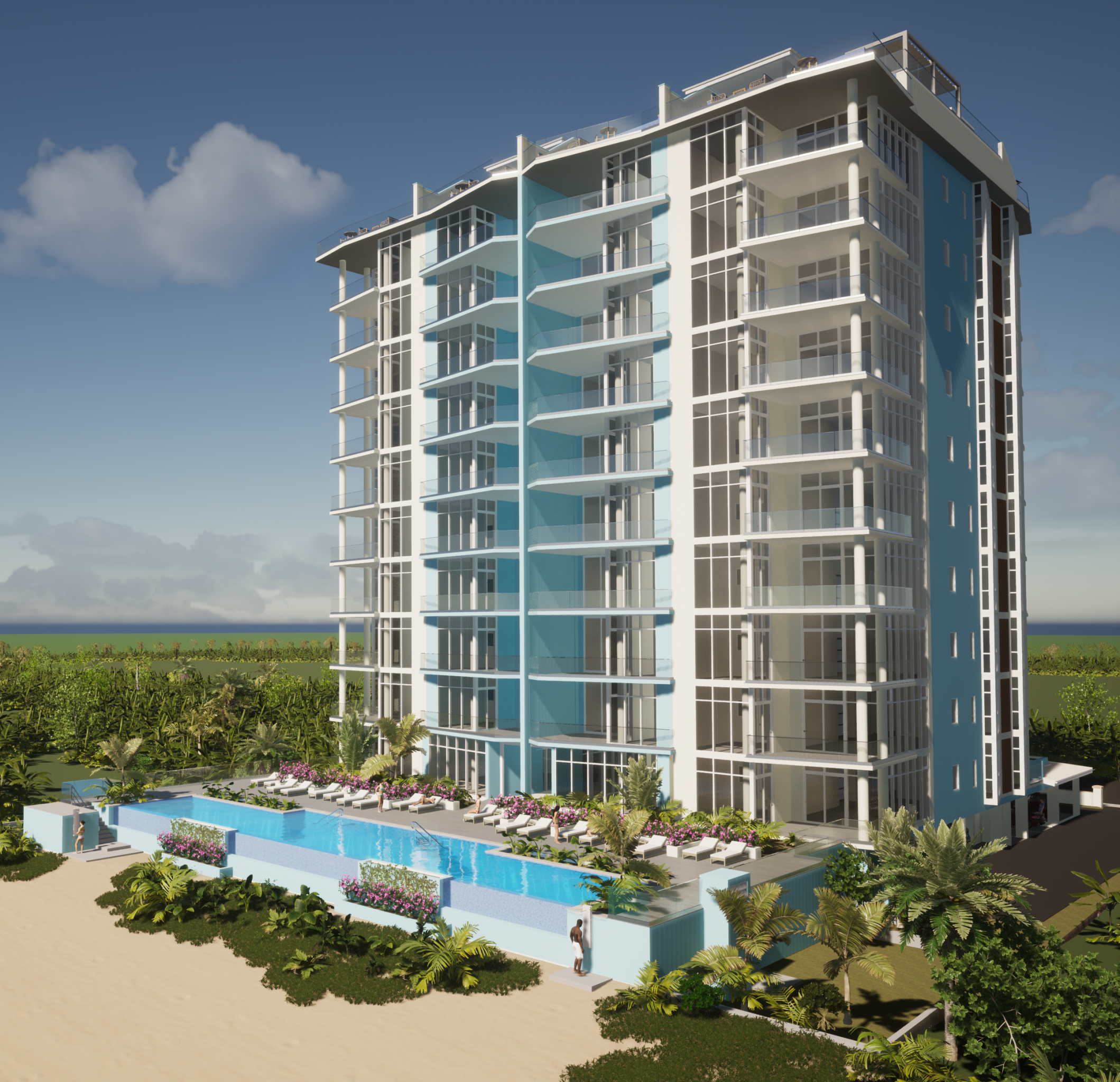
A Grand Court judge has rejected an attempt to halt a judicial review brought by two strata corporations challenging a planning decision on the proposed Aqua Bay Club redevelopment, clearing the way for the case to proceed to a full hearing.
The ruling by Justice Jalil Asif is the latest development in a long-running battle over the plans to erect a 10-storey, $60 million building at the site of the existing Aqua Bay Club property on West Bay Road.
The Central Planning Authority granted planning permission for the development in October 2024, almost two years after the project was first announced. Residents of the nearby stratas had objected to the proposal, saying it would cause “a permanent and irreversible change of character of the last little stretch of tranquility on Seven Mile Beach”.
The planning board’s decision was taken to the Planning Appeals Tribunal, whose chairman, Peter Broadhurst, ruled in July last year that there was no chance of an appeal succeeding. The objectors then took their fight to the Grand Court, filing a lawsuit saying that the tribunal was wrong in its decision, and they were granted leave to bring a judicial review.
In a judgment finalised on 5 March, Asif rejected an application by the developer, Butler Group Limited – filed with the support of the Planning Appeals Tribunal and the Central Planning Authority – to set aside the court’s permission to move forward with the judicial review.
The application was heard over two days, on 11 and 12 Dec. 2025, after which Asif delivered an ex tempore decision – a ruling delivered orally at the conclusion of the hearing – before issuing a final written judgment earlier this month.
The developer’s lawyer, Sammy Jackson, argued that the legal action was erroneously being brought against the Planning Appeals Tribunal, rather than its chairman, who turned down the objectors’ request for the tribunal to hear their appeal.
Jackson held that it was not permissible at this stage, after the 90-day period for judicial review proceedings to be initiated, to substitute the tribunal chairman for the tribunal.
Attorney Chris Buttler, representing the strata corporations, contended that it is permissible to treat the chairman, exercising a power of the Planning Appeals Tribunal, as being equivalent with the tribunal.
Asif, in his ruling, said he was not in a position to make a decision on that issue, but it was one that would require “much fuller argument on the legal analysis” during a full judicial review.
The developer also argued that there was a delay in filing the review, a matter that the judge said could also be examined during the judicial review hearing.
In seeking to set aside the permission, the developer argued that the strata corporations’ claim should not proceed, as it did not meet the legal threshold required to pursue a judicial review.
The strata corporations in turn argued that the claim raised legitimate issues regarding the tribunal’s handling of the planning matter and should be determined at a full hearing.
Asif, in his ruling, explained that the threshold for setting aside leave is not the same as arguing the full case itself. Instead, the court must determine whether the original grant of permission was clearly wrong or whether the claim is so weak that it should not be allowed to continue.
‘Things to argue about’ in full judicial review
Judicial review claims typically pass through a two-stage process. First, applicants must obtain the court’s permission by demonstrating that their challenge is arguable. Only after passing that stage does the case proceed to a full hearing where the merits are examined in detail.
“It seems to me there clearly are things to argue about and it would be wrong for me to reach any, or to try to reach any, conclusion on the merits of the various matters raised by Mr. Jackson [during the hearing] on a summary basis. For those reasons, I refuse the application to set aside the grant of leave,” the judge wrote in his ruling.
That ruling means that the judicial review challenge will continue through the court process, where the parties can argue the legality of the Planning Appeals Tribunal’s decision in full.
A date for the substantive hearing of the judicial review has not yet been publicly announced.
The judge also ruled that the developer, the Planning Appeals Tribunal and the Central Planning Authority should jointly pay the strata corporations’ costs in relation to the appeal of the earlier decision to grant a judicial review.
Additional reporting by Cayman Compass reporter Sarah Bridge
Related Videos












I hope the redevelopment of Aqua Bay is shot down. The grandiose 10 story proposed building would be completely out of place on this stretch of SMB. The years of chaos the demolition then construction would cause for the surrounding properties as well as West Bay commuters would be immense.
It should be noted that there are numerous annual turtle nesting sites on this stretch of beach as well.
I hope that Aqua Bay loses and the lower key character of SMB in this area remains.
Too many high rises already It is starting to look like Miami Beach That is the last area of SMB that still looks like old Cayman Please keep it that way
Wash my fur, but don’t get me wet… That’s one way to describe the comments.
In the early 1990s, the island had about 30,000 inhabitants; today it has a good 80,000, and according to known estimates, it will exceed 100,000 in just a few years, solely due to the massive new hotel construction.
You can like it or not; it’s the fact.
Purely arithmetically, since Seven Mile Beach can’t be expanded, the three stories allowed back then have increased to about ten. The government has taken this into account by allowing ten stories today.
This isn’t Miami with its 50 or more stories!
The alternative would have been to preserve the island’s tranquility, refrain from building higher, limit the population, the number of cars, etc. The result would have been prices in desirable locations of US$10,000 per square foot and more, instead of the current US$2,000.
Today’s figures demonstrate that a different path was taken. The airport was massively expanded, as were hotels and vacation apartments. Today’s widespread prosperity is largely based on tourism and construction activity.
Everyone wants to be by the sea, so what’s left but to increase density on the limited land available, i.e., to build higher? It’s understandable that neighbors might feel disturbed by this, but these people forget that they could take the same approach. It should be noted that all existing owners (not just in Aqua Bay) are being provided with a new apartment free of charge, which on average represents four times the value of their previous apartment—generally a gift worth millions! Furthermore, if one doesn’t wish to move into the new, higher-rise complex, the new apartment could be sold tax-free, and two or three comparable apartments could be purchased in one of the lower, older complexes!
This alternative is not even mentioned in the entire process! The neighboring STRATAs should go to Mr. Butler and do the same with their complexes, instead of pursuing a pointless lawsuit aimed solely at delaying the process!
Michael Kluge