At a glance
- Vaccine hesitancy is rising in the United States, but Cayman health officials report no decline in local uptake.
- Parents are asking more questions, yet overall confidence remains high and most children are vaccinated.
- Coverage is strongest for early doses, with some drop-off in later shots, leaving limited but real exposure to imported cases.
Vaccine hesitancy in the US has deepened in recent years, but Cayman health officials say the spillover locally remains limited.
A December 2025 investigation by The Washington Post found childhood vaccination rates have dropped across large parts of the US since the pandemic. The share of counties reaching the 95% measles vaccination threshold needed for herd immunity fell from 50% before the pandemic to 28% in the 2024–2025 school year.
Researchers link the decline to shifting public attitudes. A 2026 study by Johns Hopkins University found people who rely on certain politically aligned or non-authoritative media sources are more than twice as likely to be vaccine hesitant.
The findings point to the growing influence of social media and alternative health messaging in shaping views, often outside established medical guidance.
Influence of US vaccination-trends in Cayman
Officials say global debate on vaccines, especially in the United States, is driving more questions from parents in Cayman but has not led to a measurable change in behaviour.
Senior Nursing Officer, Joanna Rose-Wright of the Health Services Authority said that, locally, there is no evidence of a decline in vaccination uptake linked to US trends. In fact, she said interest in immunisation remains high.
“I would not say we are seeing a decline,” she said at the launch of Cayman’s new Childhood and Maternal Immunisation schedule on 27 April. “As a matter of fact, we are seeing more persons being interested in their children being vaccinated.”
Coverage for early doses remains particularly strong. According to Pan American Health Organization data, first-dose uptake for key childhood vaccines is near universal.
Rose-Wright said initial doses often reach 96–97%, reflecting strong engagement from parents in the early stages.
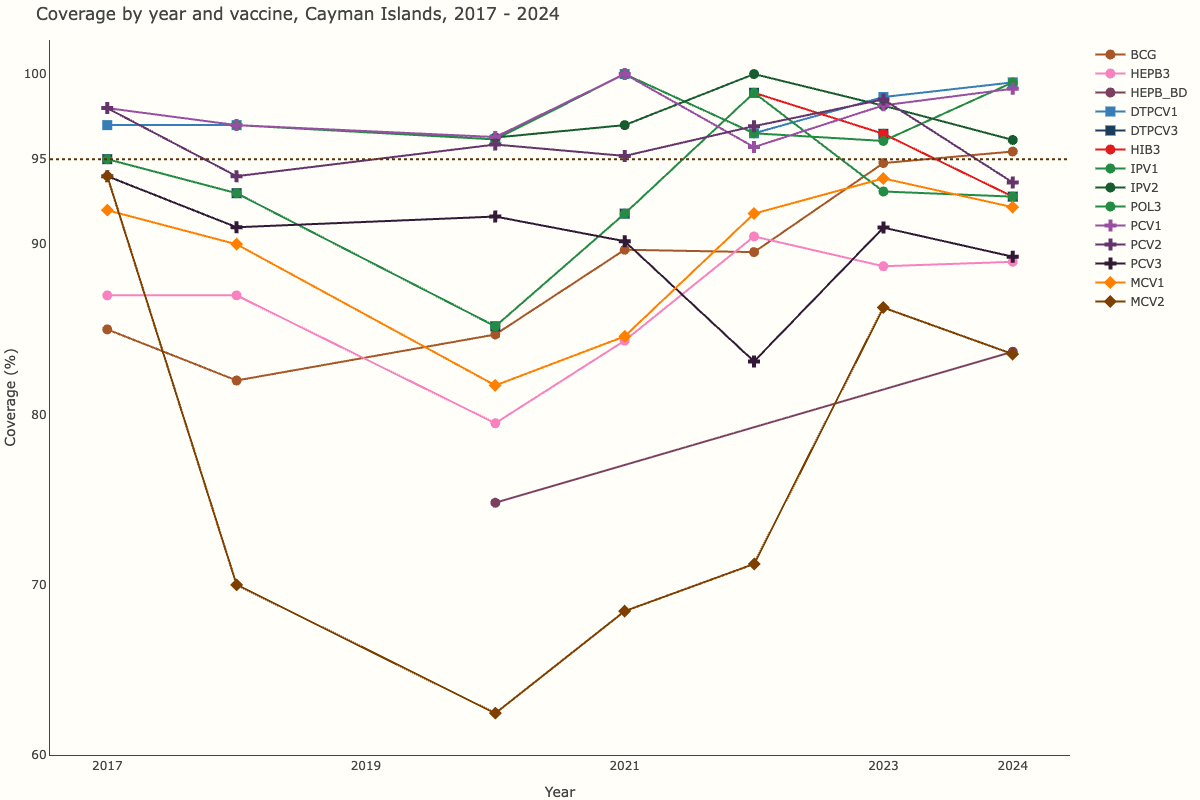
Where the system shows strain is not in refusal but in follow-through. Booster or follow-up doses tend to dip to around 92%, largely because, according to Rose-Wright, some parents miss or delay appointments rather than opting out entirely.
By the time children reach school age, many are fully vaccinated, but later administration means they are not always counted within standard reporting windows.
Parents asking more questions
Even without a clear shift in local behaviour, external risks remain.
Globally, measles has become a clear signal of what can follow when coverage slips. Once eliminated in the United States in 2000, it has re-emerged in clusters where vaccination rates have fallen.
In 2025, then Chief Medical Officer Nick Gent warned that declining vaccination rates in nearby areas, particularly Florida, could increase the chances of outbreaks reaching Cayman through travel.
“There is a threat to the north of us,” he said at the time, pointing to the islands’ close ties with the United States.
This is where Cayman becomes more exposed. Early coverage is strong, with DTP1, the first dose of the diphtheria, tetanus and pertussis vaccine, at about 99.5% and the first measles dose at 92.2% in 2024, both higher than the United States and Jamaica. But Cayman’s advantage narrows as the schedule progresses.
By the third dose of the DTP vaccine, coverage drops to about 92.8%. For measles, second-dose coverage is lower still, at roughly 83.6% – well below the 95% level typically needed for herd protection.
Comparatively, the United States maintains slightly higher completion rates at around 94–95% for third doses, while Jamaica performs more consistently, with coverage nearing 98–99% for DTP3.
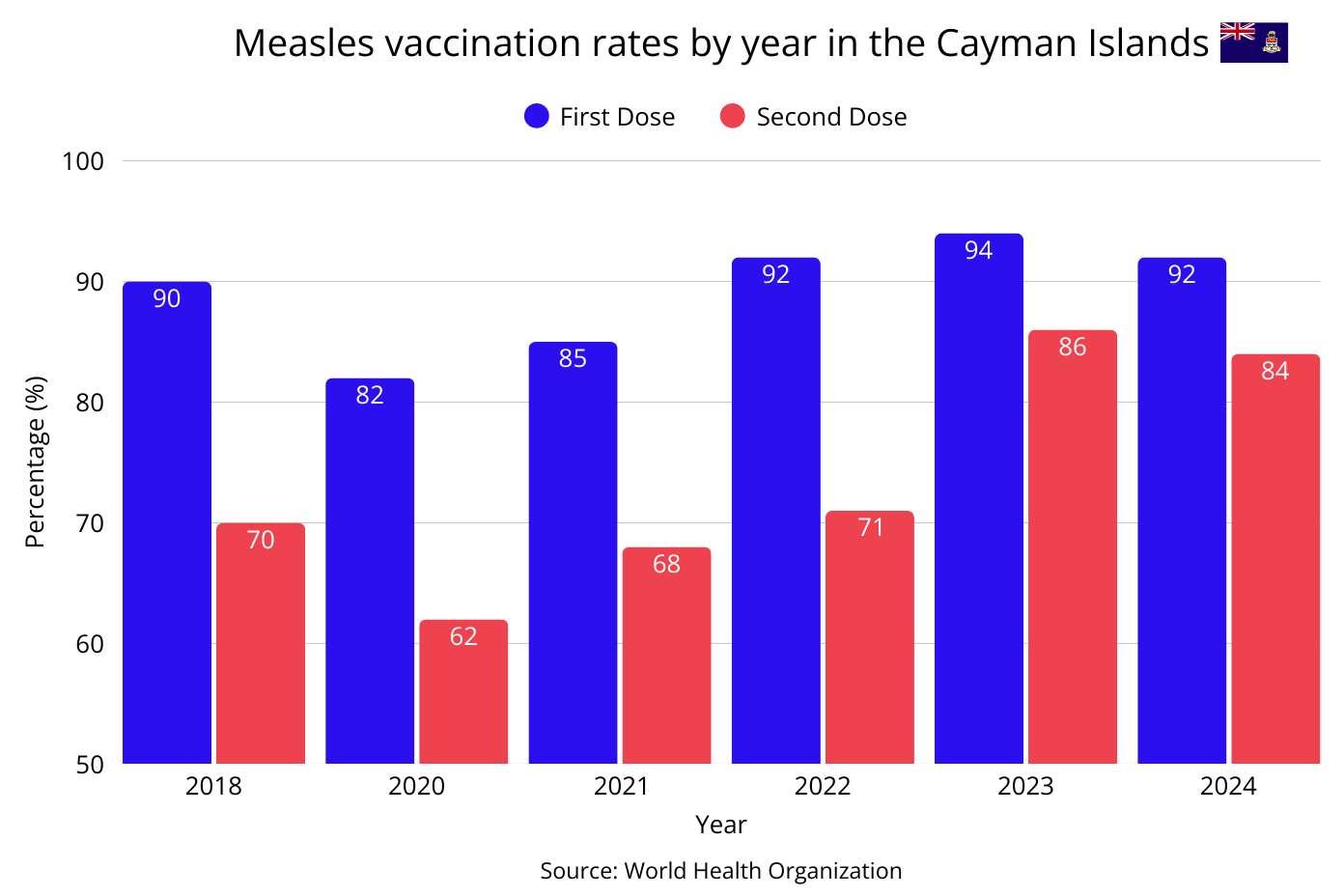
The pattern leaves Cayman in a relatively strong but not immune position. Early uptake is high and public trust remains solid, but gaps in completing full immunisation schedules create openings that could be exposed if cases are imported.
Recent developments underline that potential risk. On 27 April, the Public Health Department confirmed a case of whooping cough at a local high school, prompting officials to urge residents to check that children received their full DTP series in infancy and that adolescents and adults are up to date with the booster.
Related Videos