

CFA, MBA
Chief Investment Officer
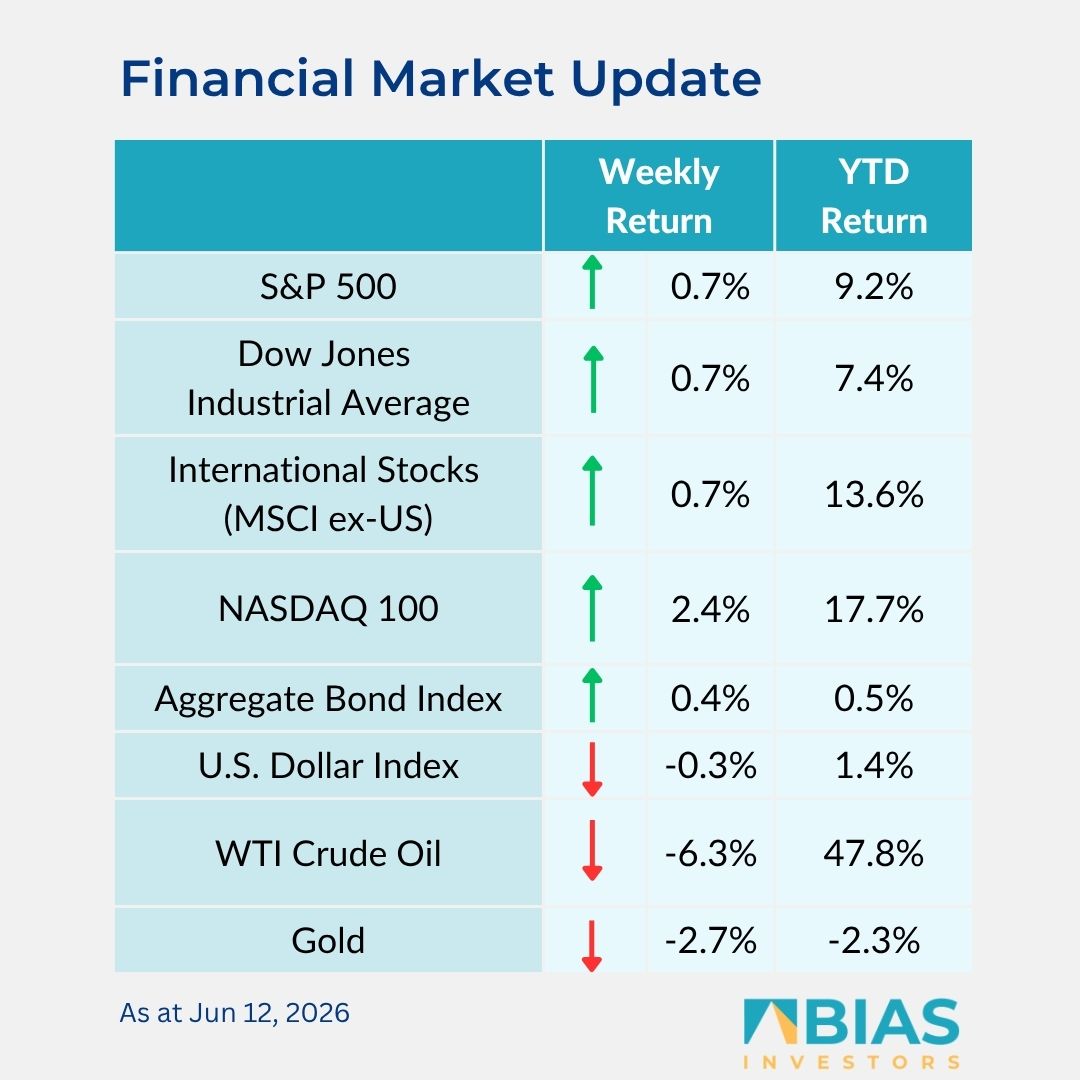
The equity markets rebounded after the prior down week.
For the week, the S&P 500 Index was +0.7%, the Dow Jones Industrials +0.7%, and the NASDAQ +2.4%.
The materials, consumer staples, and financial sectors led the S&P 500 Index for the week, while the communications services, energy, and utility sectors lagged. The 10-year US Treasury note yield was 4.479% at Friday’s close versus 4.546% the previous week.
Recent reports on inflation showed higher energy prices pushing overall inflation, and core inflation more moderate.
The May Consumer Price Index (CPI) was +0.5% month-over-month (m/m) and core CPI (excluding food and energy) was +0.2% m/m. The year-over-year change in CPI was +4.2%, and core CPI was +2.9%.
The May Producer Price Index (PPI) rose +1.1 m/m and core PPI (ex food, energy & trade) rose +0.8%. The year-over-year change in PPI was +6.5% and core PPI was +5.1%.
We should get a clearer sense of monetary policy direction when the Federal Reserve publishes its updated Summary of Economic Projections at the 17 June Federal Open Market Committee (FOMC) meeting. Current CME Fed funds futures show the potential for a 0.25% increase at the December FOMC meeting.
We are at the cross-over point in earnings reporting this week, with one company reporting first-quarter earnings, and two companies reporting second-quarter earnings. The first-quarter earnings should close out with a year-over-year gain of 28.8%- and revenue growth of 11.8%. Second-quarter earnings are expected to grow by 21.9%, and quarterly revenue growth is expected at 12%. Full-year 2026 earnings are expected to grow by 23.2% with revenue growth of 11%.
In our ‘Dissecting headlines’ section, we look at economic impact of the World Cup.
Dissecting headlines: World Cup impact
The FIFA World Cup tournament can have a positive economic impact not just in host countries but around the world.
FIFA and the World Trade Organization estimate the tournament could impact global GDP by more than $40 billion.
The largest host nation, the United States, would receive 42% of that impact, or more than $17 billion. That would add a small 0.056% increase to total annual US GDP. Co-host nations Mexico and Canada should also see benefits but on a smaller dollar scale.
The tournament brings host city capital investment and operating expenditures, tourism spending, and FIFA expenditures.
The recent Federal Reserve Beige Book identified hiring in the hospitality sector in host cities because of the tournament. This was visible in the May Employment Report which showed 70,000 new jobs created in the leisure and hospitality sector.
The robust stadium and transportation infrastructure within the US lessened the need for massive construction projects seen in some World Cup host nations, likely limiting wasteful, tournament-specific spending.
Global wagering on the World Cup is likely to top $50 billion versus $35 billion from the 2022 tournament. The growth in betting apps and prediction markets ,and the favourable time zone for US participants is likely to create increased demand.
An interesting aspect of World Cup economics is the economic productivity of the fan base. A survey from consulting firm UKG estimates the 2026 tournament could lead to $17 billion in lost productivity across the globe as workers sacrifice work in favour of watching the tournament.
The survey showed 37% of workers surveyed plan to alter their schedules, 27% plan to miss work, and 14% even plan to watch the tournament while at work. Another 22% expect to show up exhausted and 11% plan to work while hungover.
A counterargument to the lost work shows watching a game can positively impact a worker’s mood and that can increase productivity when your team wins. A loss, however, can negatively impact productivity.

BIAS Investors (Cayman) Ltd.
Grand Pavilion (Hibiscus Way)
802 West Bay Road
Grand Cayman, Cayman Islands
W: biasinvestors.com
E: [email protected]
T: 345-943-0003
Subscribe to the BIAS Investors newsletter here.
Related Videos