Most people look at a vehicle licence plate and see only a string of numbers. John Ferguson looks at a licence plate and sees history.
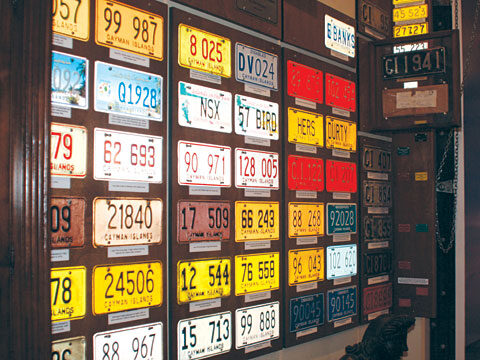
Mr. Ferguson has the world’s largest collection of Cayman Islands vehicle licence plates, many of which are on display in the Cayman Corner of the new Motor Museum in West Bay.
As he talks visitors through the display, he identifies when each plate was issued, whether it was made in Mississippi, Alaska or Jamaica, to what kind of vehicle the plate would have been attached, and exactly where and from whom he got it.
His collection of more than 50 plates at the museum is just the tip of the iceberg – he owns more than 2,000 plates from 75 countries.
Mr. Ferguson buys and trades plates at conventions and with other collectors. “Some people treat this as a business, but for me, it’s a hobby,” he said.
The collector is Cayman’s only resident member of the Automobile License Plate Collector Association, known as ALPCA, which has members in 70 countries, and he is set to featured in the association’s magazine Plates as its cover story in December. The cover shows
the collector chilling out on a hammock beside his truck with some of his number plates around him – not a bad accomplishment for someone who started collecting seriously just four years ago.
Like many car owners with a tendency towards nostalgia, Mr. Ferguson kept the licence plates of vehicles he had owned and picked up the occasional plate here and there, but his passion for collecting was truly ignited after he and his wife, Katie O’Neill, moved to
their new house in West Bay after Hurricane Ivan. He hung his meagre collection of 37 plates from the rafters on the ceiling of the two-car port and stood back to look at his handiwork.
That was when his wife asked him when he was going to cover the rest of the rafters with plates. “That was a challenge I couldn’t refuse,” he said.
Four years later, the rafters are covered in plates from every US state and every country in the world. He challenges guests to name a country and then points to a plate from there.
Briefly stumped when asked for a plate from the secretive communist nation of North Korea, he finds one in his collection that he keeps indoors. “It’s made of steel, so it’d rust if I kept it outside,” he points out logically.
His collection holds number plates from every state from the year of his birth, and he is putting together a tribute to his family in the US, with number plates from each of their birth years and from the states in which they live.
The Cayman collection on display at Andreas Ugland’s Motor Museum includes plates that he has found among fellow collectors’ collections around the world. Tom Smith, of Virginia, a fellow member of ALPCA, loaned him an early “Invalid Carriage” plate, currently called Disabled or Handicapped plates, as well as surprise item – a mint condition pair of plates made in Jamaica, with the number “CI 1941”, complete with the original envelope they had been mailed from the Department of Licensing in Cayman to a J. Waters in New Jersey. “The envelope is stamped 31 August, 1967, and includes the Treasury Department seal,” he said.
The collection also includes bicycle and motorbike plates.
He has received help in getting the Cayman collection together from a number of people in Cayman who have fed his passion for plates and filled him in on the background of vehicle licensing here.
He also has an impressive collection of plates of Native American Indian tribes. He places them on his living room floor to show visitors, stating that he has 34 of Oklahoma’s tribes and points Shawnee, Cheyenne, Cherokee Nation and others, all with unique
artwork and detail. The collection seems extensive, but he insists it’s not finished.
And once that part of the collection is complete, he’ll move on to another run of plates. And then another. And then it might be time to get a bigger car port.
Related Videos