South Korean troops are on their
highest peacetime alert amid fears of a new cross-border artillery bombardment
after North Korea warned it could continue ‘merciless strikes’ on its bitter
rival.
Tensions between the two countries
were said to be at their ‘worst levels for decades’ following the death of two
South Korean marines killed Tuesday in one of the heaviest attacks on its neighbour
since the Korean War ended in 1953.
The artillery barrage – the South
fired back and scrambled a fighter jet to the area – was close to a disputed
maritime border on the west of the divided peninsula and the scene of deadly
clashes in the past.
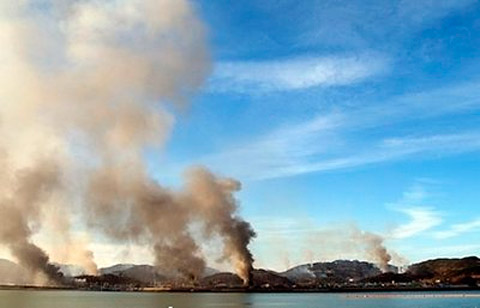
At least 200 shells pounded a
military base on Yeonpyeong Island, 75 miles west of the South Korean capital
Seoul, near a disputed maritime border, killing the marines, and injuring 17
colleagues and six civilians.
South Korea said it responded by
firing self-propelled howitzers but declined to say whether North Korean territory
was hit.
It described the attack on
civilians on Yeonpyeong, which is surrounded by 30 smaller islands used as a
base for fishing, as ‘inhumane atrocities.’
The two sides technically remain at
war because a peace treaty was never negotiated and Seoul said the attack
violated the 1953 armistice halting the Korean War.
The skirmish came as the reclusive
North, and its ally China, presses regional powers to return to negotiations on
its nuclear weapons programme and revelations at the weekend Pyongyang is fast
developing another source of material to make atomic bombs.
It also follows moves by leader Kim
Jong-il to make his youngest, but unproven, son his heir apparent, leading some
analysts to question whether the bombardment might in part have been an attempt
to burnish the ruling family’s image with the military.
Continuing their aggressive
rhetoric, Pyongyang warned shortly after the island attack that more could
follow.
In a statement, its supreme
military command declared that it the south violated its sea border ‘even by
0.001 millimetre’; it would launch merciless military retaliatory strikes.
The North had claimed the South had
provoked its attack by carrying out military operations near the border and
firing across it.
Seoul said it had been conducting
military drills in the area beforehand but had fired west, not north.
South Korean President Lee
Myung-bak, who has pursued a hard line with the North since taking office
nearly three years ago, said a response had to be firm following the attack.
He stressed an ‘indiscriminate
attack on civilians can never be tolerated,’ adding: ‘Enormous retaliation
should be made to the extent that (North Korea) cannot make provocations
again.’
But he made no suggestion the South
would retaliate further, suggesting Seoul was taking a measured response to
prevent things getting out of hand.
The North has a huge array of
artillery pointed at Seoul that could decimate an urban area home to around 25
million people and cause major damage to its trillion dollar economy.
The international community was
quick to express alarm at the sudden rise in tension in a region that is home
to three of the world’s biggest economies – China, Japan and South Korea.
World leaders are also urging both
sides to demonstrate restraint.
Related Videos