Cayman will strengthen its chickenpox inoculations for schoolchildren next year.
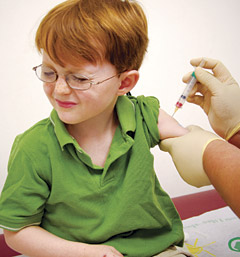
Minister of Health Mark Scotland, speaking at an immunisation conference in Cayman last week, said the Islands would introduce a second dose of the varicella, or chickenpox, shots to its vaccination schedule at school entry and is organising a catch-up programme to begin in January 2011.
Cayman’s public health service currently offers one dose of the chickenpox vaccine at 12 months of age, which can be given between 12 and 15 months.
Cayman’s Medical Officer of Health Dr. Kiran Kumar explained that the US introduced a two dose schedule with the second at four to six years of age in 2007, with a catch-up dose for children above that age, as there had been very low incidence among young children, but cases were occurring in school-age children and adults.
“As that is the situation in Cayman, our immunisation committee reviewed and considered in 2009 introduction of second dose at school entry four to six years and offer a catch-up for those who did not have this chance earlier.
“We explored with [the Pan American Health Organisation] to get the vaccine at a reduced price. As we got that, now we plan to introduce [the second dose] in Jan 2010,” said Dr. Kumar, adding: “Our chickenpox cases are low… definitely because of our vaccination programme.”
Nearly 100 cases per year
Over the past two years, there have been between 75—100 cases reported per year, and so far this year 23 cases of chickenpox have been reported, Dr. Kumar said.
Minister Scotland, speaking at the 27th annual meeting of the Caribbean Expanded Programme on Immunisation at the Marriott Beach Resort, said
worldwide immunisation programmes have prevented more than three million deaths annually from a variety of diseases.
“But apart from preventing human suffering and disability, vaccination programmes also make sound economic sense. Every year, healthcare absorbs an increasingly large share of global resources and immunisation presents governments with opportunities to reduce, and in a number of cases even prevent, some of these costs,” he said.
“For instance, by adding just one week of supplemental immunisation activity, Kenya immunised 12.8 million children against measles. That step prevented almost four million cases of measles and 125 000 deaths, saving the country a projected US$12 million in healthcare costs, over the next 10 years.”
A cost-benefit analysis in the United States indicated that for every dollar invested in a vaccine dose, authorities save up to US$27 in health expenses, he explained.
Regionally, studies reflect the same trend with vaccinations for rotavirus gastroenteritis in Latin America and the Caribbean costing US$24 per dose, while the cost to treat a patient with that illness costs an average of US$3,000 per patient.
Mr. Scotland said pneumococcal infections in infants can result in death or can impede a child’s hearing and motor skills. “From a societal perspective, such disabilities can cost governments thousands each year, while the vaccines can cost as little as US$5 per dose,” he said in his opening speech at the meeting.
Prevention saves resources
Preventing communicable diseases, rather than treating and curing patients, reduces the strain on a country’s resources and enables
public health officials to redirect healthcare funds to enhance other medical services, the minister said.
“This year the Caribbean celebrates its 19th year without an indigenous case of the measles and its seventh year without an indigenous case of rubella. Specifically here in the Cayman Islands, more than 60 years of immunisation efforts have eliminated polio, diphtheria, pertussis, neonatal tetanus, haemophilus influenza type b infections, mumps, measles, rubella, and TB meningitis,” he said.
Local statistics by Cayman’s Public Health Department show that between 90 per cent and 95 per cent of all infants are vaccinated and 97 per cent of children entering primary school are inoculated.
Cayman last year introduced two new vaccines to its childhood vaccination schedule – the rotavirus and pneumococcal vaccines, as well as a pilot programme for the Human Papillomavirus vaccine, which targeted girls ages 11-17.
Mr. Scotland cautioned that, throughout the world, thousands still die from known communicable diseases such as the rotavirus diarrhoea – which annually kills more than half a million children younger than five. In addition, last year’s H1N1 pandemic “served to remind us that we cannot predict the next killer disease with any degree of precision,” he said.
Outbreaks of supposedly “tamed” communicable diseases, such as polio, measles and whooping cough, also show that it is important for public health services to remain vigilant. “Although sporadic, these worrying outbreaks remind us that until a disease is completely eradicated, the risk of renewed spread remains. Also, the speed and frequency of global travel puts us all just a plane ride away from possible contagion,” Mr. Scotland said.
Related Videos