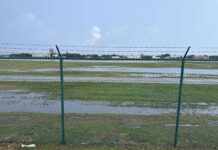
Forecasting models are calling for a very active hurricane season in the Caribbean, with the Cayman Islands having an above average possibility of being impacted by a tropical storm, hurricane and major hurricane of Category 3 or higher.
Almost on cue, forecast models continue to show an area of disturbed weather in the southwest Caribbean bringing rain, blustery winds and rough seas to Cayman through at least early next week.
Cayman Islands National Weather Service Chief Meteorologist John Tibbetts said the system south of us is under a lot of wind shear, something that inhibits hurricane formation.
“That’s usually an indicator it won’t be in a hurry to develop,” said Mr. Tibbetts.
But there is still a lot of moisture associated with the system and Cayman is expected to get a lot of rain as it drifts northward.
“It is expected to drift northeast toward Jamaica and then on Saturday or so, move back to the west,” he said, adding that rainfall models are showing increasing rain from Friday afternoon, Saturday and Sunday in particular. In addition, a small craft advisory will be in effect on Saturday and Sunday, when winds are expected to increase to 15-20 knots from the northeast and seas will be rough with wave heights of four to six feet.
Although several forecast models were forecasting development of the area of disturbed weather, the National Hurricane Center in Miami only gave the system a 10 per cent chance of developing into a tropical cyclone by mid-day Friday. However, the Centre did state some gradual development of the system was possible once the upper-level winds became more conducive late Thursday and Friday.
Need the rain
Grand Cayman could certainly use the rain heading our way.
Mr. Tibbetts said the year so far has been the driest on record.
“Dry season typically lasts from December through April but sometimes lingers into May,” he said.
From January through May this year, only 2.59 inches of rain have fallen on Grand Cayman, surpassing the 3.62 inches that fell in the same period in 2009 as the lowest on record.
Four of the five lowest January-through-May rainfall totals have occurred in the last seven years, with 2005 and 2006 also making the list. Prior to 2005, the record for the least January-through-May rainfall had lasted 43 years after only 4.97 inches fell in the period in 1962.
The average rainfall for the period between 1 January and 31 May is 12.43 inches, with an average of 5.53 of that falling in May.
Busy in the Caribbean
Colorado State University scientists William Gray and Phil Klotzbach issued their updated forecast for the 2011 Atlantic Basin hurricane season Wednesday and stuck to their 6 April forecast of 16 named storms, nine hurricanes and five major hurricanes with winds of 111mph or greater. The 50-year observed seasonal average is 9.6 named storms, 5.9 hurricanes and 2.3 major hurricanes, so the forecast for this year is significantly above average.
“The Caribbean model is calling for a very active hurricane season in 2011,” Klotzbach and Gray’s forecast report stated. “Our forecast model is calling for an ACE of 46, which is nearly three times as much as the 1949-2008 average of 15 ACE units.”
ACE stands for accumulated cyclone energy, a measure used by the National Oceanic and Atmospheric Administration to express the activity of individual tropical cyclones and entire tropical cyclone seasons.
Based on their forecast model, Gray and Klotzbach also calculate the probability of a named storm, hurricane and major hurricane tracking within 50 and 100 miles of specific locations. This year’s model puts the probability of one or more named storms tracking within 50 miles of the Cayman Islands at 53 per cent; of one or more hurricanes coming that close at 33 per cent; and of one or more major hurricanes coming that close at 13 per cent. When the distance is extended out to 100 miles from the Cayman Islands, the percentages for named storms, hurricanes and major hurricanes go up to 68 per cent and 44 per cent for named storms and hurricanes respectively, although the probability of a major hurricane tracking that close remained at 13 per cent. All of the percentages, however, are considerably higher than for an average year.
Related Videos