

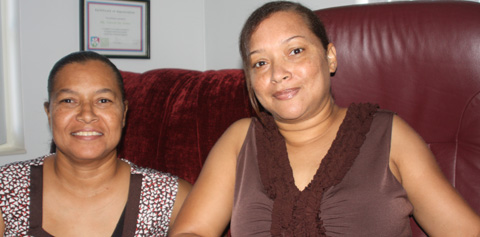
For 14 years, Agatha Elfreda Ebanks suffered abdominal pains and other problems relating to a issues with the lining of her uterus.
Despite a reluctance to undergo surgery, the mother of two finally agreed to have an operation to remove her uterus last week.
She became the first patient at Chrissie Tomlinson Memorial Hospital to undergo a laparoscopic hysterectomy and within 12 hours of the operation, she was back home.
In the past, patients undergoing such an operation had their uteruses removed using a method called laparoscopically assisted vaginal hysterectomy, or LAVH, where the gynaecologist uses keyhole surgery in combination with surgery through the vagina in order to complete the operation.
In Ms Ebanks’ case, her surgeon used only keyhole, or laparoscopic, surgery.
The technology is not new – the first laparoscopic hysterectomy was performed in January 1988 by Harry Reich in Pennsylvania, USA, but with new equipment introduced to Chrissie Tomlinson recently, it is the first time a full laparoscopic hysterectomy has been done there.
Four days after the surgery, 41-year-old Ms Ebanks said the only pain she has had was from the three small sites where the surgeon made tiny incisions through which the laparoscope – a slender tube – is inserted. The laparoscope contains fibre-optic camera heads or surgical heads, or both. Before laparoscopy, doctors had to make large openings and cut through layers of tissue to examine or operate on internal organs.
“I feel a lot a better, I feel amazing since the surgery. I used to feel bloated all the time and really stuffed, I don’t feel like that anymore,” Ms Ebanks said.
She suffered from adenomyosis, a condition in which endometrial tissue, which normally lines the uterus, is present within and grows into the muscular walls of the uterus.
Over the years, she tried everything to treat the condition, but nothing seemed to work.
Fifteen years ago, her sister Julia Simpson, underwent a similar operation, using the LAVH method, so the sisters have been able to compare notes on recovery.
Ms Ebanks’ doctor, Sarath De Alwis, explained that laparoscopic surgery means patients experience less pain, have a much faster recovery time than with more invasive surgery and have less chance of developing an infection or other post-operative complications.
He worked with a team at Chrissie Tomlinson that included Dr. Darley Solomon, anaesthesiologist Steven Gay, assistant anaesthesiologist Greg Gayle, nurses Carmen Bell, Sharon McDermott, Tamara Graham and Mohammad Abdullah, as well as Yasmine Connor, Ricardo Thompson, Beverley Brown, Donna Price and Carmen Martinez.

Related Videos







Congratulations on the surgery. On the other side,it was not necessary. A relative on mine, a young woman, who had suffered the same problem (the worst case- per doctors) since she was a little girl, changed her diet, went mostly raw, and now it is all in her past.