

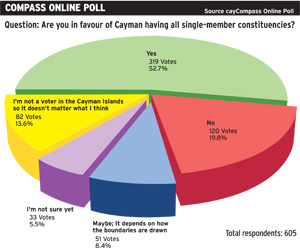

A little more than half the respondents to last week’s cayCompass.com poll favour the Cayman Islands adopting single-member electoral constituencies.
Of the 605 respondents, 319 of them – 52.7 per cent – said they’re in favour of single-member constituencies. Only three of them left comments on the poll.
“Equality for one and all!” said one person.
“With electors having only one vote each within those constituencies,” said someone else.
“Not being a voter does not mean you lack interest in the future of Cayman,” said another respondent.
Another 120 people – 19.8 per cent – said they were against single-member constituencies and many more of them left comments.
“For one thing, I think Cayman is too small for single-member constituencies and for another thing, I think it will be too expensive,” said one person.
“All I want is a national election,” said someone else. “This would help stop all the bashing between districts and Cayman might be a better place to live again.”
“I like having four votes,” commented another person.
“On the face of it this looks like democracy by and for the people, but the truth is that our islands are not sufficiently populated for this type of representative system,” said one respondent. “It has striking similarities of what has happened in other regional countries that has resulted in garrison communities controlled by corrupt politicians and thugs.”
“We have seen that the proponents of this system have produced a constitution that has been nothing but progressive,” commented one respondent. “Single-members constituencies will only further empower certain politicians, not lessen their powers, and at significant cost to the taxpayer. This should not be about the UDP vs. PPM but what is best for the country and this simply is not!”
“I would support a plan to give every Cayman Islands voter the same number of votes, but I don’t support the current proposal, partially because of the inequity of having some constituencies with many fewer voters than others,” said someone else.
“The idea of being stuck in a small constituency and being forced to vote for the likes of Ezzard scares me,” said another respondent.
“A safe seat is one in which a plurality or majority of voters, depending on the voting system, support a particular candidate or party so strongly that the candidate’s election is practically guaranteed in advance of the vote,” said one person. “This means all other voters in the constituency make no difference to the result. This results in feelings of disenfranchisement and to abstentionism among voters.”
“A change to single-member constituencies would create a top-heavy government that would cost more to run,” said someone else. “Cayman cannot afford that. It would also create disparities between constituencies with preexisting amenities like schools and commerce, and those that do not have commercial attraction. This would create vast discrepancies in the real estate market.”
Fifty-one people – 8.4 per cent – said they would possibly support single-member constituencies, depending on how the boundaries are drawn and 33 respondents – 5.5 per cent – responded ‘I’m not sure yet’ to the question. None of these people left comments.
Another 82 people – 13.6 per cent – said they were not voters in the Cayman Islands, so it didn’t matter what they thought.
Next week’s poll question:
How much will you prepare for hurricane season in advance?
Quite a bit
A fair amount
Hardly at all
Not at all
I don’t live in a place that can be impacted by hurricanes

Related Videos













Another 120 people 19.8 per cent said they were against single-member constituencies and many more of them left comments…and we’re going to publish eight of them covering all the ‘arguments’ McKeeva made recently. Allow me to address the ‘arguments’ against raised:
1) Too small? It’s a proportional system that works on percentages. It works wherever you put it and whatever numbers you give it. How do small countries and municipalities elect anyone if there’s such a thing as too small?
2) A national election is a good idea, but it will never happen here because it is creative thinking and will be even ‘harder for the electorate to adjust to’ – give me a break.
3) Person who likes having four votes – people like you are the reason we are trying to change this. Would you rather have four votes, or one person worth voting for? We’re trying to give you the second thing – against your will it seems. Could it be that you don’t know what is in your interest?
4) Garrison communities? Controlled by corrupt politicians and thugs? You mean like the one we have now which has elected the same sugar daddy for nearly 30 years who has run the country into the ground? Don’t tell me about garrison communities – we already have one and we’re trying to clean it up.
5) The Constitution was not progressive in the sense you suggest – but it was PROGRESS and in this country where certain people are determined to see that our advance as a society is stuck in molasses to ensure their re-election, it was an amazing feat. Single-member constituencies will not ’empower’ certain politicians, but it will make them accountable. If that means they actually do their jobs and therefore have greater influence – which I think is what you mean – then we might actually get something done around here. Go check the other Western democracies and see how they’re getting on with being ‘progressive’. It rarely happens because of two words: ‘special interests’.
6) If you look at the Electoral Boundary Commission report I think the vast majority of the constituencies have 800-1000 voters or so, EE and NS have around 500 and Sister Islands 2,000. Already, WB, BT and Sister Islands very roughly have one seat per 1,000 voters, and they just get split up along those lines. GT is an exception – it needs more seats no matter what we do. EE and NS have one MLA for about 200 voters and would have one MLA for 500 under SMCs. So the reforms suggested actually move us closer to equality between seats, not further away. It’s not exact but it’s worse now and what we’re doing with those districts is we’re acknowledging that although they have fewer people they are important, unique districts with their own history, needs and culture, and so we can overlook a 300 person difference to see that they have individual representation. It’s called making a sensible exception.
7) You would not be forced to vote for Ezzard. You can vote for whoever you like. In the US you can go into the deepest South you can find and in any district there will still be a minimum 25% vote for the Democrat candidate. It’s part of life in a democracy. Some districts never change, and elections are decided in the ones that do change. Right now those are GT and BT and that may not change. What will change is each person elected will occupy only one seat – which means they have no one to pass the buck to. So whoever is elected to represent you – even if you don’t like them – they will actually do the job! Isn’t that what you really want: a voice and an improvement in your living standards?
8) What is your support for that assertion? Do you prefer our current system with a bottom-heavy group of lazy, unintelligent proteges and has-beens? Can we afford that dead weight? We’re paying at least 5 100,000 salaries that those receiving them aren’t even pretending to earn – that’s 2 million over the course of a term. I hear you can get a church hall for that kind of money. As for real estate, I hope you aren’t serious – who represents a district does not change the intrinsic attractiveness of the area.
It’s very tiring work countering these ill-informed opinions. There really is no telling some of you.
Well said, Owl.
But sadly there seems to be small possibility of getting the salient points understood, let alone accepted, by the clients of the old guard.
Your (4) hits the nail on the head. Would that it would hit the sugar daddy likewise.
Look around the Caribbean and its family despots and despair.