

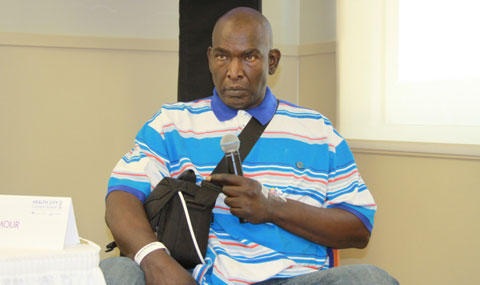
A 48-year-old Caymanian returned home Thursday after successful artificial heart implant surgery at Health City Cayman Islands, in what physicians say is a first for the Caribbean.
The Left Ventricular Assist Device, a mechanical pump that supports heart function, was implanted in Albert Seymour two weeks ago by the chief surgeon at Health City, Dr. Binoy Chattuparambil, and his specialized team. The highly complex surgery took nine hours to complete.
Mr. Seymour, who has a wife and three young children, was nearing death due to advanced heart failure, a condition where the heart becomes severely weakened and loses its ability to pump enough blood to the entire body.
“When I came here, I was like the walking dead,” Mr. Seymour said at a press conference Thursday at Health City. “I thank the doctors and.. everybody that supported me and made me feel good and at home. They gave me a new life.”
Dr. Binoy explained that when a patient reaches this critical stage, there are only two options – either a heart tissue transplant or “artificial pump,” which is what was used to support Mr. Seymour’s heart.
The heart support device is connected to an externally worn control unit and battery pack, which has a 10- to 12-hour battery life. It is often used as a temporary method for patients waiting for a heart transplant, but in Mr. Seymour’s case it is a permanent solution. The machine is lightweight, and Dr. Binoy said life after implantation of the ventricular assist device is near normal with patients being able to do everything besides contact sports and swimming.
The longest survivor with an implant of this particular model used in this procedure was eight years.
Mr. Seymour had been having symptoms of heart failure for the past 12 years, and eight years ago he had to quit his job because of his deteriorating health. During the last stages of his condition he was barely able to walk and was frequently hospitalized.
“…Last year he was really incapacitated he couldn’t walk without difficulty. He couldn’t even sleep in the night on the back,” Dr. Binoy said. “The last five months he was sitting on his chair every night and sleeping.”
Mr. Seymour visited a hospital in the United States to see if he could get a heart transplant, but he was not able to because he had inadequate insurance coverage. “It was like he was marching towards the end,” said Dr. Binoy.
According to health officials, Mr. Seymour’s insurer was able to cover more than $1 million for the procedure, but that was still not enough to cover costs in the U.S.
Health officials said the East End hospital was able to offer the procedure to Mr. Seymour for roughly $500,000.
Although Cayman passed a Human Tissue and Transplant Law last year, there are no regulations in place to allow organ donations by Cayman residents. So the heart support device was Mr. Seymour’s final option.
“We decided we would go ahead with the surgery. Because we don’t have transplant options here, and the law and licences will probably take time to establish. So, the only option left for him was having this Left Ventricle Assist Device,” the doctor said.
The device
According to the American Heart Association’s website, the Left Ventricular Assist Device, or LVAD, is implanted just below the diaphragm in the upper part of the abdomen. Then, “another tube attached to the pump is brought out of the abdominal wall to the outside of the body and attached to the pump’s battery and control system. Left Ventricle Assist Devices are now portable and are often used for weeks to months,” the website says.
The device operates by sucking “the blood from the failed chamber” and pumping it “to the body part where it is supposed to go,” said Dr. Binoy.
After surgery
“The surgery went quite smoothly…It is a very complex and long procedure, but we thought it went really well,” said Dr. Binoy. “Post op recovery was quite smooth…” Two days after the surgery, Mr. Seymour was walking, and by day six he was out of the critical care unit.
Mr. Seymour said, “I’m a new man, I’m born again. This was a big experience that I went through …I think this was the best thing that happened to Cayman and the best thing that happened to me.
“I’m out alive and thank the lord for that. I think life goes on.”
Health City
“…It certainly is very big for Cayman. It is going to bring business to Health City, and Health City is going to be able to expand its horizons in terms of networking through the Caribbean,” Minister of Health Osbourne Bodden said Thursday.
“I think Health City is going to play a pivotal role in the health of the Caribbean going forward and is certainly going to play a pivotal role in driving down the cost of healthcare in these islands,” he added.
Of the roughly 700 procedures carried out at Health City Cayman Islands since it opened in February, 50 have been cardiac surgeries, health officials said. The hospital also carries out additional specialist procedures, including joint replacements and spine surgeries.
The hospital also has plans to open a Heart Failure Unit in the next few months, officials said, headed by Dr. Ravi Kishore.

Related Videos








Very happy for mr. Seymour and glad the procedure went well. Can the compass please clarify why the procedure was cheaper when everything else on the island is so expensive? If medical is cheaper at health city, shouldn’t that apply straight across the board for all medical facilities on island? Also, why is property insurances so high yet in comparison it’s cheaper in the USA? 22 doesn’t add up to 4 in Cayman.
So many ill people spared the torture of traveling to the U.S.hospitals! What a blessing to have Health City in the Cayman Islands. At Home Even The Walls Heal!
Many more joyful years to Mr.Seymour.