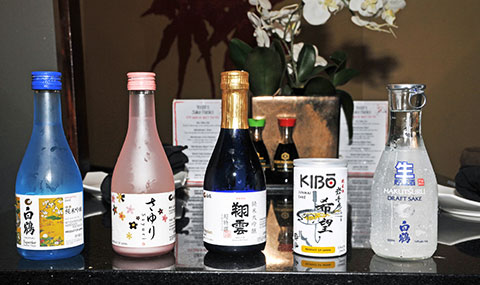
Grand Cayman residents looking for authentic Japanese saké can soon say sayonara to the North American versions of the beverage.
This fall, Jacques Scott will start selling five different new sakés from the producer Hakutsuru, making a range of Japanese sakés available retail for the first time in the Cayman Islands.
Jim Sculace, the vice president of sales for Saké One, visited Cayman earlier this month to preside over advance tastings of new products with local bartenders. He also spoke about the new products over lunch at Yoshi Sushi.
Saké sales have increased tremendously in the U.S., topping 3 million cases a year, he said, citing the popularity of sushi as one reason, and the fact that people are generally experimenting more with international foods and beverages as another reason.
Until the last decade or so, most saké sold in the U.S. was of low quality and served hot, mostly in Japanese restaurants. The availability of better saké – from Japanese as well as from North American producers – led to the realization that good saké is best consumed slightly chilled, not hot.
Premium saké
Many people believe saké is wine made from rice, but it’s a brewed beverage more akin to beer.
The two principle ingredients in saké are rice and water. The other two ingredients are yeast and a special mold known as koji-kin that creates enzymes that covert rice starch into fermentable sugars.
The key to making premium saké, which is roughly defined as the kind with a retail price of $10 or more for a 720ml bottle in the United States, lies in the milling, or polishing, of the rice grains.
“The fats and proteins are on the outside of the rice grain,” Sculace said, noting that these compounds bring harshness and undesirable tastes to saké. “The more to the center you mill, the smoother and finer the saké will be.”
To take off these outer layers, rice is loaded into rotating cylinders with abrasive surfaces that polish off the outer layers. The lowest grade saké, called futsu, is polished to no more than 70 percent of its original weight. Junmai Diaginjo, the highest grade of saké, is polished to at least 50 percent of its original weight and sometimes more.
“It takes two days to get it to 40 percent and for higher grades of saké, it takes three to four days,” said Sculace.
Cocktails and variety
Saké has a lot of similarities to white wine: It can be sweet or saké can be dry; It can have a variety of aromas and flavors, ranging from tropical fruits to spices like anisette; it is best served in a wine glass that focuses its aromas; and it pairs well with seafood.
Saké has also become increasingly popular as a cocktail ingredient in everything from the simple sakétini to elaborate concoctions featuring fruit juices and other spirits. Because it is lower in alcohol, cocktails that use saké instead of spirits can promote responsible drinking. If using saké to replace a spirit in a cocktail, the general rule is to use one with a similar flavor and sweetness profile.
The Japanese sakés Jacques Scott will import will offer a variety of styles and flavors and will range in retail price from roughly $20 to $37 for a 720ml bottle. he least expensive that will be available will be Hakutsura Excellent Junmai, a very traditional saké that is the most popular brand in Japan.
“You can’t get any more traditional that this,” Sculace said of this hearty and rustic saké.
It would pair best with oily fish like mackerel or deep fried tempura or conch fritters.
Other sakés on their way to Cayman include:
- Hakutsuru Draft, a light and smooth saké that is light in flavor and body, and would go with light foods or make a good cocktail ingredient to replace vodka or white rum.
- Hakutsuru Superior Junmai Ginjo, a fragrant saké with aromas of anisette. Junmai Ginjo is the most popular style of saké in the U.S.
- Hakutsuru Sayuri Nigori, which is sweeter and lower in alcohol than most sakés. Its sweetness will allow it to pair well with spicy food and chocolate. This roughly filtered saké is naturally cloudy and should be shaken in the bottle before serving.
- Hakutsura Sho-Une Junmai Daiginjo, a delicate, high-quality saké that is velvety smooth and will pair with lighter seafood dishes like snapper, flounder, snow crab or raw bar fare.

Related Videos