Mizu Asian Bistro Bar’s Executive Chef Dylan Benoit spent the summer in Asia with his brother Lucas, exploring the region’s cuisines, techniques and ingredients, with the aim of enhancing and further perfecting the menu at Mizu. In the fourth of a five-part series he shares his culinary adventures.
We arrived in Phnom Penh, Cambodia’s capital, early one afternoon after a relatively short bus ride compared to some of the other 18-hour trips we had taken on this adventure. Nevertheless, even though it was only four hours, it was equally as arduous.
As soon as you cross the border into Cambodia, the quality of the roads takes a nose dive. The dirt roads are heavily traveled, acting as the main transport routes between Ho Chi Minh in Vietnam, and Phnom Penh. Mopeds carrying coconuts, transport trucks and buses full of chickens, all simultaneously weave, dodging potholes and massive puddles at speeds which seem unfit for the road conditions.
When we finally reached the bus stop in Phnom Penh, we grabbed our bags, which were covered in mud, hopped on a tuk-tuk and headed straight for the hostel. Not surprisingly, we were very hungry and eager to try some authentic Cambodian Khmer – the regional cuisine which focuses on freshness and simplicity by using what is available and in season.
During the tuk tuk ride we passed a restaurant called Tom Yum Kung, named after a traditional Thai soup, which typically is spicy shrimp soup flavored with galangal, kaffir lime leaves, mushroom and lemongrass. As it turned out, the restaurant was right around the corner from where we were staying, so we dropped our bags and headed there for a bite to eat.
Our main agenda in Cambodia was to try Khmer food. Even though tom yum kung is a traditional Thai soup, I figured the Khmer food could wait. I was eager to try an authentic version of this delicious soup we serve at Mizu. When we sat down, we were presented with a menu, half of which was Thai food, the other half, Khmer.
We knew right away we were in a good spot because when we arrived around 3:30 p.m., the place was still busy with a lunch crowd, and we were the only Westerners in the joint. The restaurant wasn’t much to write home about, maybe 40 seats.
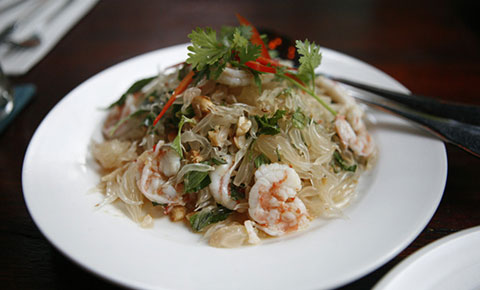
We perused the menu and picked a couple of items to enjoy as an appetizer: tom yum kung soup and pomelo salad with poached prawns. For the mains we decided to be a bit more adventurous: fish amok and stir fried beef with lemongrass and wood ants. We joked momentarily about ordering the fried tarantulas with coconut rice, but decided against it. By the time we had finished grimacing at the thought of stuffing crispy arachnids into our mouths, our appetizers arrived.
The aroma of the tom yum kung soup was divine. I noticed that the soup was creamy, not like any other tom yum I had ever had. The soup was delicious, the creaminess of the coconut milk coated my mouth and balanced out the inherent spice in the broth. The lemongrass and kaffir lime were fresh and vibrant, and when mixed with culantro (a close cousin of cilantro) and the oyster mushrooms, created a perfect balance of hot, fresh and sour.
We tucked into the pomelo salad. The flavor was so fresh and vibrant it surprised me. Pomelo is much like a grapefruit but quite a bit larger, with larger pulp that is slightly less sweet. When segmented, the pulp breaks apart easily into thousands of small locules bursting with flavor. The pulp is tossed with fish sauce, sugar and lime and mixed with poached prawns, fresh herbs, chilies and crushed peanuts. Another example of the four pillars of Asian cuisine, hot from the chilies, sour from the lime, salty from the fish sauce, sweet from the pomelo. Perfection.
We devoured the salad and passed the ludicrously large bowl of soup back and forth until our mains arrived.
Amok is a very traditional Khmer dish consisting of a thick coconut curry steamed in banana leaf. Any number of ingredients can be the main component of amok, including chicken, egg, tofu, fish, pork and shrimp. The Amok was presented in three banana leaf cups. In the bottom of each cup was some finely shredded cabbage, topped with the curry and crowned with thinly sliced chili and julienne of kafir lime leaves. The fish was light, flaky and incredibly moist, with a rich coconut and light curry taste.
The beef, lemongrass and wood ants dish arrived next. It looked like a normal beef stir fry with chunks of bell pepper, onion and fried basil. However, it was also studded with large tree ants just shy of an inch long, their segmented bodies, legs and antennae all still intact, like brown sprinkles on an ice cream sundae.
Lucas tucked in first and I watched his expression for a few seconds while he chewed away. I was half expecting him to gag, spit it out, or gargle his beer as if it was Listerine, but he didn’t. Instead, he finished chewing, had a sip of beer and declared that it was actually pretty good. One can’t do a food tour through southeast Asia and not expect to eat a few insects, so I grabbed a big bite too. As it turns out, he wasn’t kidding, it was pretty good! The lemongrass was definitely a dominant flavor, with beef and garlic following right behind. The ants didn’t have any flavor, or if they did it was overpowered by the lemongrass, but they certainly had a texture, one I was having a bit of trouble with on the first bite, but by bite three or four I forgot they were even in there.
By the time we finished off the meal, we were ready to be rolled out of the restaurant. We paid for our meal, which came to the equivalent of about $12 for both of us, including half a dozen beers. We wandered back into the afternoon sun, our bellies full, ready to explore this exciting new city.


Related Videos