

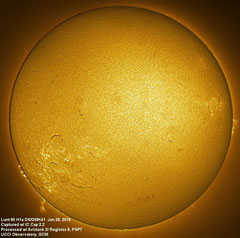
The sun, the star at the center of the Earth’s solar system, still remains a mystery in many ways, says Ashvin Murugesu, a local student who graduated this year with a degree in astronomy in the U.K.
“So little is understood about the sun, and it’s the nearest star to us,” said Mr. Murugesu, who gave a free talk on the sun and its effects on the Earth at the UCCI Observatory on Wednesday night. The event was organized by the Cayman Islands Astronomy Society.
The sun, which formed nearly 4.6 billion years ago, accounts for more than 99.86 percent of the mass of the solar system, and provides all the energy for life on Earth, but still remains a mystery to scientists.
“It plays such a vital role in our everyday life. It’s very mysterious as well, and it’s hard to actually test it because it is so hot,” said Mr. Murugesu.
The 22-year-old Cayman Islands Astronomy Society member said he was 13 when astronomy began to really pique his interest. “I was always kind of interested in space, but I think everyone to some level has an interest in space,” said Mr. Murugesu.
“I was watching this show called “The Universe” which was on the History Channel, and it just captivated me … since then, I was hooked on it and wanted to do it.”
An interesting fact about the sun that baffles scientists is that its magnetic pull switches position from north to south every 11 years, said Mr. Murugesu.
While he harbors a strong interest in the sun, the budding astronomer also enjoys other areas of astronomy, including the beginning of the universe and the formation of different galaxies.
He said astronomy is a great hobby and suggests people check out one of the free meetings of the Astronomy Society.
“Come out to the Astronomy Society’s meetings. You get to see that things in the sky aren’t just little points of light, you can actually see the planets and moons in a lot of detail,” he said. “I recently showed my parents what the moon looked like and they were just blown away.”
Mr. Murugesu graduated with a bachelor’s degree with honors in astronomy, space sciences and astrophysics at the University of Kent. Next, he plans to study a one-year accounting degree at the London School of Economics.
The Cayman Islands Astronomical Society hosts free monthly meetings at Pedro Castle. For more information, email Chris Cooke at [email protected].


Related Videos






