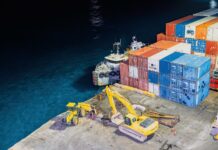
For the second consecutive fiscal year, the Cayman Islands Port Authority has reported significant financial losses from which, according to auditors, it may not easily recover.
In the 2012/2013 fiscal year, the public agency lost more than $2.6 million.
Statements released in Legislative Assembly this week revealed that the authority’s liabilities exceeded its assets by that amount during the year.
Auditor General Alastair Swarbrick noted in his evaluation of the agency’s financial statements that such losses prompt significant concern about its ability to continue operating.
“Given that the Port Authority has already increased fees in 2010, there is limited room for further maneuver on the revenue generation side, if the expected downward trajectory of cargo and cruise passenger volumes continues,” Mr. Swarbrick said. “The likely options include staff rationalization and direct government support to sustain operations.”
The port’s operations are considered critical to government and the Cayman Islands as a whole, so it is likely that government would step in and provide funding, Mr. Swarbrick noted. Some help may be on the way in the form of increasing cruise ship visits. In 2013, Cayman saw one of its poorest years in the past decade for cruise passengers, with fewer than 1.4 million visitors. This year, the number of cruise visitors is expected to rise to 1.8 million. However, the audit report also noted – as it did in 2012 – that a significant revenue source of the port, cruise passenger tender fees, remained uncollected during 2012/13 over a dispute with the cruise lines.
“The authority amended its tender fees in March 2010, along with other fees, but before the implementation of those fees, it was realized that the charges to the tender company will only be passed on to the cruise lines,” the audit report stated. “The fees conflicted with the Florida-Caribbean Cruise Association agreement and were never charged.”
The loss of anticipated port revenue from the tender fees was estimated at more than $500,000 per year for the 2011/12 and 2012/13 government budgets. In testimony before the Legislative Assembly’s Public Accounts Committee last year, port officials noted that cargo shipments dropped off by half between 2005 and 2013. Operational costs during that period stayed roughly the same, they reported.
“There is not a lot the port can do to cut,” the port’s James Parsons told the committee, pointing to personnel costs and the two freight cranes. “Salaries were cut 7 percent in 2010, but we have a lot of operational costs on our cranes. We did a major overhaul, which cost a lot of money, and then did a second overhaul.”
Cargo operations, traditionally supplying 75 percent to 78 percent of port revenues, used to pay for themselves, Mr. Parsons said. “But over the last five years, cruise contributions and tenancies at the port, 22 percent to 25 percent of revenues,” declined, while ongoing subsidies to the Cayman Brac port remained $500,000 per year, he added.
A 2011 KPMG study addressed financial issues for the next three years, and the authority paid off a half-million-dollar loan, but “the cash flow just isn’t there,” Mr. Parsons said, between “consultancy and legal fees and capital” outlays.
Related Videos