


At a glance:
- Large audit firms are facing growing pressure as artificial intelligence changes how clients value accounting and consultancy work
- The AI challenge comes as Cayman’s professional services sector increasingly hires from low-income jurisdictions
- Industry insiders say junior staff are most at risk from AI trend
Cayman is home to some of the world’s highest-paid accountants and auditors. Senior partners at the top of the largest firms can earn millions of dollars per year. Yet that layer of well-paid partners is supported by a foundation of audit staff and tax professionals on relatively low salaries.
The industry has always operated on this pyramid model, with the idea being that the eventual rewards justify the hard early years. An “up or out” philosophy means the ranks thin as you move up the pyramid. But now, with audit consultancies coming under pressure from AI, the model is changing and that could have significant implications for Cayman.
Changing face of audit in Cayman
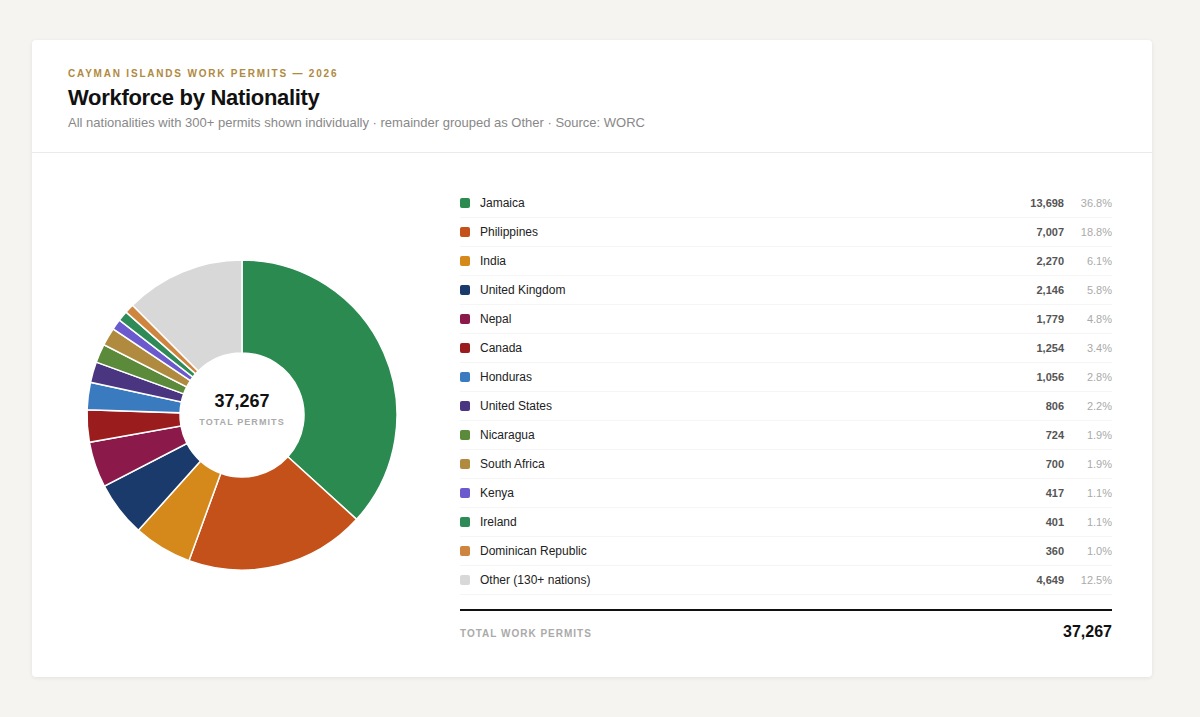
One way that large audit and consultancy firms in Cayman control costs is by hiring entry-level staff from lower-income countries. Recent WORC data shows a significant increase in work-permit holders from India, Africa and the Philippines, many of whom work in professional services firms.
“They like to hire staff from low-income countries that are far away from Cayman,” said a mid-level Cayman-based professional for one of the Big Four – the collective name given to Deloitte, EY, KPMG and PwC.
The composition of Cayman’s auditors has changed over time said Nick Joseph, founder of immigration consultancy, Reside Cayman. “In the beginning, during the 1970s and 1980s almost all accountants in private practice were Caymanian or British. By the 1990s the British started to be replaced by Canadians and others from around this region.”
“By the 2000s the Canadians dominated the industry. By the 2010s large numbers in [relative terms] of South Africans joined the profession. By the early 2020s recruitment expanded to include significant numbers of Indians and Kenyans.”
“Now recruitment seems to have expanded across East Africa with Zimbabweans and Tanzanians amongst those I have come across – together with growing numbers of Filipinos and Nepalese,” said Joseph. “It is simple economics. The labour is often cheaper than Caymanian or British counterparts.”
Cutting costs at the bottom of the pyramid
The mid-level source, who wanted to remain anonymous to protect his career prospects, said entry level staff at the auditors are earning around $55,000 per year. “When you consider they will be working up to 80-hour weeks during busy season, it’s not a good salary on a per-hour basis.”
The Compass also spoke to a former partner at one of the large audit and consultancy firms based on the islands. “I benefited from the situation, but I always knew it was unfair. If there are cuts to be made, the partners obviously want that to happen lower down in the pyramid and that means squeezing the entry-level staff.”
The bedrock of the audit industry in Cayman is legislation that states that Cayman-registered funds and companies can only be audited by firms based in the jurisdiction. It guarantees revenues for the audit firms, which then focus on delivering the audit for the lowest possible cost.
“Often, the bulk of the work on these audits is carried out by global delivery centres [offshore hubs in low-income jurisdictions] and then the final report is signed off by a partner based in Cayman,” said the mid-level source.
The AI squeeze
None of the above is news to people who work in the industry. But what’s changing now is that AI is putting extra pressure on profit margins. In one infamous example, the Financial Times reported that KPMG told its own auditor, Grant Thornton UK, to reduce the cost of completing its monthly accounts because AI made it cheaper to do the work.
In recent years, there have been high-profile mistakes, where well-known audit firms have published AI-generated, error-strewn reports. Clients – who realise the Big Four are using AI to produce some elements of reports – expect to pay lower fees.
“If your business model is based on charging people high hourly rates for your knowledge, and that information is now democratised and more readily available to everyone due to the adoption of AI, your operating model is under threat,” said the former partner. The historic Big 4 model of “time and materials” billing is being disrupted by “value-based” pricing for services where critical thinking is required, he said.
In March the Financial Times reported that KPMG was “cutting close to 600 UK jobs”, while in 2025 it reported that 175 junior auditors were made redundant from PwC in the UK last year.
“It’s not that AI will destroy the Big Four, but it will drastically change their business and revenue models,” said the mid-level source. Indeed, Financial Times analysis found that in 2025 the Big Four advertised more AI specialist roles than auditor jobs.
Most at risk are the junior and mid-level staff, as AI can now complete or automate many of those basic tasks, especially around market research, data aggregation, data modeling, sampling, document review, testing and presentation. Starting salaries for consultants at the Big Four have not increased since 2022, reports the Financial Times.
All of the professionals interviewed for this story believed that the coming changes would likely mean fewer junior audit staff would be hired in Cayman in the future. The pressure on entry-level roles could also make it more difficult for Caymanians to enter the field.
None of the audit professionals that the Compass spoke to for this story were willing to go on record, citing potential career impacts in a small market. The Compass also reached out to the Big Four, but PwC declined to comment, while Deloitte, KPMG and EY were yet to respond by the time of going to print.
Related Videos












Interesting.
When I worked at one of the Big Four firms in the Cayman Islands, in the tax department, most of the entry- and mid-level professionals were from the US. We had two Canadians. It looks like CPA (or equivalent) title is not strictly required for entry-level international auditor roles at Big Four firms.
With experience in both tax and audit, I struggle to believe that AI could replace human judgment when dealing with the highly complex and unique circumstances of each client.
One could argue that judgement should be left to senior-level professionals. It is true that removing routine tasks would shift cognitive demands from mechanical execution to higher-level analysis. However, wouldn’t this raise risks of cognitive atrophy and over-reliance on unverified AI outputs*?
While removing manual work would lower traditional burnout, actively overseeing too many AI tools and managing AI-generated content would create a new form of acute mental fatigue known as ‘AI brain fry. Toggling between AI tasks and deep analytical work would leave a brain scattered, making it tough to focus and way easier to make mistakes.
*refers to the risk of accepting “hallucinations”—confidently wrong information—without checking, which is becoming a major issue.
“Clients – who realise the Big Four are using AI to produce some elements of reports – expect to pay lower fees.”
Do they, the clients, realize that, as of 2026, every AI-produced audit report or substantial output must be reviewed and validated by a qualified professional (senior-level) to meet regulatory, quality, and liability standards.
While AI accelerates data gathering, it does not replace the human judgment, professional skepticism, and accountability required by audit standards. So, where should the fee reduction come from?
It would be unreasonable to negotiate a physician’s fees given the current landscape, where AI plays an active and advanced role in clinical decision making.
Unlike medicine, where a single diagnosis is often formulated and reviewed in minutes, a financial or internal audit requires cross-referencing massive, interconnected datasets.
Medical AI matches current data against known disease patterns. Audit AI flags anomalies, but humans must still trace physical invoices, bank statements, and contracts to prove the reality behind the data.
Doctors seek a matching condition to treat it. Auditors must actively search for what is missing, hidden, or intentionally manipulated, requiring deep skepticism.
Medical tests analyze a single patient. Audits often evaluate millions of transactions, requiring complex statistical sampling and data normalization across messy, disparate software systems.
A misdiagnosis is a tragic error, but an unspotted corporate fraud can collapse entire financial markets. Regulatory bodies (like the PCAOB*) mandate strict, human-signed documentation for every conclusion.
• PCAOB is a nonprofit corporation established by Congress (the US) to oversee the audits of public companies and SEC-registered broker-dealers.
A similar problem has arisen for junior lawyers in Cayman. Government was unwise to increase the PQE requirement to five years without first focusing on materially improving the education system. It has accelerated law firms’ use of technology to plug the seniority gap, and will reduce opportunities for Caymanians in coming years.