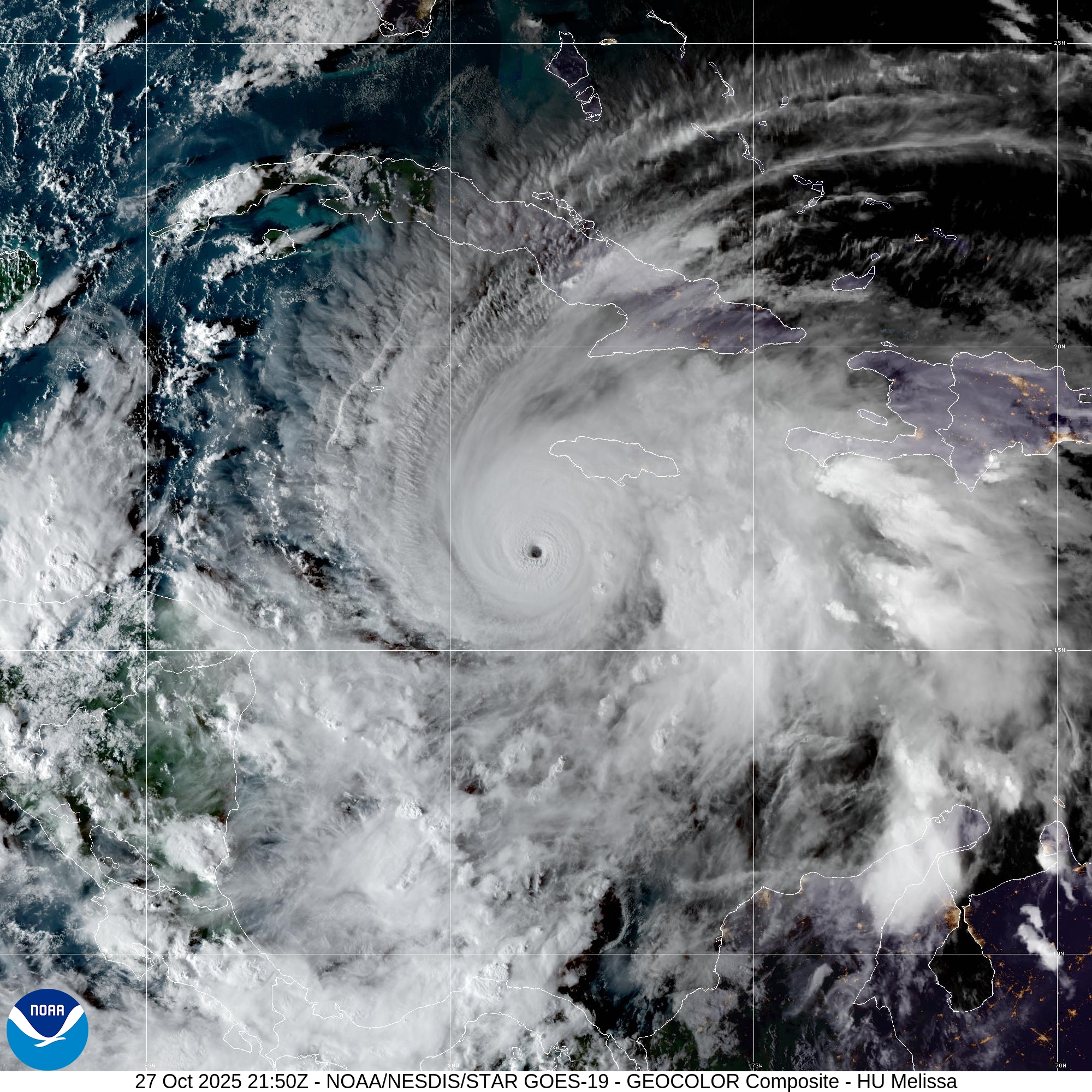
Artificial intelligence is rapidly transforming the science of hurricane forecasting, promising faster predictions and new insights into how storms may develop, but forecasters at the US National Hurricane Center say the emerging technology will complement, not replace, the traditional models and human expertise that remain at the heart of storm prediction.
During the 2025 Atlantic hurricane season, National Hurricane Center meteorologists began experimenting with several new artificial intelligence weather-prediction systems alongside their existing forecast tools. The goal was simple: determine whether these new models could improve the ability to predict where storms will go and how strong they might become.
In a question-and-answer session, Wallace Hogsett, National Hurricane Center science operations officer, said, “The use of AI in hurricane forecasting is accelerating … Last season was all about experimentation, including working with our partners to verify and test these tools before using them for operational decisions.”
Forecasters used several AI systems during the season, including models developed by Google DeepMind, as well as new artificial-intelligence forecasting tools created by the National Oceanic and Atmospheric Administration and the European Centre for Medium-Range Weather Forecasts.
Hogsett said that, at the National Hurricane Center, these systems are not used in isolation, but rather as part of a larger forecasting “toolbox” that includes traditional physics-based weather models, satellite observations, hurricane hunter aircraft and decades of forecasting experience.
“Traditional numerical weather prediction models and AI models take very different approaches,” Hogsett explained. “Because they use different methodologies, their forecasts have different types of errors, which can actually be very valuable to forecasters. These differences can be very helpful for forecasters to understand the full range of uncertainty and communicate the risk more effectively.”
The early results have been promising. During the 2025 hurricane season, AI models provided strong guidance on the track of several storms.
One of the most notable examples was Hurricane Melissa, a powerful Category 5 hurricane that devastated parts of the Caribbean. Some AI models identified the likely path and intensity of the storm earlier than many traditional models, providing valuable guidance for forecasters.
Former National Hurricane Center branch chief James Franklin said on US National Public Radio that the performance caught the attention of meteorologists reviewing the season’s forecasts.
“The model performed very, very well, which was very impressive,” Franklin said. “It was the best guidance we saw this year.”
Faster forecasts and more data
One of the biggest advantages of artificial intelligence forecasting is speed. In a press release published by NOAA at the end of the 2025 hurricane season, it was noted that traditional weather models simulate atmospheric processes by solving complex equations describing wind, temperature, moisture and pressure. These calculations require powerful supercomputers and can take hours to complete.
AI systems take a different approach. They analyse vast historical weather datasets to learn patterns in how the atmosphere behaves, allowing them to generate forecasts much more quickly.
NOAA recently launched a new generation of AI-driven forecasting models designed to provide faster guidance for meteorologists. One of these systems, the Artificial Intelligence Global Forecast System, can produce a 16-day forecast using only about 0.3% of the computing power required by traditional models.
That efficiency means forecasters can run far more simulations, helping them understand the range of possible storm scenarios.
“Forecasting hurricanes is all about communicating a range of possibilities,” Hogsett said. “Because AI models run so quickly, we may soon be able to generate thousands of possible forecast outcomes to better estimate uncertainty.”
Research highlights strengths and limitations
Despite the enthusiasm surrounding AI forecasting, scientists caution that the technology is still evolving.
A recent study by researchers at Rice University evaluated leading AI weather models, using hundreds of tropical cyclones from the Atlantic and Pacific between 2020 and 2025.
“We found that the AI models we evaluated performed remarkably well in predicting cyclone tracks,” said Avantika Gori, assistant professor of civil and environmental engineering at Rice University.
But predicting hurricane intensity – how strong a storm will become – remains more difficult.
Research scientist Kate Musgrave of Colorado State University’s Cooperative Institute for Research in the Atmosphere said this has long been a challenge for AI systems.
“Intensity … is not captured well in the AI models,” Musgrave said, although she noted that newer systems are improving as they incorporate more historical storm data.
The Rice study also found that some AI-generated storms appeared realistic, but failed to satisfy key atmospheric physics relationships governing real tropical cyclones.
“These inconsistencies are not always obvious,” Gori said. “Wind fields can look realistic while still violating key aspects of atmospheric physics.”
The team also found that both AI models tended to overestimate inner core size, especially in stronger storms. Such biases matter because cyclone impacts depend not only on track, but also on how winds are organised, factors that shape projections of wind damage, rainfall and storm surge.
A powerful new tool, but not a replacement
For forecasters at the National Hurricane Center, the lesson is clear: AI models are powerful tools, but they must be carefully evaluated and interpreted.
“We often hear the question of whether AI will replace human forecasters,” Hogsett said. “The answer is a resounding no.”
Instead, meteorologists expect artificial intelligence to become an increasingly important part of hurricane forecasting, helping scientists analyse massive datasets, test more forecast scenarios and provide earlier warnings.
As coastal populations continue to grow and hurricanes threaten millions of people across the Caribbean and the United States, researchers say every improvement in forecasting can make a difference.
“We want to bring every tool to the table,” Musgrave said. “We’re talking about lives and property.”
Related Videos