

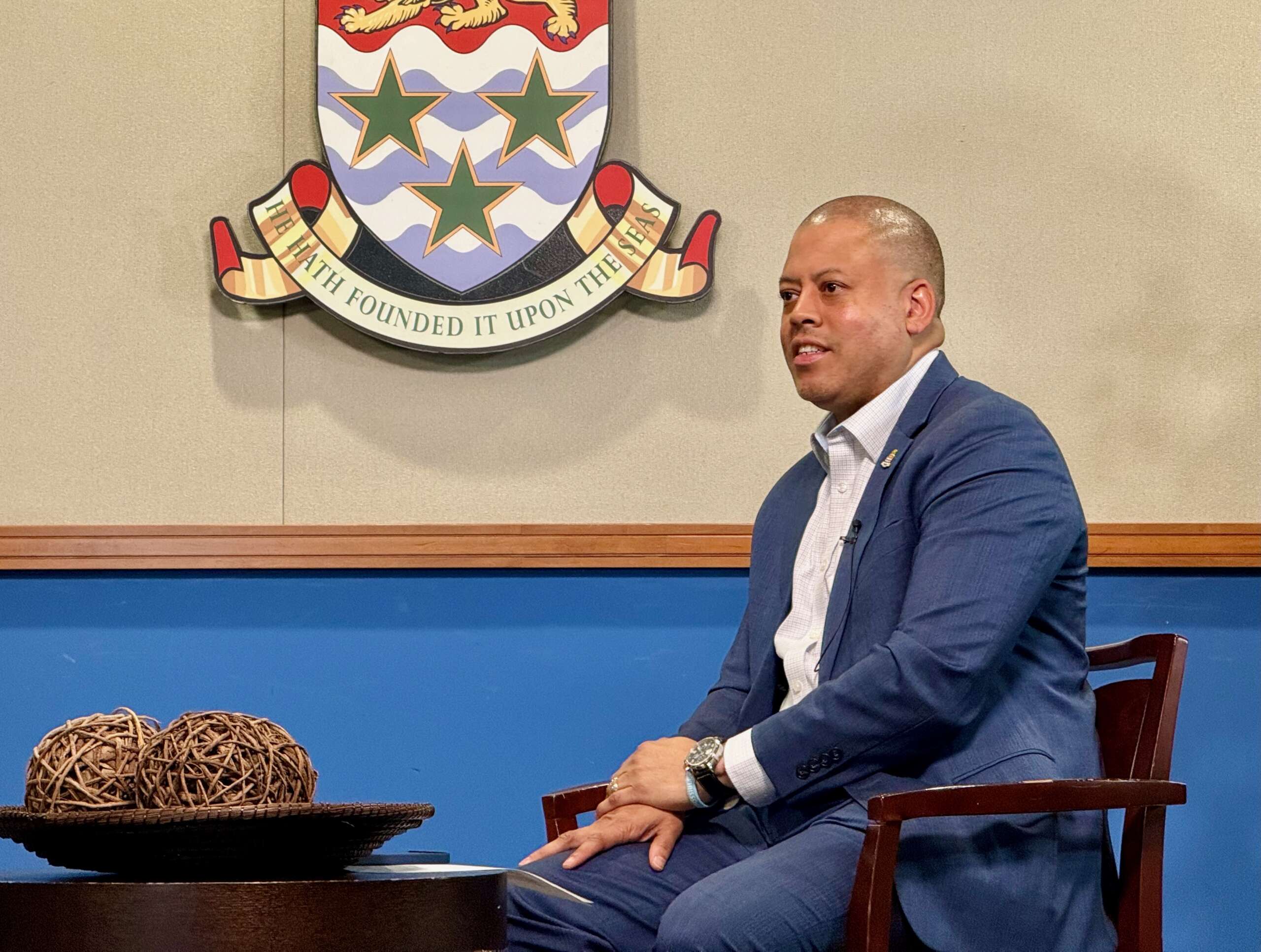
Premier André Ebanks says his coalition government has made meaningful progress on tackling decades-old problems in its first year, but acknowledges the harder work is still ahead.
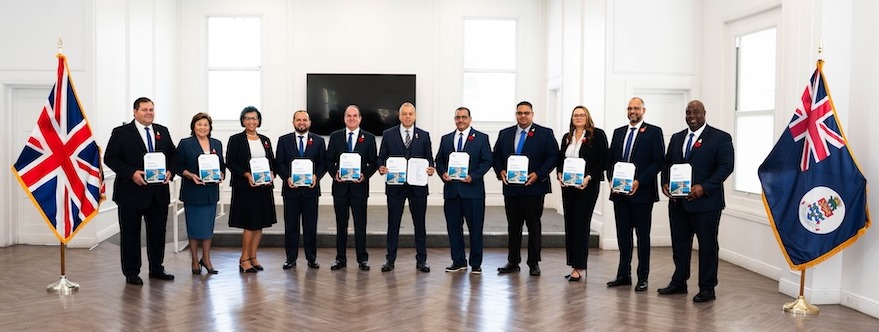
Government has cited immigration reform, a new housing report, the implementation of the $8.75 minimum wage, record tourism arrivals and more than doubling funding for childcare for Caymanian families among its signature achievements so far.
Ebanks said the stability of the National Coalition For Caymanians – formed from two new political parties and three independent MPs – was a success story in itself, given Cayman’s recent chequered history of coalition governments.
The NCFC released a report and press release Wednesday characterising their first year in government as one of “meaningful momentum.”
In an interview with the Compass on Monday, Ebanks said the group was steadily working through a to-do list of problems that had been put off for too long by previous administrations.
He cited the signed coalition agreement as a critical difference between this government and the previous PACT and UPM administrations, which were plagued by infighting and shifting alliances.
He acknowledged differences of opinion within the group but said all 11 MPs were committed to moving forward together.
“No matter how different the viewpoints may be coming in on a particular issue, what we have maintained is respect for the process, respect for each other and respect for the data. Once that occurs, you can usually reconcile most views, and that has been the case with us so far.”
Immigration reform provides ‘path to the C Suite’
Ebanks highlighted the introduction of the Caymanian Protection Act as “the most visible advancement” his government had made.
He said there had been demands for reform for nearly 15 years.
In terms of the practical difference it would make for ordinary people, he said, “Caymanians are now getting a stronger pathway to the C-suite, also [government has] a better tool of population management, and what business should see is a more effective, efficient system to get necessary labour when needed.”
Asked about possible negative consequences, including reports of professionals leaving the islands because of both cost of living and the more restrictive immigration regime, he said it was too early to make those kinds of judgments.
The legislation was just the starting point, he added, with reform of the permanent residency points system and residency by investment rules to follow.
Land use and development
The to-do list for the rest of the term includes completing Plan Cayman, the development framework that has not been formally updated since 1997, beginning to implement proposals from an extensive housing report and reforms aimed at reducing the cost of living.
One of the key issues that has challenged governments for decades is land use and planning. Ebanks said he wants to bridge the gap between what he sees as the polarised perspectives focused on environmental protection and the development needs of a growing country.
A seminar called ‘Cayman Forward’ will put representatives from both camps in the same room.
“There is far too much tension between them both, and we need to be able to, as a country, determine firmly where we are going to protect and where we are going to consider the built environment.”
He said government’s designation of new protected areas was a step in the right direction, and the Plan Cayman process would help establish much more clearly where building could take place and where land should be conserved.
Asked why the Plan Cayman process, which began in 2017 and is itself an attempt to update a planning framework last formally revised in 1997, had taken so long, he said he was confident the minister for Planning would bring it forward substantially, if not fully, this term.
Cost of living
Bringing down the cost of housing and energy is the coalition’s key long-term strategy for addressing Cayman’s high cost of living.
Ebanks acknowledged there were few levers at government’s disposal to meaningfully impact family budgets. Government recently introduced a four-month fuel duty cap to prevent petrol prices and electricity costs from escalating further during the summer months. But he acknowledged this was a short-term measure.
He believes the biggest inroads can be made by finally shifting Cayman away from fossil fuels.
“We have to accelerate solar. That is the longer-term plan. It is not just that it’s going to impact each household. If every business and every market is also at solar, then their prices should also lower.”
He accepted that would take time to translate to cheaper bills, but said the country had to get started. Also on the cards is an expansion of the home insulation programme run through the Ministry of Sustainability as a grant-funded trial, which he said could radically reduce power bills for vulnerable households.
On housing costs, he pointed to the residency by investment reform as one mechanism to slow land price inflation, alongside planning changes that could allow smaller, more affordable homes to be built.
Government is looking at further amendments to the residency by investment rules to ensure wealthy new arrivals could qualify through investment in businesses and avenues other than real estate, arguing that the existing rules were driving up land prices and pushing housing further out of reach for Caymanians.
Landlord and tenant legislation and the completion of Plan Cayman are the next significant legislative steps on the table.
Asked whether enhancing the cargo port or opening new trade routes could make food less expensive, he said it was an area of consideration, but insisted bigger impacts could be made elsewhere.
“By a mile, it is energy and it’s housing. When you look at the bar graph, food (is at) a much lower level. … So we now have to zero in on reducing the biggest factors, because then you have more money in your pocket for the smaller factors.”
Coalition partners
One thing the premier is confident about is the unity within the coalition.
Asked if he thought the 11 MPs who started the term together would finish it together, he said, “If we continue working the way we’re working now, sky is the limit.”
On whether they would run together as a joint ticket at the next election, he was more circumspect, saying only, “we’ll see.”
Compass Media will continue its coverage of the NCFC administration’s first year in office and key national issues across all platforms.
Related Videos












Ebanks is right that the C-suite gap is the real problem. Everything he is doing to address it is wrong.
The Business Staffing Plan regime – compliance pressure on private sector employers to hire Caymanians irrespective of competitive outcomes – does not produce C-suite professionals. It produces compliance hires. And compliance hires harm the people they are supposed to help: placed in roles above their current capability, they struggle to perform and are permanently tagged in colleagues’ and clients’ eyes as regulatory appointments rather than merit ones. This poisons the well for every Caymanian who earned their position legitimately, because institutional clients cannot distinguish between the two categories once a preference regime is known to exist. In a jurisdiction of 40,000 Caymanians serving a global client base, that signal travels fast and sticks.
The scholarship programme is not closing the gap either. The Auditor General found CI$144 million spent on Caymanian employment programmes between 2019 and 2023 with no measurable impact on the unemployment rate. Funding non-vocational degrees at mid-tier universities does not produce competitive financial services professionals. It produces people with credentials that serious employers do not recognise, and then we blame the employers.
The answer is better inputs: scholarships conditional on STEM or professional degrees at Russell Group or Ivy League institutions only, followed by a mandatory three-year international secondment at a blue-chip firm in London, New York, or Hong Kong before return. A Caymanian who has survived three years at a serious firm in a competitive market is a fundamentally different proposition to an offshore employer than one trained entirely domestically. That is what C-suite formation actually requires. No accreditation framework or work permit condition replicates it.
Bermuda tried the BSP equivalent in 2001. It reversed the policy in 2013 after watching its talent base drain and its competitive position collapse. Cayman spent a decade benefiting from that mistake.
Andre might try to consider why. But then, that wouldn’t win votes by whipping up anti-expat hatred. I’ve advised my friends not to come to Cayman, and to look instead at Singapore, Hong Kong and Dubai (yes, Dubai with Iranian drone attacks is more attractive than Cayman under the NCFC regime).