

CFA, MBA
Chief Investment Officer
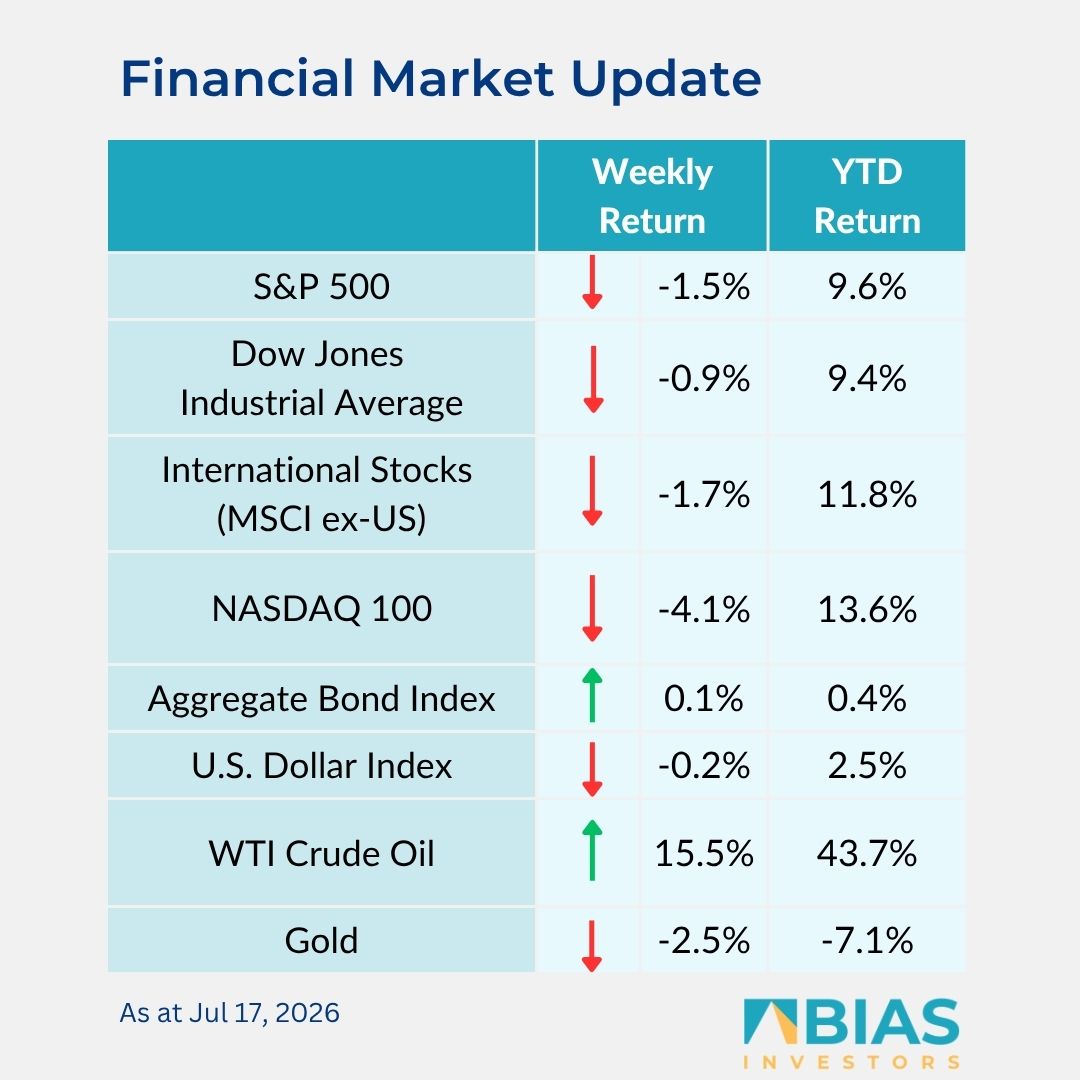
Despite cooling inflation, an escalation of military action in the Middle East and a pullback in semiconductor and AI-related stocks led markets lower last week.
For the week, the S&P 500 Index was -1.5%, the Dow Jones Industrials -0.9%, and the NASDAQ -4.1%. The energy, real estate, and consumer staples sectors led the S&P 500 Index for the week, while the technology, communication services, and industrial sectors lagged. The 10-year US Treasury note yield was 4.549% at Friday’s close versus 4.563% the previous week.
June inflation data reflected lower energy prices month-over-month with the Consumer Price Index (CPI) 0.4% lower and the Producer Price Index (PPI) 0.3% lower. The rate of core inflation also cooled month-over-month with core CPI flat and core PPI only 0.1% higher.
Recent military action in the Middle East has reversed the downward move in energy prices with national average gasoline prices +3.4% for the week, and diesel prices +4.8%.
CME Fed funds futures currently show no projected increase in interest rates for the 29 July Federal Open Market Committee (FOMC) meeting, and a single 0.25% interest rate increase for the year at the September meeting. This is in line with the policy projections from the FOMC.
The tempo of the second-quarter earnings reporting season increases this week with 86 companies in the S&P 500 Index scheduled to report earnings. Second-quarter earnings are expected to grow by 24.7% and quarterly revenue growth is expected at 12.8%. Full-year 2026 earnings are expected to grow by 24.5%, with revenue growth of 10.9%.
In our ‘Dissecting headlines’ section, we look at items within the CPI that can influence consumer perceptions of inflation.
Dissecting headlines: Inside the CPI
Economic data like the Consumer Price Index, doesn’t get seen or analysed by the average consumer. Those consumers are building their thoughts on inflation and the economy from their personal experiences when they are shopping, pumping gas, and writing a rent check.
Groceries (‘food at home’) were 0.2% higher in June versus May, and 2.7% higher year-over-year. Within this data consumers see the actual prices at the store where ground beef is 12.4% higher year-over-year and milk is 9% higher, but eggs are 27.9% lower and chicken is 2.3% lower.
Consumers will adjust their shopping behaviour based on price changes. Restaurants (‘food away from home’) showed prices 0.2% higher monthly, and 3.6% higher year-over-year.
Gasoline prices were lower in June versus May by 8.5%, but still 22.5% higher year-over-year. While some driving miles may be influenced by gasoline prices, it is also the case that money spent on gasoline can draw away from other discretionary expenses. Other auto-related expenses show auto insurance down 0.2% in June versus May.
Auto insurance is still 5.7% higher year-over-year and has increase for the past few years due to more expensive cost of repairs from a combination of more technology being damaged in each accident, and higher labour costs. Vehicle repair and maintenance costs are 4.4% higher year-over-year.
A persistently higher category within the core CPI is housing. Housing prices were 0.3% higher in June and 3.9% higher year-over-year. This is a large portion of a consumer’s monthly budget and heavily impacts behaviour.
There are some bright spots as cell phone service was 0.3% lower monthly in June and 1.3% lower year-over-year as there is a high degree of competition among service providers. Medical care costs were 0.1% lower monthly in June and only 2.1% higher year-over-year.
Overall, consumer prices are still growing above the Fed’s 2% target level, and the University of Michigan Consumer Survey shows more than half of consumers say high prices are weighing on their personal finances.

BIAS Investors (Cayman) Ltd.
Grand Pavilion (Hibiscus Way)
802 West Bay Road
Grand Cayman, Cayman Islands
W: biasinvestors.com
E: [email protected]
T: 345-943-0003
Subscribe to the BIAS Investors newsletter here.
Related Videos