

Implementing long-discussed immigration reform emerged as one of the defining actions in the National Coalition For Caymanians government’s first year in power.
Immigration and Caymanian employment were central issues during the 2025 election debates and rallies, with candidates campaigning on how they would balance economic growth in the Islands with mounting public concern over population growth, infrastructure strain and opportunities for Caymanians.
That debate has intensified as the population in Cayman has climbed to over 90,000, with more than half being non-citizens, and the rapid growth putting pressure on housing, schools, healthcare and roads.
Sweeping immigration reforms were passed by lawmakers in December last year and implemented on 1 May 2026, in the form of the Immigration (Transition) (Amendment and Validation) Act 2025, after widespread debate and some delays. Government described the legislation as the most significant immigration overhaul in more than a decade.
Among the key measures introduced in the legislation was extending the pathway to Caymanian status for most residents from 15 years to 20 years, and from seven years to 15 years for those married to a Caymanian. The changes also mean those granted the right to be Caymanian on the basis of marriage or civil partnership are required to file an annual declaration for the first seven years after being granted that status.
The amendments include provisions to prevent job-hopping among work-permit holders within the first two years of the permit being granted. Employees who leave their jobs within those two years are required to leave Cayman for one year before being allowed to return and take up new employment, unless there are specific prescribed circumstances.
The new legislation also impacts married couples on work permits. Under the previous system, married work-permit holders could align their term limits to whichever spouse had the longer remaining one. The new law reversed that position.
The revised act also made substantial changes to Residency and Employment Rights Certificates. For example, those holding an RERC as a spouse or civil partner of a permanent resident or Caymanian, who previously could apply for naturalisation after one year, must now wait 15 years.
Changes were also made to combat marriages of convenience, with the legislation allowing the director of Workforce Opportunities and Residency Cayman (WORC) or the immigration board to consider whether there are reasonable grounds to suspect that the marriage is genuine or not.
The requirements relating to the financial standing of work permit holders with dependents were also changed. Now, expat workers must earn at least $5,000 per month for a first dependent, and another $1,000 per month for each additional dependant.
‘Grandfathering’ provisions
Government also introduced follow-up amendments to the legislation after concerns emerged that some long-term residents and individuals who had already applied for the right to remain in Cayman could be unfairly disadvantaged during the transition to the new system.
The revised ‘grandfathering’ provisions, for example, ensured applicants already pursuing permanent residency would still qualify under the previous 15-year pathway rather than the new 20-year threshold.
The same exemption also pertained to those who had applied before 1 May 2026 for RERC through marriage or civil partnership, dependency of RERC holders, certificate of permanent residence for persons of independent means and their dependents, British Overseas Territories citizenship by connection with Cayman, and asylum.
The amendments included a new category of ‘Caymanian as of right’, recognising individuals born in Cayman on or before 26 March 1977. It was introduced to address a cohort of approximately 2,618 people born in the islands between 1 Jan. 1969 and 26 March 1977, for whom no specific statute applied.
The government also changed the name of the law to the Caymanian Protection Act, effectively reverting to the name of the original legislation, first put in place in 1971 in response to the growing number of non-citizens moving to the islands and gave Caymanians priority in the local job market.
At the administrative level, WORC, this year sought to tackle a growing backlog of work-permit applications. Officials said more than 1,400 applications had been processed within a three-week period earlier this year, while additional staff were hired to improve long-term efficiency.
Government also increased immigration-related fees for the first time in more than 15 years, arguing that rising demand for public services and infrastructure required updated funding mechanisms.
It also introduced express fees for expedited processing of annual and temporary work permits and business visitors’ permits. Some fees increased dramatically, with status grants on the grounds of naturalisation now costing $5,000, up from $1,000, and the grant of the Right to be Caymanian by Cabinet going from $1,000 to $10,000.
The government earlier implemented legislation that placed term limits on non-Caymanian civil servants, to align with private-sector practice. Previously, non-citizen government employees were not subject to the so-called ‘rollover’ policy, but under the amended regulations, like workers in the private sector, they would now need to apply for permanent residency to be allowed to remain in Cayman after 15 years.
More changes ahead
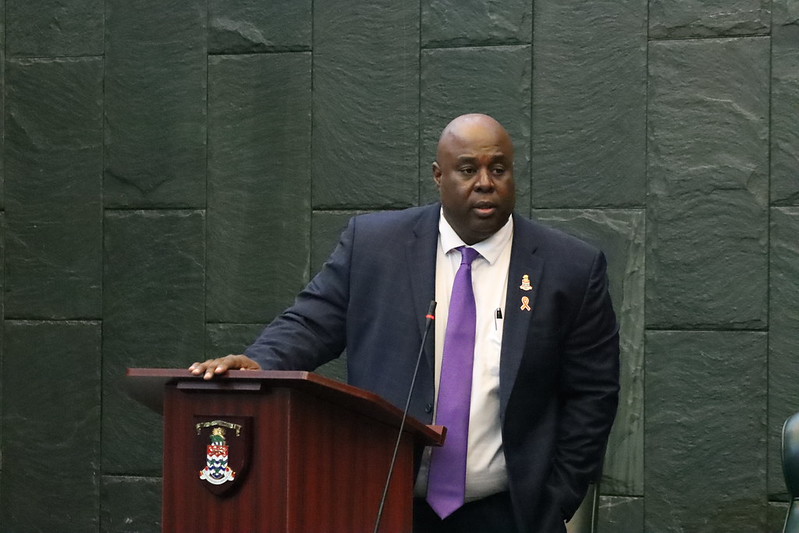
Immigration Minister Michael Myles, who has spearheaded the legislative amendments, described the reforms as representing “a defining moment for our islands”, and he has repeatedly stressed that the changes are “only one part” of a broader effort to reshape immigration and labour policy.
Myles and Premier André Ebanks have indicated that further changes to immigration and employment laws lie ahead and are already being worked on.
Speaking in Parliament on 1 May, the day the immigration reform legislation came into effect, Myles said the amendments to the laws and regulations were part of a “national transformation” that included ongoing efforts to amend the permanent residency system, enhancing worker protection, pension reform, and development of a national workforce plan.
It is expected that the upcoming round of immigration amendments will address the permanent residency points system, as well as a review of residency-by-investment programmes, and further labour-market protection for Caymanians.
The sweeping changes to the immigration legislation implemented this year mostly did not address the question of permanent residency. Currently, a person who has lived in Cayman for over eight years can apply for permanent residency, which, if granted, then sets them on the path to Caymanian status. Between 2015 and 2025, more than 9,000 people received permanent residency.
Future amendments are likely to include changes to the existing permanent residency points-based system, introduced in 2013. Currently, applicants who achieve a minimum of 110 points – based on age, career, education, financial stability and ties to Cayman, among other considerations – can acquire the right to continue to live and work in Cayman.
Another expected change involves allowing high-net-worth individuals to reside in Cayman by investing in the islands’ infrastructure, rather than by buying real estate only, through amendments to the residency by direct investment legislation.
Efforts to promote more Caymanian employment in key industry markets are likely to be addressed through a national workforce plan, which aims to better align the education system and immigration policies with the needs of local economy. This is likely to include a national workforce database to match Caymanian graduates and scholarship recipients with jobs in their relevant fields.
Although no specific timeline has been given for completion of the next round of immigration legislation reform, it is likely to involve a similar level of debate, legislative drafting, consultations and meetings that the last round involved.
Related Videos












A year of “defining moments” and the article notes, almost in passing, that Cayman now has a population north of 90,000, more than half non-citizens, and more jobs than it has people to fill them. Minister Myles called that last point “the most blessed problem we’ve ever had.” In a labour market where demand exceeds supply, wages rise and resident workers are already protected by arithmetic. The theoretical case for aggressive protectionist intervention presupposes a surplus of workers unable to find employment. The government’s own description of the labour market contradicts the premise of the legislation it spent two years drafting.
The two-year job-mobility restriction is the provision that will do the lasting damage. A fund accountant who discovers compliance failures at their employer, a lawyer whose firm’s practice does not match their specialism, an analyst whose promised client exposure never materialises: none can correct course without either enduring two wasted years or leaving the jurisdiction for twelve months. These are the years, late twenties to mid-thirties, in which professionals build the expertise and networks that define their careers. The people deterred by this provision are precisely those Cayman needs to attract and retain.
The article does not mention that the Auditor General found CI$144 million spent over five years on Caymanian employment programmes produced no measurable impact on the unemployment rate. It does not mention that two judicial reviews of the work permit framework were already filed before the Act commenced. And it does not mention that Bermuda introduced comparable term-limit restrictions in 2001, reversed them in 2013 after watching talent drain south to Cayman, and spent a decade explaining to its financial sector why it had done this to itself.
“More changes ahead.” One assumes so. The question is whether any of them will be preceded by an economic cost model.
The message which NCFC is sending to financial services, and which we are in turn relaying to our friends and colleagues around the world is: CAYMAN IS CLOSED FOR BUSINESS. WE HATE EXPATS, AND WE WANT YOU TO SUFFER.
We are focusing growth in better-governed jurisdictions. We will not attempt to create further jobs here, and over time we will reduce the headcount we currently have in Cayman.