

The new Caymanian Protection Act represents the most significant reform of the islands’ immigration laws in more than a decade. The changes, expected to come into force 1 March, have prompted widespread questions from readers about how the law could affect them.
The Compass spoke with HSM partner and immigration expert Alastair David to analyse some of the key nuances in the law.

We also consulted Daniel Altneu, a partner at Bedell Cristin, as well as Immigration Minister Michael Myles and Chief Officer Wesley Howell, to help break down what the law might mean for readers and their families.
The key changes and who is most impacted
One of the central changes in the bill is a significantly longer timeline before a person becomes eligible to apply for Caymanian status – 20 years for most people and 15 years for those married to a Caymanian.
Caymanian status brings with it the right to vote, the right to own businesses, and freedom from annual work-permit fees, which, in some professions, can run into tens of thousands of dollars a year. As a result, the changes carry a substantial financial and practical impact for people aspiring to status, as well as for their employers.
Other groups that are likely to feel the impact most quickly include new work-permit holders, who will not be able to change employers during the first two years of employment, and married couples, who face tighter rules around term limits and residency.
Who is covered by the old system?
Currently, the Caymanian Protection Act, while passed, is not scheduled to come into force until 1 March.
The bill includes transitional provisions. Anyone who already holds permanent residence will remain under the old system, meaning they will still become eligible to apply for Caymanian status after 15 years of residency.
“Under the earlier version of the bill, many more people would have been grandfathered in,” said David.
“Under the amended version, that protection largely applies only to people who already hold permanent residence.”
There is greater uncertainty for people who have applied for permanent residence but are still waiting for a decision on their application. If they do not get approval by the time the legislation comes into force, they will likely fall under the new provisions of the law, David believes.
“From what I can see, they will fall under the new system,” David said, noting that the law appears to treat the grant of permanent residency and the commencement date of the legislation, not the application date, as the cut-off point.
In an update published by HSM in a newsletter to clients, the firm wrote, “This amendment will adversely affect at least 600 people who are currently working pursuant to a Permission to Continue Working with pending PR applications if decisions are not given before the CPA comes into effect.”
For work-permit holders, the new job-change restrictions will apply once the act comes into force, so that provision largely impacts new arrivals to Cayman. Ultimately, the regulations will determine what exceptions apply.
Changes from the draft law
Changes to the transitional provisions in the draft act, which were approved by Parliament, have raised created uncertainty to who exactly would be ‘grandfathered’ in with respect to when they could apply for Caymanian status.
The initial draft of the law grandfathered in anyone who has a ‘certificate, permission or exemption’ – which lawyers say could have been interpreted quite broadly. The amended act passed by Parliament much more specifically references anyone who has been ‘granted the right to reside permanently’ in the Cayman Islands.
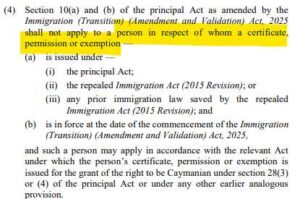
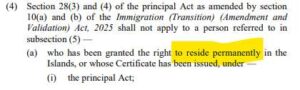
The finalised act creates a cut-off for the transitional provision to anyone who has legal permanent residence granted at the time the legislation is passed, in the view of two senior local attorneys who analysed the Act.
In simple terms, they say, if someone has a permanent-residence application in motion, that application will be treated under the old law, but a subsequent status application will fall under the new law.
Altneu, a partner at Bedell Cristin law firm, said this was an “unexpected shift” from the draft bill that would primarily impact those waiting for a decision under the permanent residence points system.

“The bill specified that these individuals would be fully grandfathered into the pre-existing pathways to the right to be Caymanian,” he said.
“Even if their applications were granted after commencement of the Caymanian Protection Act, they would have retained their eligibility to apply for the right to be Caymanian on grounds of naturalisation after at least 15 years’ legal and ordinary residence in the islands or at least five years after the receipt of their Certificate of Naturalisation or Registration. However, the act has removed that transitional protection.”
He added, “With pending Permanent Residency Points System applicants currently being scheduled for History and Culture Tests in May 2026, this change could have a meaningful impact on many individuals and families who had previously been reassured by the transitional provisions.”

Chief Officer Wesley Howell said anyone who applied before the act comes into force should still be under the old timelines – even for a future Cayman status application.
He said the transitional provisions were intended to prevent anyone from being disadvantaged.
“We’ve not sought to move the goalpost for anybody that has a legitimate expectation,” he said.
However, both lawyers say that is not what the law currently says, and if that is the intent they believe an amendment would be needed. The sought clarity could also perhaps be addressed by the forthcoming regulations.
A misconception about human rights laws
There is a common misconception that UK or international human-rights laws requires Cayman to offer citizenship after a fixed period of residence. According to David, that is not the case.
“There is no European or UK requirement that Cayman must grant citizenship after a certain period,” he said.
“Extending the timeline from 15 to 20 years is within the government’s margin of appreciation, and is likely to be lawful.”
He noted that the UK itself is currently debating extending its own timelines for long-term residency and citizenship.
Harkening back to the introduction of term limits, Howell said there is an EU provision that covers certain rights, acquired over continuous legal residency, but how that would be interpreted is unclear.
“How long is that piece of string? We don’t know,” he said. “We believe that it’s less than 10 years – that is the whole reason why term limits were introduced in the first place, because there was significant pressure in relation to the persons who had been the islands for decades without having any sort of long-term residency.”
How the changes affect married couples
For a relatively small but significant group of people, one technical change could have a major impact.
Under the existing system, married work-permit holders can benefit from whichever spouse has the longer remaining term limit. The new law reverses that position.
“This is the section that surprised me the most,” David said.
“The changes are punitive for married couples. Where spouses previously benefited from the longer remaining term limit, the new law ties both spouses to the shorter one.”
For example, a worker who might otherwise expect to remain eligible for work permits for nine years could find themselves limited to just three years if they marry a spouse who has already spent longer on the island. The spouse could still rollover or apply for permanent residence, but these are not always viable options for families.
Howell said the aim here is to prevent people racking up years of residency by default or “strategically extended their time limits by entering into marriages or civil partnerships”.
Another significant change removes provisions that previously allowed dependents of permanent residents to remain in Cayman after the death of their spouse.
“The consequence of that could be devastating,” David warned.
For instance, a stay-at-home parent and children could face legal uncertainty – or even removal – following the sudden death of the family’s main permit holder.
“The biggest potential legal challenges relate to marriage provisions and dependent rights,” he said.
The impact on spouses of Caymanians
Spouses of Caymanians will also face longer timelines.
The waiting period to apply for permanent residence increases from one year of marriage to seven years.
They will also be required to submit annual declarations to Workforce Opportunities and Residency Cayman (WORC) during that period.
The impact on people with children
There is one significant change for expatriate families. The minimum salary requirement to have a ‘dependent’ added to a work permit has increased significantly.
A minimum monthly income of $5,000 (up from $3,500) is required to include a single dependent on a work permit. Another $1,000 per month (up from $500) is required for each additional dependent.
So, a family of four, where only one parent works, would require a salary of $7,000 a month – $84,000 per year – to relocate to Cayman, compared with $4,500 a month or $54,000 annually under the previous legislation. A single mother-of-one would now need to earn at least $60,000 annually to bring her child to Cayman.
The thresholds apply for new permits, and there is potential impact for firms trying to attract talent from overseas, especially as a job or work-permit offer would clearly not include work or income for a spouse.
Where it gets complicated for people already in Cayman is on work-permit renewals. Immigration lawyers say they simply don’t know how these would be treated. But the potential scenario arises for people who have worked in Cayman for a number of years and are settled with families, that they may no longer meet the minimum salary requirements to have dependents stay with them when they apply for a new or renewed permit.
The Compass has sought clarity from government on this and are awaiting a response.
The job-hopping ban
The bill introduces a prohibition on work-permit holders changing employers during their first two years in Cayman.
The stated aim is to prevent job-hopping and clamp down on labour-brokerage schemes involving permits for jobs that do not exist.
There is a carve-out allowing workers to change jobs where they can satisfy WORC that there were “prescribed circumstances” leading to the termination of their employment, though those circumstances have not yet been set out in regulations.
“The restriction is not a complete ban,” David said.
“Its legality and fairness will depend on the exceptions written into regulations. If abused workers cannot change jobs, that would create serious problems.”
This will impact new permit holders only, so it doesn’t apply to someone who had a permit issued before the new legislation commences.
ID cards for work-permit holders
The law introduces a new fee for work-permit ID cards, though few details have been published about how the system will operate.
David raised concerns about enforcement.
“As drafted, officials could demand to see a work-permit ID card without reasonable suspicion of a crime being committed,” he said.
“From a civil liberties perspective, that is concerning.”
How the law helps Caymanians
The legislation is explicitly designed to prioritise Caymanians in the labour market. One of the main mechanisms for doing so is economic pressure.
“It will become more expensive to employ expatriates,” David said.
“That may encourage hiring Caymanians, but it will also affect industries where Caymanians are not available.”
Ultimately, he said, the success of the reforms will depend on how they are implemented.
“If, in five years’ time, Caymanians are progressing further and doing better, then that will be good for the country,” he said.
“But that outcome depends on how the law is applied.”
Myles believes it will not be meaningfully more expensive to hire from overseas. When Caymanians are not available, he says, work permits will be granted. As of now, the application fees have been subject to a small increase, but work-permit fees have not gone up.
He agrees that success is also about implementation in tandem with other reforms to improve training and education, and align scholarships with a workforce development plan.
Related Videos












At this stage, the way CIMA raises financial service fees every year to pay government employees, I don’t even care hearing about the work permits anymore because the finance sector will die in Cayman. They don’t incite start ups with the CIMA fee structure. You pay hundreds of thousands of dollars to a regulator and they don’t respond to you. It’s a really bad look so work permits are a drop in the bucket as finance as a whole is dying.
Good article, but it inadvertently omits that Myles are WORC are in fact becoming increasingly irrational in refusing to grant work permits, and this is making life far harder for the financial services sector. E.g. see inter alia:
I wonder how this will affect recruitment for senior sales/ business development executives.
As I understand it (and sincere apologies if I’ve misunderstood things), Caymanians generally don’t prefer jobs where sales commission is a major component.
From personal experience, no one will hire a putative sales supremo without a trial period. Unless one can generate revenue, CVs mean nothing – and no one knows how a new hire will fare in company X or market Y until they’ve proved their revenue-generation chops. Trial periods for expats seem to be a no-no in the new set-up.
How, then (outside of financial services), are employers supposed to find their next commission-motivated business development directors?