

Government is being urged to reconsider its new two-tier driving licence fee amid concerns that it will increase the cost-of-living and could be open to legal challenge.
Several business owners warned the change, which will mean an eight-fold increase in the cost of a driving licence for non-Caymanians, will add to the cost of doing business and push up prices for everyone.
Food delivery services, bus drivers and security and construction workers are likely to be most immediately affected with many businesses considering subsidising licences for workers who need to drive for their jobs.
The most direct financial impact will fall on low-wage work permit holders – particularly new arrivals who have yet to get a licence – and their employers.
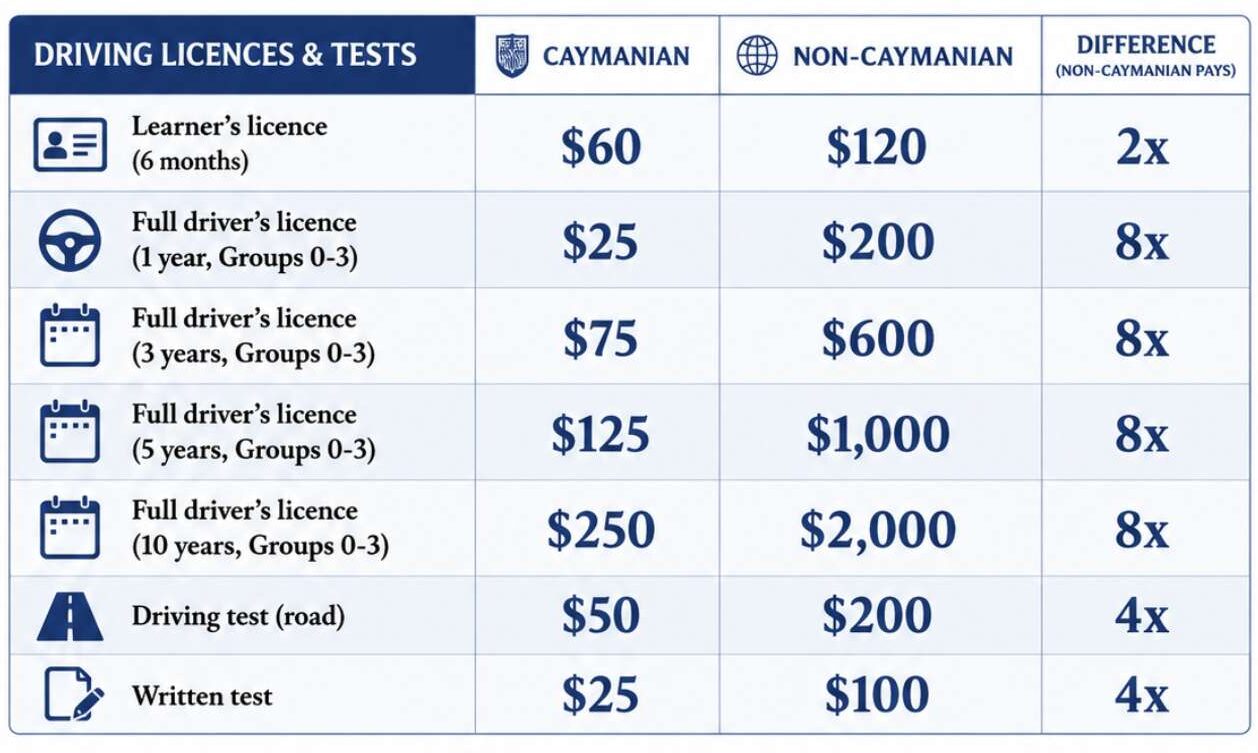
The new cost of a three-year licence for work-permit holders and permanent residents will be $600, while a 10-year licence will cost $2,000.
Caymanians will continue to pay $75 for a three-year licence and $250 for a 10-year licence.
Plans for the new fee structure were announced last year as part of the budget briefing. At the time, Finance Minister Rolston Anglin indicated it was a necessary measure to help balance the books and would bring in an estimated $9.6 million per year.
Since then, government’s finances have stabilised. MPs voted another $134 million in supplementary spending last month.
The DVDL fee increases were published in the government gazette earlier this month and will come in to force on 1 Sept.
Anglin, during post-budget interviews, insisted the package of new fees, which also included a stamp-duty hike on luxury homes, were specifically designed not to hurt Caymanians.
Speaking on CompassTV show Forefront earlier this year, Anglin said government was confident that all its fee increases would not impact the cost of living. He added that government is permitted to differentiate on the basis of nationality when imposing fees.
“Government would certainly not have gone down this road if we were not secure around these protections,” he said.
However, some business leaders and concerned citizens believe the new fees will contribute to inflation for everyone, including Caymanians, and could lead to more unlicensed drivers on the road.
Legal experts also suggest the premise of charging dramatically different fees depending on nationality could be open to challenge.
Asked this week, if government would reconsider the policy, the coalition did not rule it out.
Nickolas DaCosta, acting minister for finance and economic development, said, “The new Drivers’ Licence Fees were announced in November 2025 as part of a package of new revenue measures at a time when government was working to balance the 2026-2027 budget.
“The NCFC government continues to monitor the socio-economic and financial conditions carefully.”
Cost to business
Several business owners say they will have to subsidise the cost for low-wage workers, while families are also expected to do the same for nannies, helpers and carers.
Kenrick Webster, owner and founder of Webster’s Tours, said it was another significant expense on top of the minimum wage increase that made recruitment tough. He said it would be too big of an expense to the business to fund staff licences and he expects it to become harder to hire.
“We will not be able to attract any work-permit holders due to the fact that they will not be able to afford these fees,” he said.
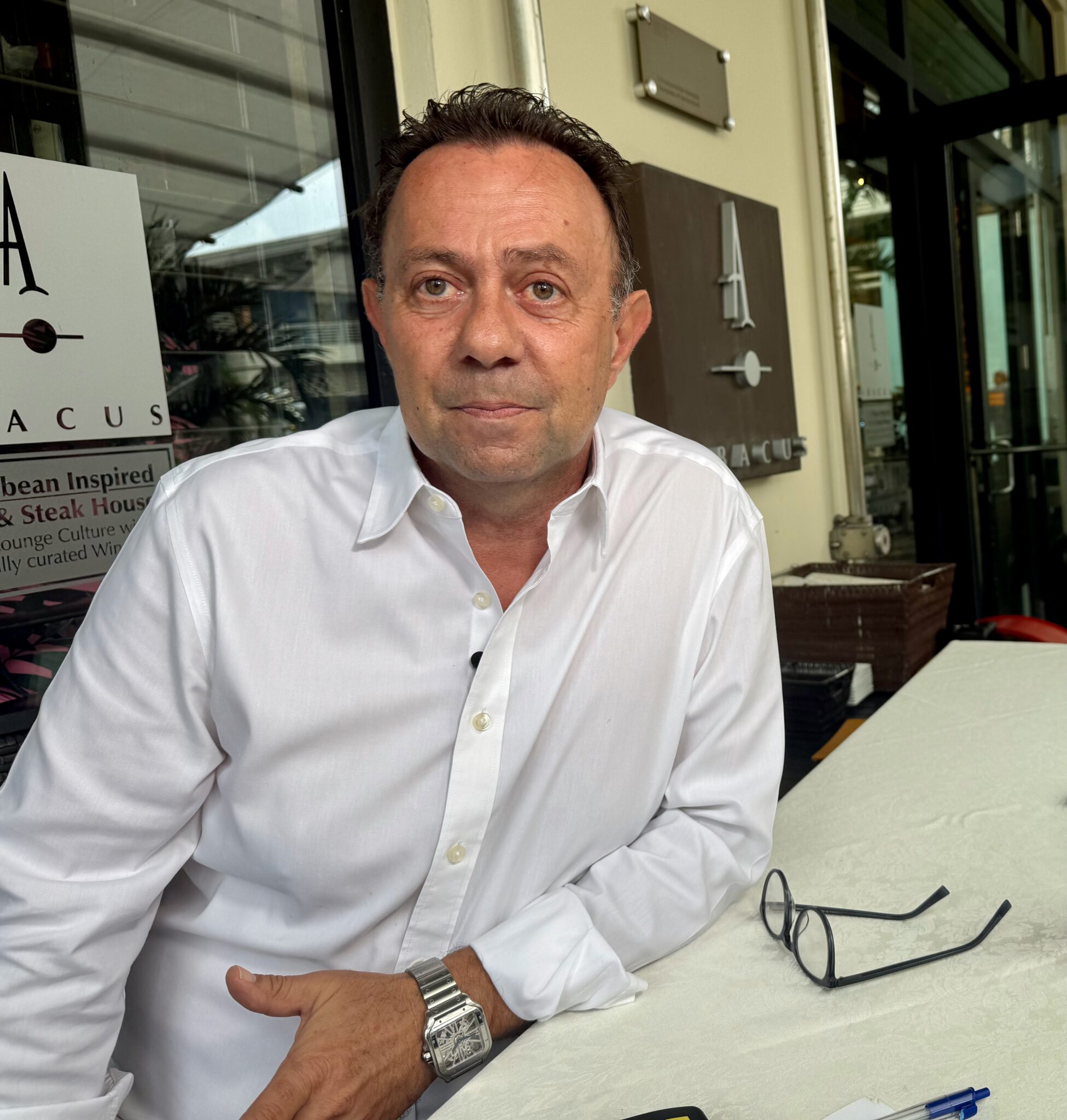
Markus Mueri, of NM Ventures restaurant group, said the policy would further add to the cost-of-living. He said a driver’s licence is a necessity in Cayman, especially for people in tourism working shifts and on weekends.
“Punishing work-permit holders in this way is wrong. The Cayman Islands should first implement a 24-hour-a-day reliable public transport system for people to get to work. After that, one can make changes.”
A group of concerned business owners and citizens will meet this week to discuss options for action.
Jason Butcher, owner of the Auto Spa and one of the organisers of that meeting, said he remains hopeful that government may reconsider the move.
He said there had been no serious consultation with businesses before the measure was introduced. And he questioned the claim that it would only impact non-Caymanians.
“This is going to affect every business that has drivers and every person who has a nanny who has to pay for a driver’s licence for them.
“It’s going to just increase costs for everybody in the Cayman Islands.”
Butcher said he would have to subsidise licences for his employees because they need a car to get to work and need to be able to drive to do their jobs.
“This isn’t ultimately about who pays the licence fee,” he said. “Businesses absorb the cost, and those costs are eventually reflected in the prices every resident pays for everyday goods and services.”
Potential legal challenge?
The fairness of having one fee for non-Caymanians that is eight times higher than the fee for Caymanians has also caused concern.
Attorney General Sam Bulgin, speaking in Finance Committee last year when the measure was first discussed, said there was a “presumption of legality” from his office on the two-tier fee structure, until and unless a court says otherwise.
He gave his opinion that, “Government has the wide berth to carry out preferential treatment for Caymanians without running afoul of the general discriminatory provisions in the Constitution.”
Nonetheless, lawyer Christopher Perry believes there is an arguable case that the licence-fee policy does not meet the constitutional bar.
“The Constitution does carve out taxation and licence fees as an area where the government is entitled to distinguish between Caymanians and non-Caymanians.
“The main issue is not the amount of the fee itself, but whether the distinction being drawn is a reasonable and proportionate means of achieving a legitimate objective. That is ultimately a constitutional question.”

If the aim is to increase revenue, he said, there may be fairer ways to do it. If the aim is to reduce the number of vehicles on the road, he questions whether the measure is a reasonable and proportionate means of achieving that.
Given the limited availability of public transport and other practical alternatives, he said a driver’s licence is a necessity rather than a luxury for many people living and working in the Cayman Islands.
He added, “One of the questions is whether there may be unintended consequences. For example, if the cost of obtaining or renewing a licence becomes too high for some people, there is a risk that it could lead to an increase in unlicensed and uninsured drivers on the road.”
Perry, managing partner of PEB Attorneys, added that he has been approached by several individuals, including Caymanians, who have expressed concerns about the proposal and have sought advice on the issues it raises. He said he hopes that the legal and practical implications of the measure can be carefully considered as part an ongoing public discussion.
Ben Cramer, a British resident in Cayman with long ties to the island, said he was willing to put his name to a legal challenge if it becomes necessary. He said he believes the policy is unfair and he would be willing to fight it on behalf of others that may not have the resources to do so.
“You’ve got a cost-of-living crisis that’s unbelievable, particularly for low-wage labourers. God forbid we go up to this level, because they’re not going to want to pay that or be able to. You’re going to have more people on the roads unlicensed.
“It’s kind of a civic duty to challenge it, in my view.”
Delivery services hard hit
Among the businesses facing the greatest impact are delivery services, which are already suffering from fuel price hikes, minimum wage increase and new regulations on e-bikes. Both Bento and Let’s Eat said they would be impacted.
Food delivery app Bento currently employs 60 drivers and is in the process of hiring a dozen more to meet growing demand across the Cayman Islands.
General manager Joao Santana said the company was already subsidising gasoline for its drivers amid spiralling fuel costs and would subsidise the new licence fees as well.
“We always will provide support to our drivers because this is essential to their duties. They cannot perform any work if they do not have it,” Santana said.
He added that the increase was sudden and dramatic, with licences going up 700%.

He likened the situation to the 40% increase in the minimum wage implemented earlier this year, and suggested incremental yearly increases would be much easier to handle for businesses.
He said Bento also already had to cease part of its operation with drivers using e-bikes because of new licensing and insurance requirements that had made that mode of transport unfeasible financially.
Santana questioned whether payment plans or reduced fees for people who rely on vehicles for work could be introduced to lessen the impact.
And he agreed all consumers would ultimately end up paying for the increases, regardless of nationality.
“When you go to the grocery store today or to restaurants, you don’t see different prices for Caymanians. The prices are the same for everyone, and they’re higher than they used to be,” he said.
Adam Sax, owner of Let’s Eat, said the changes, combined with recent increases to the minimum wage, fuel, insurance and other operating costs added up to a significant financial impact.
“For a business of our size, these additional costs amount to hundreds of thousands of dollars annually,” he said.
Sax said Let’s Eat has invested in tech, AI and operational efficiencies to absorb those costs without passing on increased prices to customers or compromising service quality. He said the company would review all options including subsidising licences for its drivers amid concern that the costs will make it harder to recruit and retain drivers in a business that already operates on tight margins.
Sax added that a more gradual approach to new fees and costs would have been preferred.
“Our concern isn’t simply that fees are increasing, it’s the pace and scale of the increases. Changes of this magnitude leave businesses with very little time to adapt.”
He added, “While these measures may appear to target non-Caymanians, the economic reality is that costs flow through the entire supply chain.
“Increased operating costs affect importers, distributors, restaurants, retailers and delivery providers alike, and ultimately those costs are borne by everyone living in the Cayman Islands through higher prices.”
Mark Anthony, owner of Burger King, Popeyes and Tim Hortons franchises, said he had advised all his employees who had pending renewals within the next six months to go and renew their licences now before the new fees hit.
“I think this will be another hard blow to operating costs for businesses that require employees to drive,” he said, adding that it would just add to the costs consumers pay in stores.
“Is this increase designed to reduce the number of drivers on the road? How many people will not renew and take their chances?”
Adonai Rochez, an emerging young Caymanian entrepreneur and Cayman Junior Achievement award winner, said he was deeply concerned by the proposed increase in driver’s licence fees and was prepared to oppose the policy politically and, if necessary, through the courts.

“I am Caymanian, so this policy may not affect me personally in the same way it affects work-permit holders,” he said. “I firmly support putting Caymanians first, but that principle should not be used to justify placing an unreasonable burden on another person’s ability to work, provide for their family and contribute to our economy.
“How can we say that a fee of this magnitude will not cause serious hardship to a single mother working as a waitress, a construction worker supporting a family, or any ordinary resident living from one paycheque to the next, when the cost could represent more than half of what that person earns in an entire month?”
He added that there had been no transparent analysis of the reasoning behind the increase.
Economist Simon Cawdery said the policy was better in theory than in practice.
“If we have a good public transport system, having a policy of raising driving licence fees would actually encourage people to use it, which would be a good thing. But we don’t.
“People still need to drive. Some people won’t be able to afford new licences, so the secondary effect is that more people are going to be on the roads without licences, or with fake licences, and more people are going to be on the roads uninsured.”
Related Videos












If anyone fears the unintended consequences of the cost of DL’s just try to grasp the effect of a property tax aimed at outsiders exclusively.
The economics here don’t support the stated rationale, and the likely side effects are worse than the problem the fee claims to solve.
They sold this last year as necessary to balance the books: the fee was projected to raise $9.6 million annually. CIG has already outrun that number: MLAs voted $134 million in supplementary spending just last month. Whatever fiscal gap the fee was meant to close, it isn’t closing it. The revenue is immaterial against the numbers CIG is now working with: a poor trade for real reputational and legal exposure.
Then look at who actually pays. The headline rate applies to non-Caymanians, but as several of the employers quoted in this piece make clear, the cost doesn’t stay there. Businesses will subsidise licences for delivery drivers, security staff and construction workers, or lose them; families will do the same for nannies and carers. Those costs land in the prices every resident pays at the till, exactly as fuel costs and the minimum wage increase already have. The claim that this measure “will not impact the cost of living” for Caymanians does not survive contact with reality. Little of MLAs’ efforts ever do.
The secondary effect is worse than the primary one. With no 24-hour public transport, a licence isn’t optional for a shift worker with no other way to an 11pm delivery or hospitality job. Price it out of reach for the lowest earners, and the economist quoted here gives the realistic result: more unlicensed and uninsured drivers on the road. That is a safety cost borne by every driver, Caymanian and non-Caymanian alike, not a cost confined to the people the fee targets.
There is also a straightforward investment-climate problem. Predictability and rule of law are the actual product this jurisdiction sells. An eight-fold, nationality-based fee differential, introduced with no serious consultation, according to the business owners quoted here, sends its own signal. Every work-permit holder and every employer weighing where to base staff now knows the rules here can move sharply and without warning. That signal costs more than $9.6 million a year in the medium term, even if it never shows up in a single line item. Put bluntly, the message is: FOREIGNERS WE HATE YOU, DON’T COME HERE, DON’T INVEST HERE, AND DON’T CREATE JOBS HERE.
On the legal point, the Attorney General’s “presumption of legality” doesn’t amount to a considered view that an eightfold differential survives a proportionality challenge. Christopher Perry frames the question correctly: proportionality of an eightfold multiple to a legitimate aim, not whether government may distinguish by nationality at all. That is a genuinely open question, and litigation risk on a measure raising under $10 million a year is a strange result to have engineered. Of course, they didn’t engineer: one suspects they didn’t think much about it at all.
None of this needed to happen. There is no legitimate case for charging one class of resident eight times more than another for a driving licence; it is not a scarce national asset to be rationed by nationality, it is paperwork. Government’s real problem is spending, not revenue: a public payroll past $700 million a year, a civil service of more than 8,000 for a population of 90,000, a dump unresolved for 37 years, a third world public transport network too useless to give shift workers an alternative, and educational outcomes that are a decades-long embarrassment. Scaled to Hong Kong’s ratio of civil servants to population, under the same London-handles-defence arrangement Cayman has, that headcount would sit near 2,000. Set against that, an eight-fold fee wall aimed at work-permit holders looks less like fiscal policy and more like performative xenophobia deployed as a distraction: cheap to stage, aimed at a constituency with no vote, while the numbers that actually determine Cayman’s solvency keep moving the wrong way. A jurisdiction heading toward a fiscal reckoning doesn’t need a tax on foreigners’ driving licences: it needs a government which has the integrity and competence to eviscerate the civil service and slash costs. Don’t hold your breath – it’s easier to blame foreigners for everything.
– Yet Another Lawyer –
Bad idea for all the reasons given. If one is looking for $9 million – look at all the registered funds – over 30,000 of them. Adding another $300 (or even $1000) to the annual cost of maintaining a registered fund isn’t even a drop in the bucket for the finance markets. Stop putting it on the backs of the people who can least afford it.
Or maybe just spend less on the bloated civil service. Or shut down/privatize any one of our many white elephants (Turtle Farm, Cayman Airways).
I don’t think you can conceptionalize what $1,000 and annual increases does to funds. It drives them out. The funds don’t just say “oh it’s a small amount”.
Relying on fund for every government issue when the government is overspending and discriminating on expats blatantly by hurting the whole economy is not the answer. Reducing government bloat is where they need to start. Facing the truth sucks but the government is overspending and no one is holding them accountable. Frankly because they can’t unless we elect better government officials. The current admin spends like there is no tomorrow and frames “us vs them” and that they are improving Canadians lives when in reality hurting them. They won’t address CUC monopoly or the traffic or public transit which we are behind by probably 20 years.
An increase in driving licence fees for non Caymanians was mooted some years ago , and rejected due to ethical concerns. It seems our current politicians have no such worries. They are mandating far bigger increases knowing full well the devastating effect it will have on so many of our low wage earners, on the basis it does not apply to Caymanians!. Shame on every Caymanian responsible for this legislation.
So many sob stories. I hope that Government does not make a single change. Caymanians have been fighting to make a living in their own country for decades. We have watched as previous governments ignored our cries for the population increase to be halted. Yet here we are on the verge of 100,000 people and still the cost of living skyrockets every year.
I am NOT sorry to say, if you do not like the increase in driving license fees then LEAVE. Go to Bermuda or the Bahamas or anywhere else in the world. The Cayman Islands have been a welcome mat for far too long.