During the early days of Cayman’s coronavirus lockdown, Phillippa Miller’s 4-year-old son became fearful of going outdoors.
While he wanted to play with friends, he became anxious about the virus he knew was making people sick outside his home.
These days, Miller said her son has overcome his fear of the outdoors but now his anxieties emerge in other ways.
There are tantrums and crying, refusals to go to bed at night and anger when devices, such as tablets, are taken away.
With his normal outlets, such as playing and learning with other children, gone for more than two months now, the stress has become apparent.
“He wants to be physically active and wants to play and climb and run, but we can’t provide that to him in the amount that he needs,” Miller said.
“We’re seeing frustrations and tantrums almost on a daily basis, which before would only occur if he was really tired or sick or something.”
For a 4-year-old with emerging language and social skills, tantrums are a way of communicating distress and an indication of the impact the crisis is having on people of all ages, explained clinical psychologist Dr. Erica Lam.

As the human brain develops, so do the tools available to communicate stress and anxiety, noted Lam, who works with trauma and childhood mental health for Aspire, a specialist psychological health provider in Cayman.
By elementary school age, children’s expressions of anxiety become more sophisticated, but the underlying message may remain hidden. Unease may be expressed through complaints of a stomach ache, avoidance of schoolwork or over-excitement.
For parents who are already juggling work and home-schooling demands, stress management has become increasingly important. The physical absence of teachers, coaches and other adult figures has underlined the role of primary caregivers in guiding mental-health outcomes for young people.
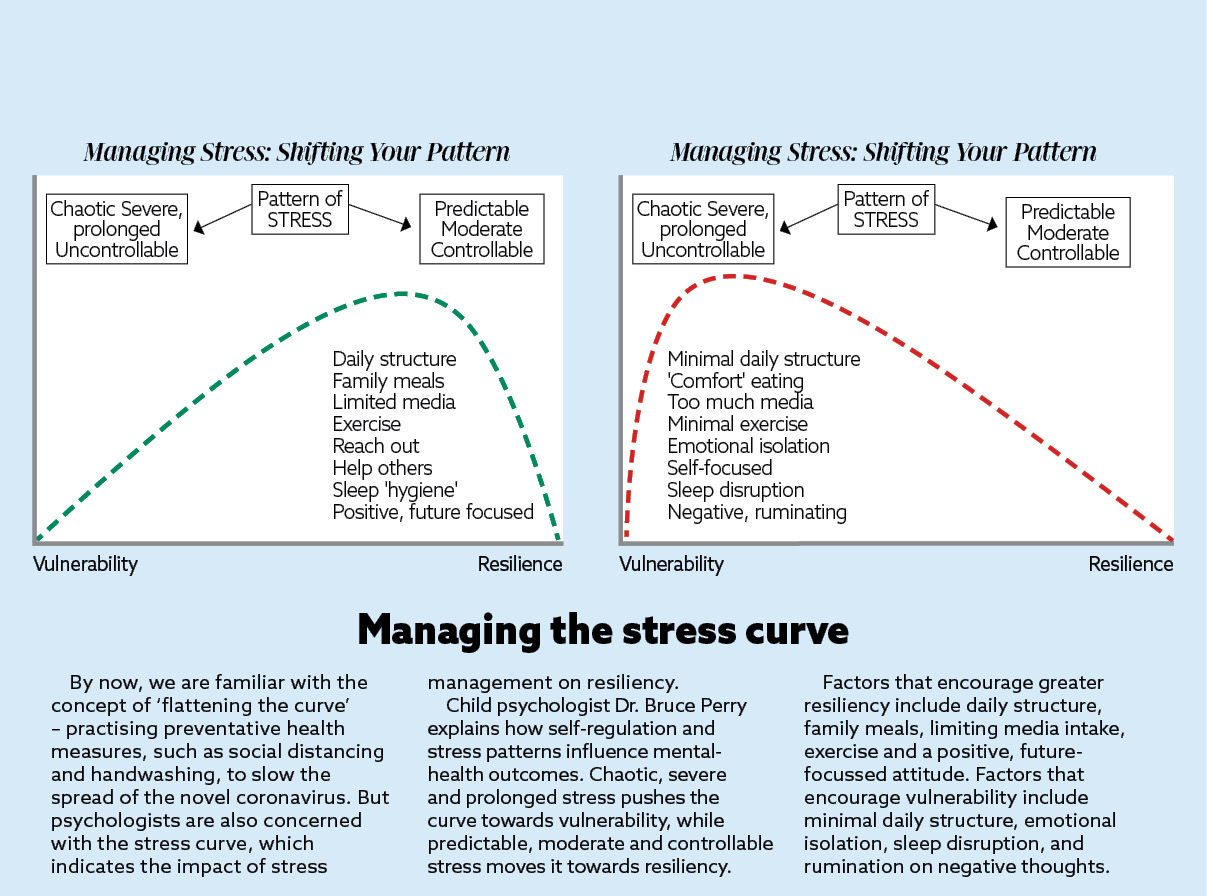
“We dictate where the pattern of stress comes in, whether you shift them into more resilience,” Lam said.
“You modulate their stress level. You create a structure, a predictable environment, and you kind of reassure them that there is an end to this.”
Parents assume the role of framing the situation for their children, Lam explained. In an ideal scenario, that would mean communicating that the situation is controllable, has a level of predictability and will eventually come to an end.
Stress management during a pandemic is no easy task, however, and Lam recognises that parents are facing a difficult job. The crisis has meant unemployment and pay cuts for many families. Paired with the added roles of teacher and 24-hour caregiver, parents are understandably tired.
For Karla Austin, a single parent of a 6-year-old, the lockdown has required her to take on an extensive list of responsibilities with very little support. Austin and her daughter moved to Cayman just six months ago, providing them little time to form friendships or establish a network before the crisis took hold.
“The longer it goes on, it becomes more and more challenging,” Austin said.
“Because, as parents, and then now as a single parent, you’re asked to do so much. Essentially, you are everything now for this child. You are the teacher, you’re the playmate, hair services, the chef.”
Before, if she needed a break, Austin could call a sitter or she could plan an evening out to Camana Bay, where her daughter could play.
Neither of those outlets are available to her anymore.
Even something as simple as making a grocery run has become complicated. While parents have been encouraged to leave children at home during shopping trips, for a single parent that may not be an option.
Austin has discovered that parenting during a pandemic comes with an array of logistical challenges.
“If there’s something that pops up and I may need to step out to the local mini-mart or the gas station, that’s where you’re considering, ‘OK, can I park the car here where I can see her and quickly run inside and get what I need and come back?’” Austin said.
“I have to be more planned now, more scheduled now.”
The complications that come with meeting essential life demands, such as providing food and shelter, have forced schoolwork and other activities onto the back burner for many families.
Michele Ebanks is one of many parents who has assumed the role of substitute teacher, but the feasibility of home schooling, alongside a full-time work schedule, varies widely from day to day. The day’s events rely largely on the mood of her 5- and 9-year-olds, who have grown tired of learning from mom.
“It’s been 11 weeks and you don’t even know what they’re really learning and if they’re really absorbing what you’re teaching them,” Ebanks said. “And we haven’t had communication from the education department. We don’t know how they’re going to integrate these kids back in September.”
The uncertainty of the school situation has made the crisis much more difficult to manage, she explained. With no end in sight, parents are struggling to manage expectations and plan for the coming months.
“It takes everything in your power to get to the end of the day,” Ebanks said.
With summer break just weeks away, she said, parents still don’t know if they’ll be able to send their children to camp, how year-end exams will be handled, or if their children will ascend to the next grade level as planned.
Providing guidance and clear communication, however, could go a long way to improving the mental health of families and the long-term development of children, Lam explained.
While public messaging so far has focussed on health threats and the need to remain vigilant, leadership must also consider the tone of messaging moving forward, she said.
“During this time, the message that we’re sending to our community, to our young people is that in order to protect yourself, you need to wear a mask. You need to keep your distance. Don’t share anything,” she said.
“But we need to really look after our young people and think about the message that we’re going to send after COVID-19.”
Young children’s brains remain malleable, Lam explained, so the messages sent by role models can have an important impact on development. Whether the crisis moves children towards resilience or vulnerability depends on the guidance provided by adults.
“I think as a society, as community leaders, as adults,” Lam said, “we have a responsibility to think about the message that we send to our young people.”
Related Videos