


While various space agencies around the world continue to probe the universe in search of answers to life’s greatest mysteries, Caymanian law student Brittany Cousins has some questions of her own.
Namely: how should other-worldly ambitions be balanced against the need to deal with problems closer to home?
Those questions have since been published by Hong Kong-based daily newspaper South China Morning Post, which has a readership of more than four million globally.
Cousins, 23, is now in her third year at University of Kent in the United Kingdom. Her work was published in the Letters section of the South China Morning Post on 10 Dec., 2020.
“We are talking about public funds of between $250 million to $2.5 billion per launch that is being used to fuel space missions which have a 50 percent failure rate,” Cousins told the Compass.
“Given the current economic climate, where so many businesses have tanked and so many economies have tanked, it begs to ask the question, ‘Does the scientific research outweigh our quality of life on Earth?'”
She had hoped to attend the Hong Kong Baptist University in September 2020 in person, as part of her school’s student exchange programme. However, those hopes were dashed because of COVID-19.
Nonetheless, she signed up for the virtual version of the student exchange programme and then selected a module on engaging public discussion through advanced research and writing.
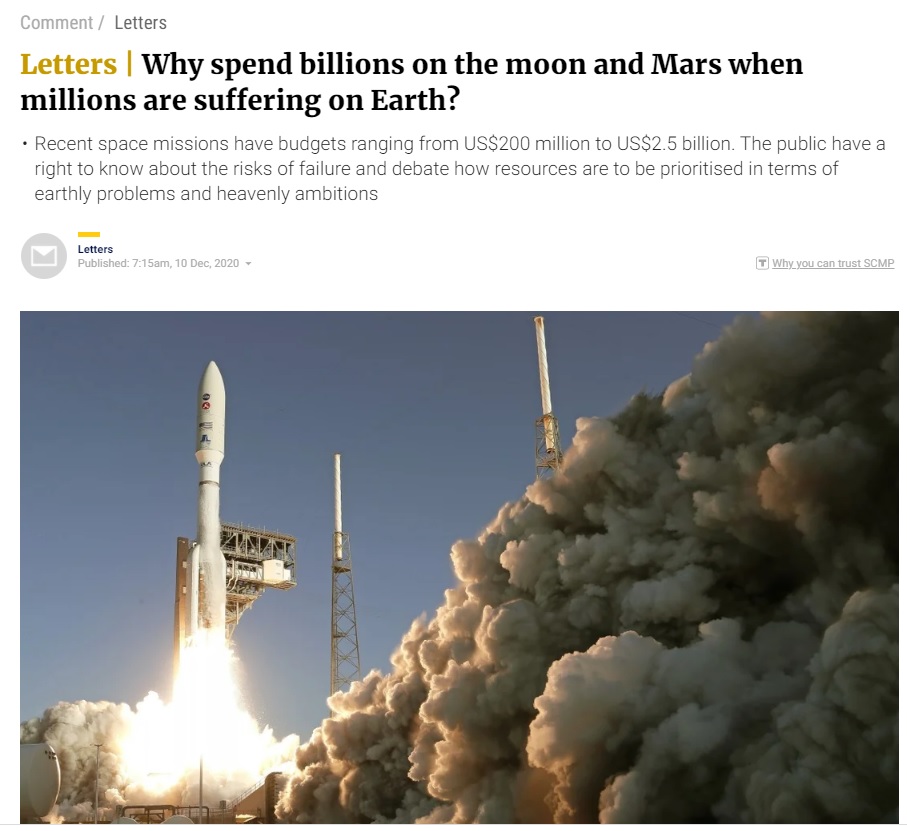
“I saw the topic about space exploration and the kid in me got so excited, because I have always loved astronomy,” she said. “However, I must say that law and rocket science are as far apart from each other as probably the planets themselves.”
After partnering with another exchange student, Cousins began the five-week process of researching the topic and writing the paper.
“We sent questions to all the major space agencies, such as NASA, the ESA (European Space Agency), and China National Space Administration,” said Cousins. “However, none of them replied, and we kind of expected that, but it didn’t deter us; it just prolonged the process.”
Cousins said that, after collating the data from various independent news sources, they looked to tutor Simon H. Wang for guidance.
“He is known for being vocal and critical of China’s actions, especially in the Hong Kong region,” said Cousins. “He told us our paper would be submitted as letters to the paper, but that we should also understand there was no guarantee it would be published.
“I was so excited when I got the news that I was published, because even though I didn’t get to physically go [to Hong Kong], my name was there, and I made my mark.”
In her paper, Cousins delved into the costs surrounding the launch of various space vehicles, but also the public’s right to know about them, and to understand the financial implications that come with each failure.
“Despite the lockdowns, there were numerous launches during 2020, dating up to July,” said Cousins. “Several of those were destined for Mars, even though there is a high failure rate of the rockets even making it through that planet’s atmosphere.
“What we found was that a lot of people look at the launches and think, ‘Oh wow, this is so amazing.’ What they don’t realise is that, as taxpayers, they are the ones paying for it.”
She added, “They should be given a choice on how their money is spent. Should it be chasing answers in the stars or solving problems here on Earth?”
Cousins told the Cayman Compass the experience of being published in Hong Kong is still surreal.
“I’d just like to encourage any young Caymanian who is reading this to not be limited by any labels and to think outside of the box,” she said. “Don’t be afraid to search for the answers, and don’t let anyone put limits on you or what you can do.”
Related Videos







Please check your facts. ” …space missions which have a 50 percent failure rate,” . I don’t think that is correct.