


Iconic Stooges frontman Iggy Pop may not be particularly tall in stature, but when it comes to stage presence, he carries a very big stick. Agile, energetic and mesmerising, he more than proved at a recent concert that he has no plans to go gentle into that good night.
When told I would have the chance to interview Iggy Pop, prior to the ‘Songs and Stories’ event he was headlining at the Harquail Theatre on 12 Feb., I confess I felt I would have my work cut out for me.
I can put my hand on my heart and say I cannot recall Radio Cayman back in the day ever hosting a Punk Hour (perhaps sandwiched between the BBC World News and the birthday requests show?) which might have introduced me to his band’s music at a young age. I’m trying to imagine Loxley Banks announcing the next track as, “And now, from the ‘Raw Power’ album, a bit of ‘Search and Destroy’.”
It doesn’t compute.
As I walked across the parking lot of the building where I was meeting Iggy, notes in hand, I sincerely hoped the advance research I had done would be sufficient not to reveal me as a complete pleb.
Rounding the corner to the outdoor elevator, I nearly crashed into the man himself with his friend and one of the concert organisers, David Wilson.
“Hi, Vicki!” he said, flashing me a killer smile. “I’m Iggy. Nice to meet you.”
Okay, maybe I was going to survive this.
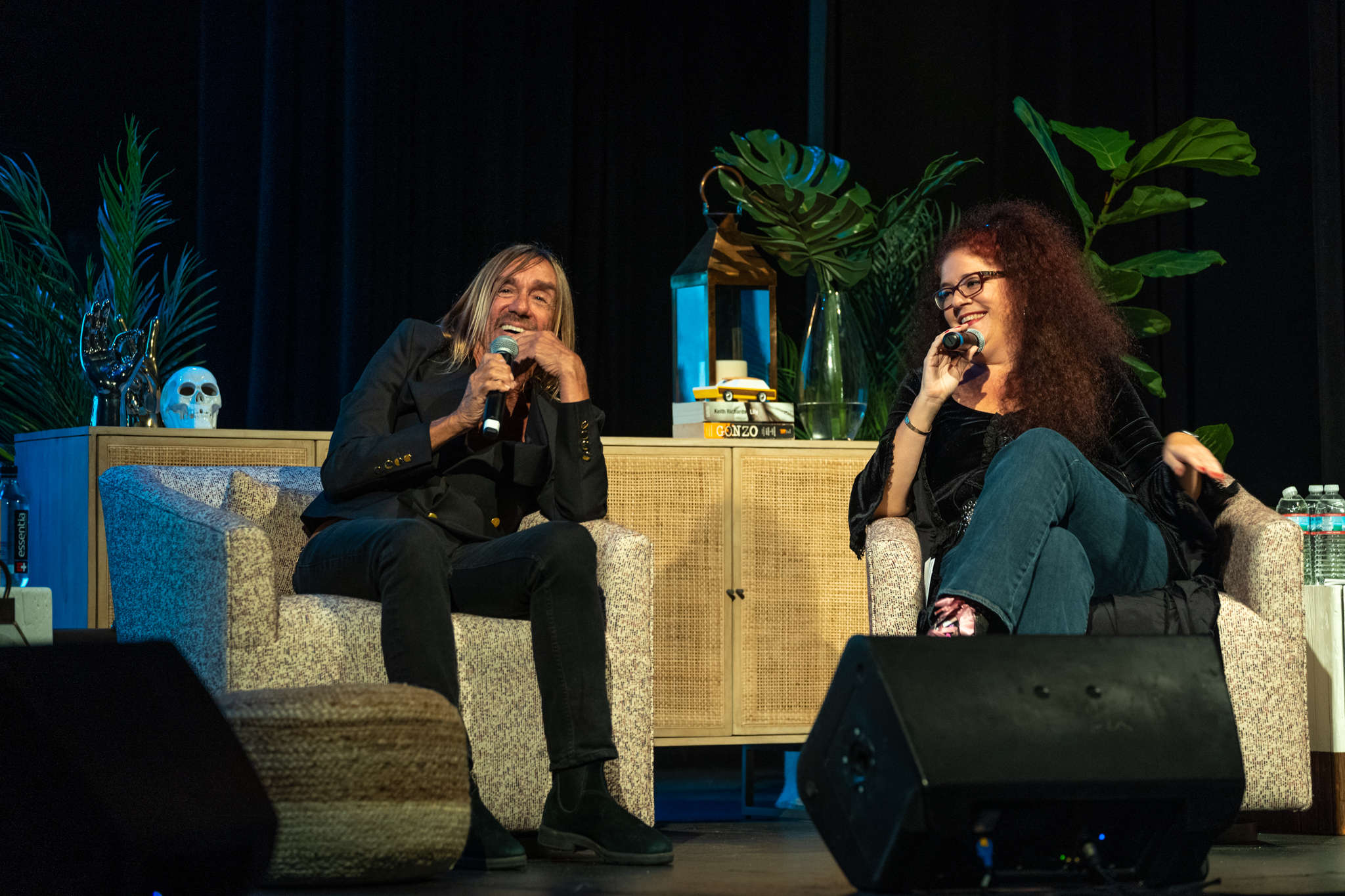
Our interview was to be held in the offices of Inclusion Cayman, the non-profit organisation chosen by Iggy to benefit from the proceeds of ‘Songs and Stories’. He wanted a tour of the place and to hear more about the work Inclusion was doing, before sitting down for a chat with me.
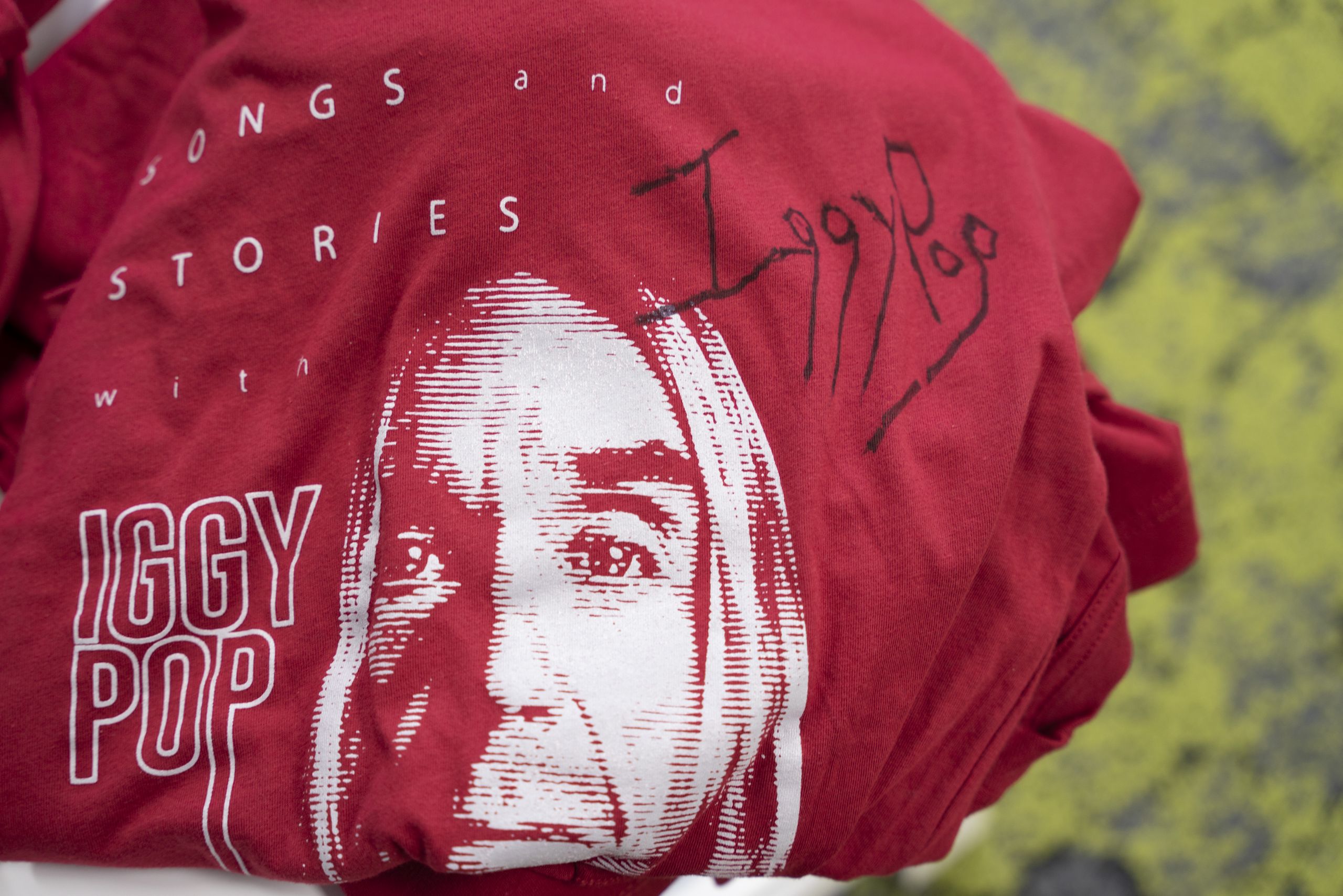
His genuine interest in what the staff had to say, and happy willingness to sign some T-shirts, charmed everyone in the room. It was hard to reconcile this person with the writhing, sometimes-screaming leader of The Stooges band, famous for antics on stage in his early days that included – but were certainly not limited to – throwing peanut butter on the audience and smashing glass on his chest.
Finally, I had his full attention. Time to delve into the questions.
Actually, I’m jumping the gun a bit here, because somehow I managed to talk about me and my family’s early days here for the first seven minutes. When I played back the audio recording in order to write this piece, I was cringing by my phone, willing myself to shut up. However, in my defence, it was only because Iggy was keen to learn more about the past of these islands.
He has had a home here for 15 years, and only wishes he’d known the Cayman of yesteryear.
Early days
Born James Osterberg, Jr., Iggy Pop grew up in Ypsilanti, Michigan, west of Detroit. He spent his childhood years living in a trailer home with his parents, who, according to Iggy, “Lived a good life in good order [and had a] great relationship.”
His interest in music started at a young age with a drum kit. With limited space in the trailer, and perhaps unwilling to have the living room commandeered by their son bashing on drums all day and night, Iggy’s parents gave up their master bedroom to accommodate his interests and they moved into his room.
Transferring to the stage, “began as a seduction”, he explained, referring to the talent show he entered at the age of 14, where he garnered “a lot of nice attention”.
He and some friends started The Iguanas band a year later when they were still in high school, and it wasn’t long before they were making a name for themselves throughout Michigan. Any pub quiz team worth its salt will also know that Osterberg later became known as Iggy due to his connection with The Iguanas.
It wasn’t just the lure of audience adoration that kept the band motivated – there were financial benefits to be reaped as well.
“Every year we were getting work on the weekends and making actual pocket money, where you could buy clothes and a car; things like that,” he said. “We had no expenses; you’re living with your parents… it was great!”
Unsurprisingly, the idea of playing with the band over attending school held great appeal for teenaged Iggy. A future path of further institutionalised education was not one he cared to follow.
His thought process at the time was, “If I was in a band, think of all the free time I’d have, especially on a nice day!”
One of The Iguanas’ band members was from a well-connected business family, and so they managed to procure themselves a full-time gig in a posh resort area of northern Michigan, the summer after they graduated high school. The Iguanas were now the resident band at Club Ponytail.
Named groups such as the Four Tops, Shangri-Las and Crystals, along with artists like Bobby Goldsboro, all went through the area, and Iggy would play drums for them. Although he was loving this life, he felt it was incumbent upon him to go back to his home town and attend university.
He did it for a semester and was miserable.
“I thought I had something… wasn’t sure what,” he said. “I thought I would approach music as a life study and a life work.”
In the manner that most parents would react at the news that their child was ditching university to pursue a dream, Iggy’s father was not keen on his son’s plans.
“[He] was upset because he thought I was throwing my life away, but he let me go,” Iggy said.
The Stooges
After The Iguanas, the next group that Iggy joined was the blues band Prime Movers. He was also now working at a record store, where he started developing his taste in music and tried to figure out how to get ahead as a performer.
“The first thing was to stop being the drummer,” he laughed, realising the key for him was to get out in front. “So, I decided that the best way to do that was I needed guys who knew even less than I did; hence The Stooges.”
He subsequently left the Prime Movers to start a new band.
Brothers Ron and Scott Asheton took the positions of guitar and drums, respectively, with Dave Alexander on bass. This left Iggy free to take his rightful place at the microphone.
With everyone in position, he could not fail, as the alternative was back to university as a mature student or limited job options. Much like the stage dives he would later invent, Iggy was all in.
At the time, the goal was to “get a band, get a following and make a record”, he revealed, “and that was accomplished”.
The Stooges’ first, self-titled album was not terribly well received by critics. The follow-up, ‘Fun House’, was also hardly a commercial success upon first release.
“The Stooges was not at the top of anybody’s playlist,” Iggy laughed. But a cult following for the band’s music and their infamous shows was growing, the latter largely due to the lead singer’s go-for-broke approach to performing. Nothing was off the table, and as he said himself – with a chuckle – at the 12 Feb. Harquail event, the band got a reputation for being “unpredictable”.
They experimented with a range of different ‘instruments’ in their recordings – everything from swords and oil drums to blenders and vacuum cleaners had their moments in the spotlight.
Although The Stooges may have been considered an acquired taste in the ‘60s and ‘70s, years down the line they finally got the larger recognition they deserved for their groundbreaking work.
In 2004, Rolling Stone ranked them 78th on their list of 100 greatest artists of all time, and in 2010, The Stooges was inducted into the Rock and Roll Hall of Fame.




Flying solo
A few years after the band broke up in 1974 (they later reformed in 2003), Iggy launched his solo career, now as Iggy Pop.
A close friend of The Stooges was named Jim Pop. Iggy thought the last name was “cool”, and so decided to acquire it.
“I had the Iggy – I couldn’t get rid of that, it was stuck on me – so I thought, ‘Well, jazz it up with Pop’ [laughs].”
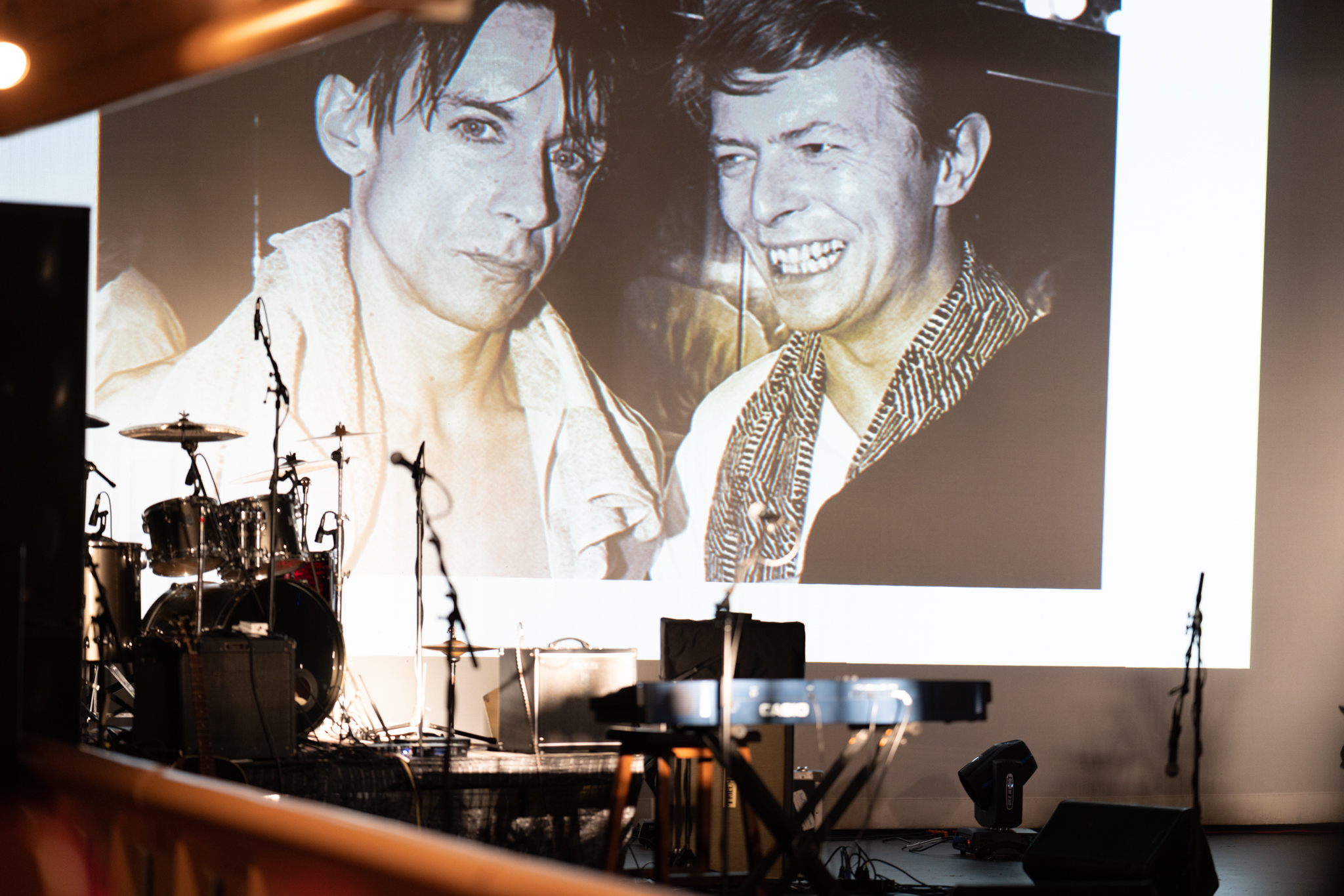
Around this time, he began collaborating with David Bowie, who, among other things, produced Iggy’s first two solo albums, ‘The Idiot’ and ‘Lust for Life’ (for which Bowie came up with the name of the title track and the chord progressions on a ukulele).
The two wrote many songs together, including Iggy’s ‘Funtime’ number and ‘China Girl’, which he originally released on ‘The Idiot’, but garnered greater attention when Bowie re-recorded it for the 1983 ‘Let’s Dance’ album. Bowie’s version made the top 10 in the UK and US markets.
Iggy has often stated that Bowie resurrected his career.
Future collaborations with other artists followed. His song ‘Candy’ – a duet with Kate Pierson of the B-52s – was his biggest mainstream hit, peaking at 28th position on the US Billboard Hot 100 in 1990.
When asked whether he prefers to work with others or go it alone, he’s his refreshingly honest self.
“If I had the entire stroke of genius, then I’d probably want to do it all myself,” he laughed, adding that he is very proud of the songs he did alone, but that his best work has all been from collaborations.
His most recent solo album, ‘Free’, was released in September 2019. He subsequently performed tracks from it at the Barbican in London to rave reviews, headlining the night of 21 Nov. as part of the London Jazz Festival.
To quote The Telegraph: “As band and performer loosened up, it turned into just about the rawest, rockiest and least polite jazz concert ever… The music sounded great, his voice sounded great, and Pop’s charisma expanded to fill the room.”
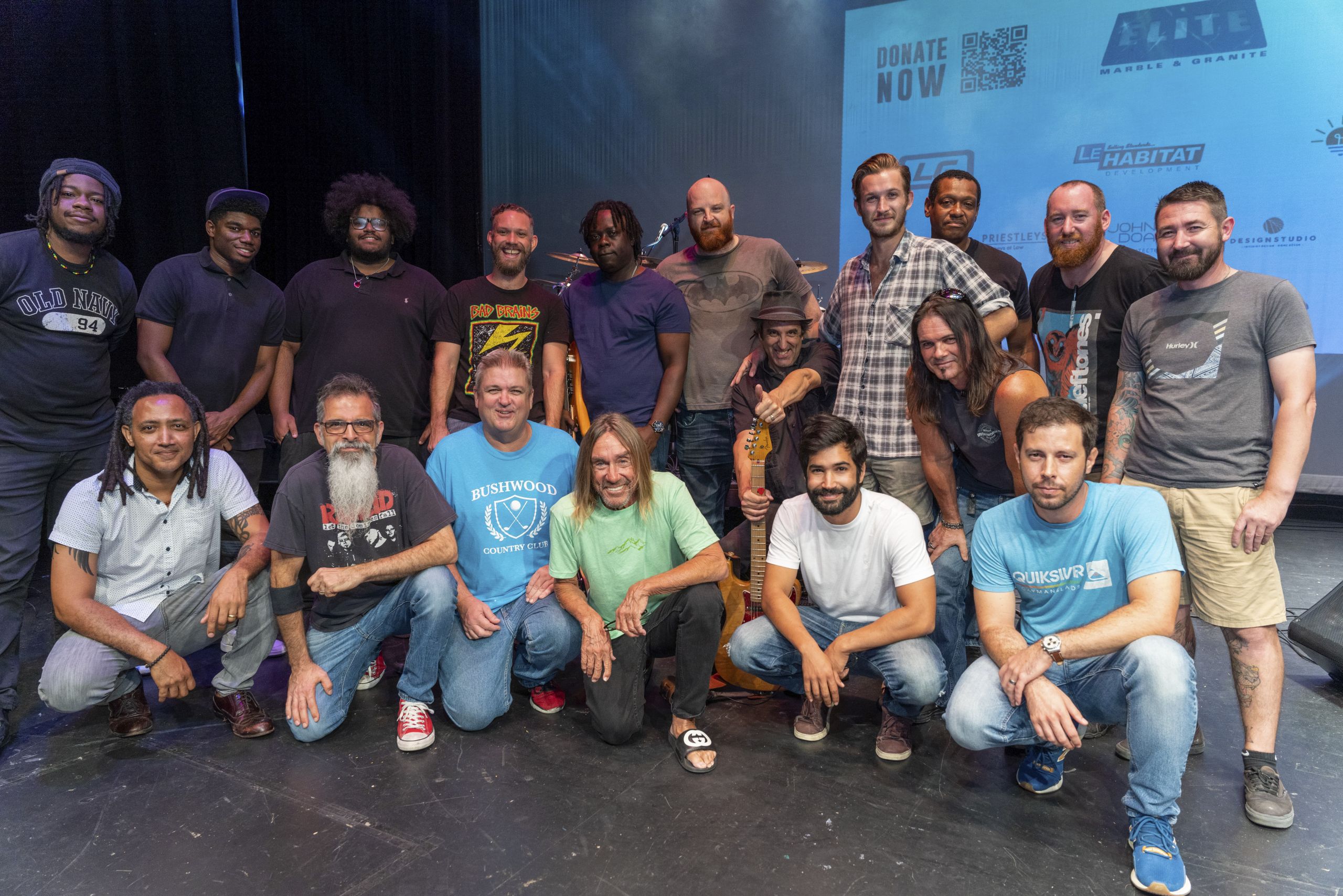
That sentiment was echoed when Iggy took to the stage here in Cayman on 12 Feb., his first live performance since the Barbican.
There were no plans for him to sing on the night – I would be interviewing him on stage about his songs being played by local bands Clever Knots, Kuhyah, Sugardaddi and Suckerbox. No promises beyond that.
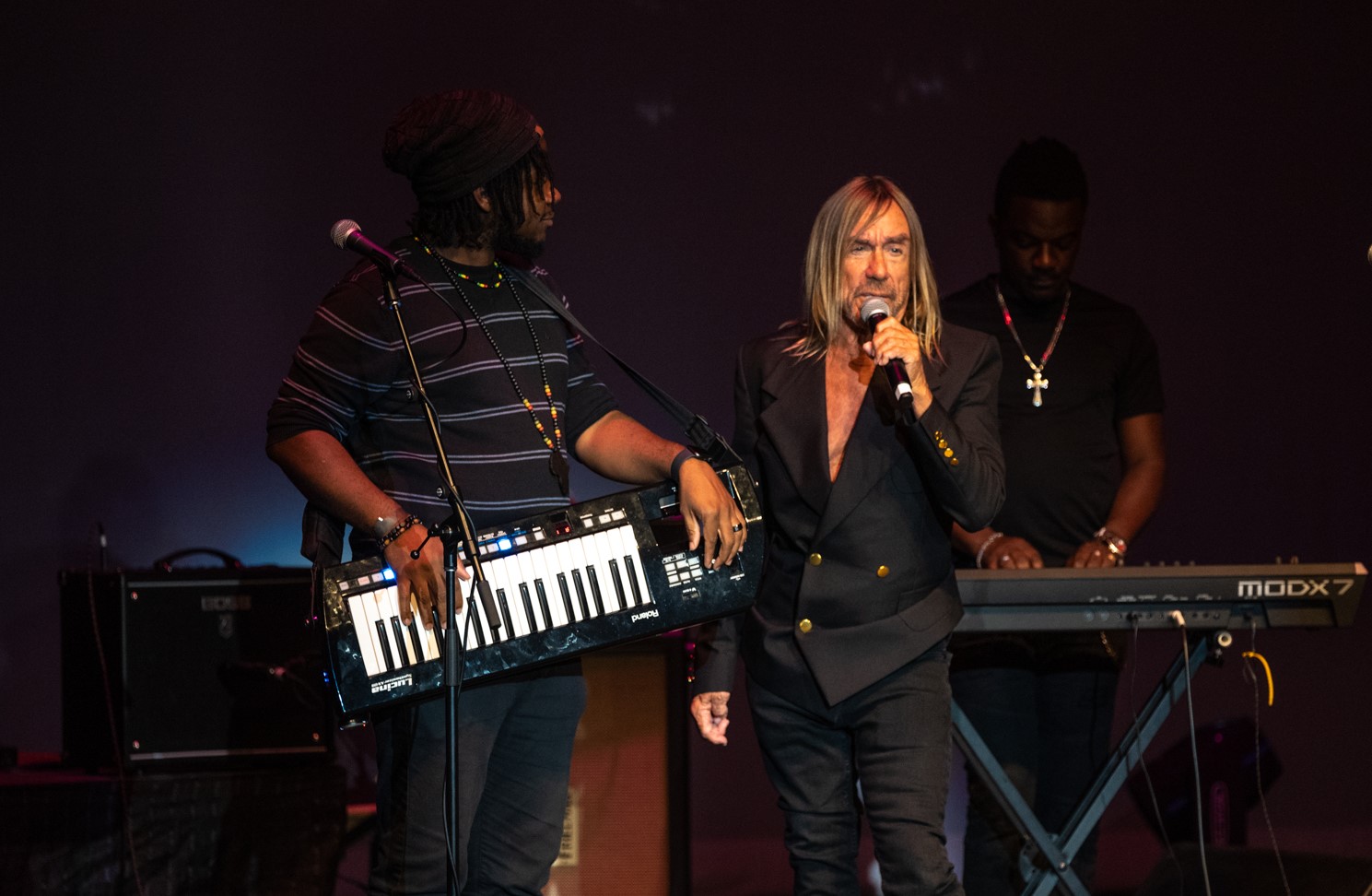
Yet, to watch him interacting with the musicians and unable to sit still from the first beat, it was clear that taking a back seat just isn’t in his DNA.
Sure enough, about two songs in, he was up and taking command of the microphone, much to the delight of fans who leapt to their feet and cheered for the Godfather of Punk.
The bands were understandably in Seventh Heaven, particularly as he insisted on introducing each act and naming individual musicians.
For the rest of the evening, he prowled the stage like an apex predator, never letting the energy drop. It was a wild ride that no one wanted to end.
Retirement? Nah…
Perhaps learning lessons from his parents, who never had much money but were happy, he admitted with a laugh that he’s “never been one of those people who seriously wants to be rich”, so clearly it is the love of performing that drives him. But he has definite feelings about that, too.
“Stage work I would do as long as I’m not embarrassed about it; as long as I feel it’s good,” he said. “There are days already that I wish I was retired, but I think it would be really bad for my mental health.”
He makes sure he gets in a lot of rest these days. “The line I like to use is ‘[As an] older performer, you have a duty to resemble yourself’. That’s kinda what I try to do.”
No matter what, Iggy will probably keep his hand in, even if the method of delivery changes. He already hosts 40 shows a year of ‘Iggy Confidential’ on BBC Radio 6 Music, which he describes as a “kind of performance”, where he is required to talk, but it’s not as intense as stage work.
Based on what we witnessed that night at the Harquail Theatre, the man resembles himself just fine.
Long may the Godfather reign.
Related Videos













Unfortunately , I was unable to attend….couldn’t get tickets 😕 is there a recording of the event…would really enjoy seeing it.
Simply amazed at the title. Had to look again. And it is still there, along with a picture of a very short man. Truly disturbing! 😄 (btw, William Burroughs was 7 feet tall when wearing heels).