
As Cayman’s Freedom of Information Act marked its 10th anniversary in 2020, the jurisdiction also hit a significant milestone, that of the lowest number of requests since the legislation’s implementation.
The decline in requests has been attributed to the COVID-19 pandemic, with which Cayman, like the rest of the world, continues to grapple.
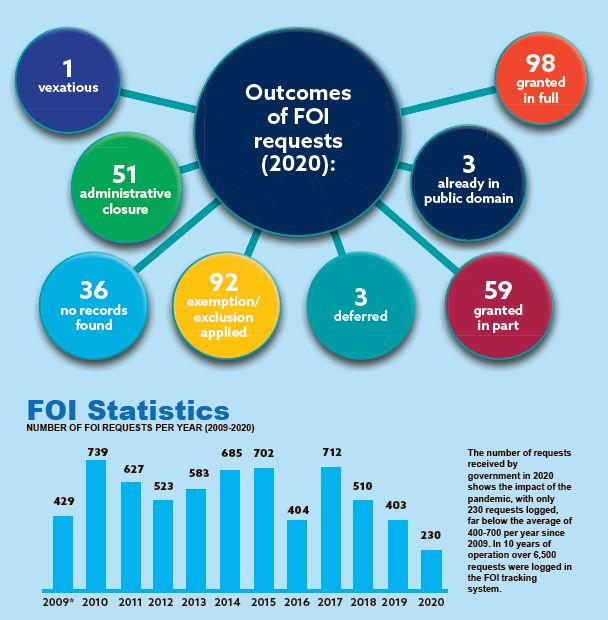
Ombudsman Sandy Hermiston, in her message for International Right to Know Day on 28 Sept., said 230 FOI requests were made last year, of which 61% were disclosed in full or in part. In 2019, a total of 403 requests were received.
According to the Ombudsman’s Office statistical report, last year’s numbers were “far below the average of 400-700 per year since 2009. In ten years of operation over 6,500 requests were logged in the FOI tracking system.”
Government, Hermiston said, has disclosed public information in roughly half of those cases.
“As time has gone on, we believe more and more government agencies are making information available to the public proactively, reducing the need for FOI requests. This was one of the original goals set out in enacting right-to-know legislation more than a decade ago,” she said.
Last year, the Workforce Opportunities and Residency Cayman department received 52 requests, the highest for 2020, followed by the Royal Cayman Islands Police Service with 33 requests and the Ministry of Education, Youth, Sports, Agriculture and Lands with 10.
Deputy Ombudsman Jan Liebaers, in the international ‘Right To Know Day’ statement, said,
“Request handling times have remained stable since last year, but many previous years saw quicker responses from the government.”
In 2020, the average time cases stayed open remained stable at 30 days. About 46% of FOI requests took longer than 30 days, compared to only 37% in 2017.
“We are looking forward to improvements being made to the government’s FOI tracking system, which should give us more specific data next year,” he added.
The government’s FOI tracking system, which was upgraded in early 2021, keeps tabs on when cases are closed. This includes many cases with legitimately extended timelines, or those that were internally reviewed or appealed.
The FOI Act requires public authorities to give their initial decision on an FOI request “as soon as practicable” but not later than 30 calendar days after receiving it. Making an FOI request does not guarantee that the records sought will be disclosed if they fall under one of the act’s exemptions.
In just under 40% of requests made last year, exemptions were claimed, or another reason was applied, to deny access.
As for the information released in 2020, 98 requests were granted in full, 59 in part and 92 had exemptions/exclusions applied. In 36 requests, no records were found.
Related Videos