

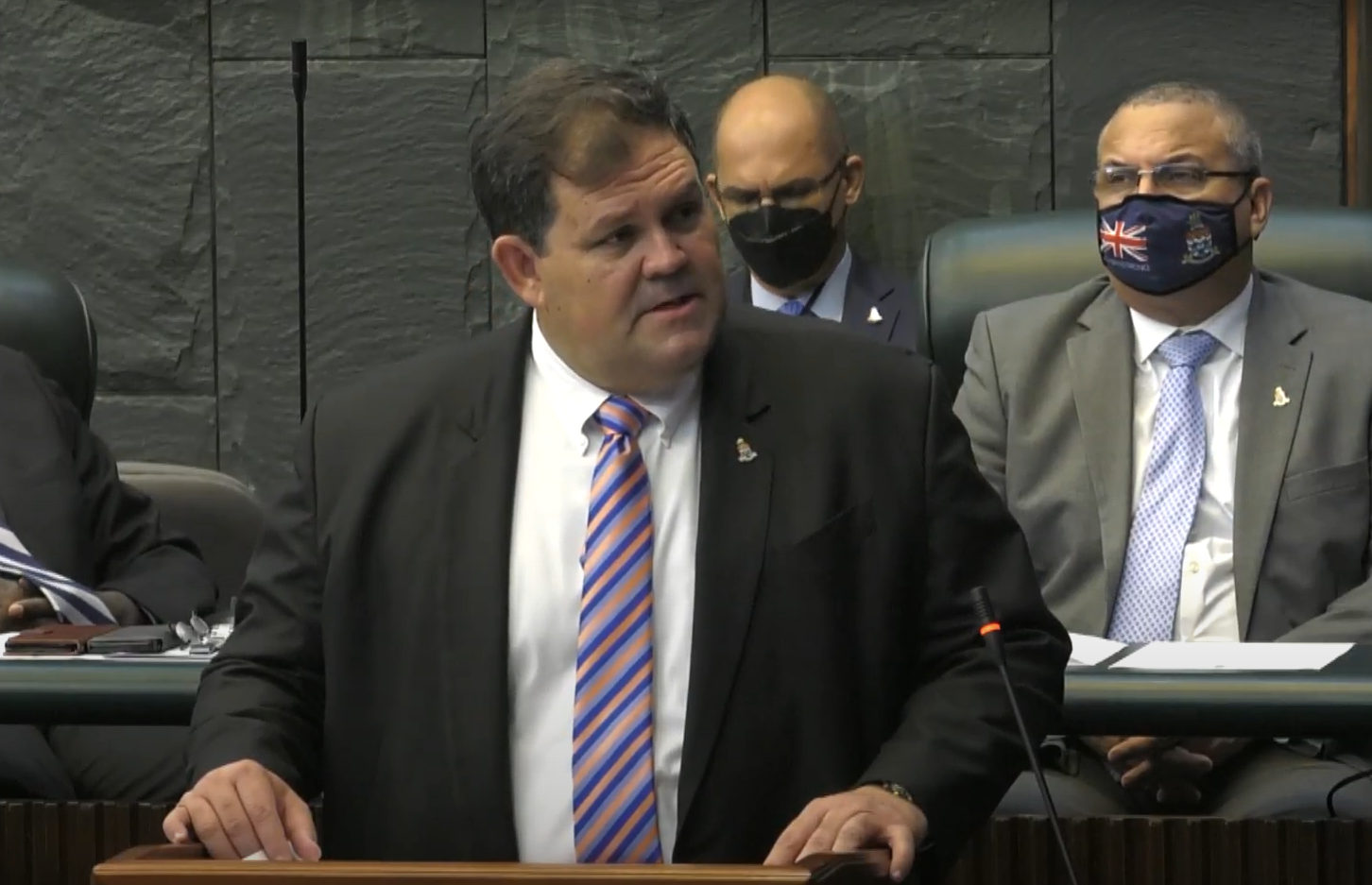
In his budget address on Friday, Premier Wayne Panton painted a picture of economic marginalisation of a Caymanian middle class which “is under assault”.
In order to “tackle socially-corrosive issues like inequality and wealth disparity” head on, Cayman would need to institute policies to protect the middle class from disappearing and create an economy that is distributive in nature, he said.
Panton used much of his almost two-and-a-half-hour address to outline how Cayman had moved away from the success story it once was, and how the pandemic had uncovered the social ills that were all too often hidden under economic and prosperity statistics that only benefitted the few.
The premier said the priorities and projects contained in the two-year budget reflected “the clear statement of change” that people had voted for in April.
He said his government’s vision is for Cayman to be held up as one of the most sustainable countries in the world, in which all citizens can thrive, noting that “prosperity without sustainability is not an option”.
He said his government was determined to prepare and assist Caymanians to avail themselves of the opportunities to live their best lives and allow future generations to have the same opportunities.
Misleading statistics
Panton sketched the success story that Cayman had presented to the world until the pandemic, as a strong economy with a low unemployment rate, low debt, a world-leading financial services industry, strong real estate industry, record-setting tourism industry and vibrant employment market.
But this idealistic picture of Cayman “brimming with confidence and optimism and enjoying an economic miracle”, Panton said, did not stand up to closer scrutiny.
Regular topics of conversation within the community questioned whether Cayman was going into the right direction, who it is developing for and who benefitted from this prosperity.
“Even those who are doing well expressed concerns, not just about their own offspring but about the general condition of our community.”
The premier said too many people were facing a growing crisis, could not cope and were left behind.
Equal access for Caymanians to a high quality of life was no longer guaranteed.
Hard-working business owners and employees were finding themselves only one medical bill or paycheque away from financial ruin.
Housing and land prices had soared out of reach for most Caymanians.
Caymanian university graduates were finding no jobs or future for themselves, “despite 22,000 work permits”.
“Countless numbers of Caymanians” were locked out of opportunities for economic prosperity and entrepreneurship, he said, citing as one example an “alarming number of waivers under the Local Companies Control Act and uncompetitive concessions to large-scale developers”, which had seemingly become the norm.
And many Caymanians had decided to move overseas because they could no longer afford to live on island.
“Against this backdrop, the COVID-19 pandemic hit us like a Category 5 hurricane and ripped off our roof, laying bare the dramatic inequalities hidden underneath the impressive statistics of record-breaking economic growth and opulent prosperity.”
Panton added: “At a time when the investments were pouring in, we opted to exclude Caymanians. For too long, we have been satisfied with the measures that inflate the success of the few.”
This meant that “socially-corrosive issues and wealth disparity” had to be tackled head on.
Impossible to outgrow inequality
Implementing policies to assist and protect the middle class, which he described as “under assault”, while continuing to encourage investment were key, Panton said.
Lasting growth and shared prosperity would come from the middle, not trickle down from the top.
“We intend to preserve a middle class, because we believe it is better for sustainability,” he said.
Cayman needed to become a country that balances the needs of society, the economy and the environment.
Panton said Cayman was small and resourceful enough to avoid a future characterised by extreme inequality, adding that his government was committed to making a meaningful and measurable difference by 2030.
But waiting for economic growth to reduce inequality would not work, because Cayman already had staggering growth, boasting an annual government budget of almost $1 billion.
Instead, Cayman would need to create an “economy that is distributive by design”.
“Economic growth alone is not the solution. It isn’t working for our people, not when a two-bedroom apartment costs upwards of $400,000 today. How many people making $3,000 a month can afford that?” he asked.
“We believe it is our duty to prepare our people to participate in, and benefit from, the prosperity all around them.”
The Caymanian success story should not become an exception or be relegated to history; and access to opportunities and being prepared to succeed had to be the norm for Caymanians, Panton said, adding, “Inequality threatens that norm.”
Related Videos








A very well-written article citing many components of Premier Panton’s speech.
I would suggest that the Premier actually take action to resolve many of the issues he had brought up. By taking action, I mean actually determining how other island nations have addressed the issues he brings up, and after reviewing their success (or failure) convene a panel of major world business leaders to develop a plan to bring Cayman into the 21st century.
In my humble opinion, I would suggest Cayman focus on small, environmentally neutral industries to provide manufacturing jobs for the average Caymanian. The proper training and responsible supervision of those Caymanians with their honest and self-starting personalities can easily succeed. Become millionaire fund managers? Perhaps not, but an honest day’s work for a fair and honest day’s pay can work wonders.
Finally, I would suggest government activities aimed at attracting international industries offering more than low-level menial jobs be carried out IN THE SUNSHINE. Only when the government demonstrates it exists first to protect all its people and corporate communities and then provides opportunities, education, and moral leadership to ensure success and prosperity for all, not just the chosen elite few.
Thank you for reading my comments, and best wishes for a Blessed Holiday Season.
Absolutely right Bob. A tourist can come to Cayman and never meet a single Caymanian except perhaps a taxi driver or immigration officer. This is because very few Caymanians work in our hotels and restaurants. Why is this?
I remember 40 years ago there were plenty of Caymanians working at the old Holiday Inn and other resorts.
Unfortunately a local law student can’t expect to graduate from UCCI and get a top job in a local law firm competing with someone with a law degree from Oxford. The government should do more to fund scholarships for our students to study overseas.
The problems caused by COVID were exacerbated by poor choices (from both parties) who kept this economy closed too long. We are now paying for that as the planes with money go elsewhere.
https://www.youtube.com/watch?v=0cAtvkjWRQU
Every failed government before us, in the history of the World, has instituted policies that are “distributive in nature”. It would be a shame to watch This government take down the work of the 10 before it by playing Jenga with the Cayman economic miracle.
It is not the fault of the successful that home prices have increased in Cayman. It’s a factor of the increased costs of raw materials, labor and land. Nor does a millionaire moving to 7 mile beach hurt a home buyer in Prospect, George Town or West Bay.
I have Caymanian friends who grew up here with no electricity and who did their homework by candlelight. Yet who today has no electricity?
In those days there were few jobs for the men, who went overseas to work, while the women bought up the children.
When I moved here 40 years ago international phone calls cost $3 per minute. Equal to $10 per minute in today’s money. Now almost everyone has internet and cell phones.
Despite what Premier Panton is saying we are far more prosperous as a nation than ever before.
I agree that too many concessions have been given to big developers but not to small ones. Why are there massive duty concessions to the developers of multi-million dollar condos but not to, for example, the developer of Downtown Reach, which is priced for local home buyers?
Socialism has never worked. It was the attack on expats in Bermuda that collapsed their economy, driving the growth of Cayman. Be very careful what you wish for. You might not like the results.
This is exactly right and completely spot on… When I got here 20 years ago ADSL dial up was $500 a month and nobody had it.. my monthly phone bills were $6000 CI as I was running an overseas business.
.. vilifying low-wage permit holders and making it difficult for businesses to hire, does not put more Caymanians in those roles. It just makes it more challenging for businesses to drive the economy forward by dealing with immigration who work against them. I’ve always been able to hire about 30-40% Caymanians for my operating businesses but there is a genuine shortage of all workers here. Government must know this. They should be focusing on growing the pie by helping business with expedited permitting- not working against the private sector and forcing the round peg in the square hole. The more permit holders the more Caymanian success. The last 20 years have proven that much