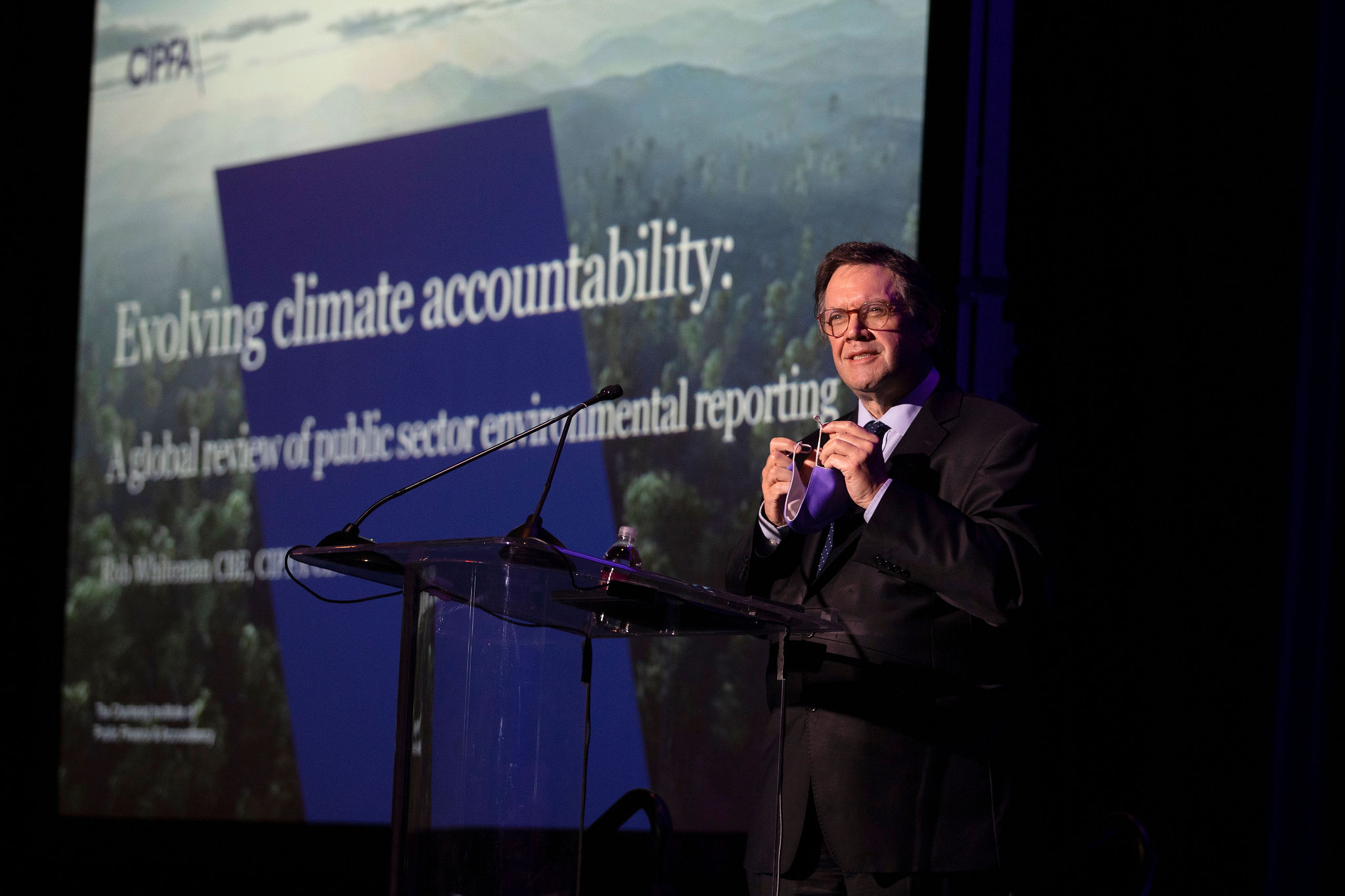
Combatting climate change, the importance of public sector accountability and evolving digital assets were the main topics at the Cayman Islands Institute of Professional Accountants’ annual summit held at the Kimpton Seafire Resort on 9 Dec.
Capital markets and the environment
“The inconveniences that we have suffered in the last year-and-a-half because of COVID are just a very easy dress rehearsal for the much bigger show that will be the disruption caused to the global economy by climate change,” said Rob Whiteman, chief executive officer of the Chartered Institute of Public Finance and Accountability.
“I do think if we’re going to stem the temperature rise and try and hold it back to one-and-a-half degrees, actually the profession and accountancy will play an absolutely vital role – as indeed will the capital markets – for the type of investment in technology that is needed.”
A session featuring KPMG’s Anthony Cowell, Jodie McTaggart and Staci Scott examined the results of interviews with 90 endowments and pension plans with nearly US$35 trillion of assets under management, which concluded that the capital markets can play an important role in the transition to a low-carbon emitting world.
“We really do have a once in a generational opportunity now to embed sustainability and ESG (Environmental, Social and Governance) into all of our financial service frameworks, into everything that we do,” Cowell said. “We’re seeing at KPMG a massive reallocation of capital towards ESG in the capital markets and Cayman can really be at the forefront and lead this to really build a better world.”
Lashonda Powell, policy advisor in the ministry of financial services, indicated at the event that a legislative ESG framework specifically for Cayman investment funds is in the works, with policy consultation to commence next year.
Financial services future
Financial Services Minister André Ebanks addressed attendees via video on the future of financial services in the Cayman Islands.
“Our vision is for the financial services industry and the Cayman Islands to be viewed as a globally respected financial services centre of excellence,” Ebanks said. “And our mission, in order to achieve that, is to improve our platform continuously so it is competitive, transparent and provides compliant financial services.”
This will require the refinement of existing products and services while continuing to innovate and create new products.
Although the Cayman Islands was still regarded in some quarters “as a problem”, he said, “we seek to change hearts and minds to be seen as a global partner.”
Virtual assets rules designed to build trust
With much of the event’s other discussions revolving around blockchain, crypto currency and the way Cayman’s accountancy and financial services professionals interact with digital assets, Petri Basson of Hash Consulting and PwC’s and Isabel Gumeyi discussed the latest trends in crypto and digital currencies, while the ministry of financial services outlined its view of virtual assets.
“The retail public has become accustomed to a stable and reliable financial infrastructure and can sometimes assume that the new crypto services that are being offered have that same safety,” said Samuel Jacques-Clothier, senior policy advisor in the Financial Services Ministry. “So we have a responsibility on both the commercial and regulatory sides to act in a way that safeguards the public and prevents misuse and deceptive practices.”
Cayman’s Virtual Asset Service Providers Act, passed in May 2020, brought in new standards. The first phase of implementation started earlier this year but the second phase, which will require companies in the space to be licensed, has yet to commence.
These standards were primarily focused on anti-money laundering and countering financing terrorists, Jacques-Clothier conceded, but the primary focus of the legislation was to build trust.
Going forward, interacting with a Cayman Islands-registered VASP means that the company has fundamental cybersecurity standards, does not have known criminals in its management team and that there is more transparency and accountability for disclosures and sources of funds, he said.
Because virtual assets can become an influential part of financial services, Jacques-Clothier said, “That’s why it’s critical that we as a jurisdiction, put a strong foundation that incubates trust today to make sure that users of financial services are protected tomorrow.”
More than 100 people attended the conference either in person or online.
Related Videos