Steve Gittings has been on a mission to help rid local waters of lionfish, designing innovative traps to capture the invasive species which threatens fish populations on reefs in the Caribbean and Atlantic.
Gittings is chief scientist at the US National Oceanic and Atmospheric Administration’s Office of National Marine Sanctuaries. His most recent ‘purse’ trap, which was patented in the US this year, is currently being tested by fishermen off the coast of Florida to determine if they can use it commercially to bolster their livelihoods by selling the fish, while reducing the population of the animals at the same time.
Much of Gitting’s early design work was done on Little Cayman, where he has been involved in the annual Nassau grouper aggregation project, known as ‘Grouper Moon’, he told the Compass in a recent interview. Gittings is a member of the board of Little Cayman’s Central Caribbean Marine Institute.
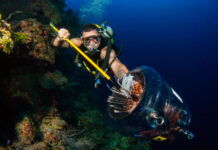
“In shallower water, where it’s 100-120 feet deep, scuba divers can get the lionfish,” Gittings said. “In deeper water, where there are lots of lionfish, they really could get out of hand, and have a lot of impact on commercially important species, if they were allowed to.”
Avoiding bycatch
For him, he said, “the trick was to come up with a trap that worked in deep water and not catch other fish, so there’d be no ‘ghost-fishing’.”
One of the biggest problems with any trap is the risk that it will ensnare creatures other than those it’s intended for. In the case of lionfish traps, there are concerns that other fish species, or larger animals, such as turtles, could get caught instead.
“With this trap, what we wanted was to contain lionfish until the moment they were going to be pulled up, with minimum entrapment of other fish, turtles or marine animals,” Gittings explained.
Luckily, he said, lionfish have a specific behaviour that makes their capture easier than many other marine creatures.
Divers who have hunted lionfish can describe how they can get extremely close to a lionfish and it won’t react until it is speared – or until the diver misses and the lionfish shoots off at high speed into a crevice.
“They have a behaviour that makes them attracted to something and staying there and being real docile, which makes them easy to kill,” Gittings said. “Other fish scramble, but with the lionfish trap, I was able to use this natural attraction to objects that they have.”
The ‘Gittings Trap’ involves a round hinged hoop – like a hulahoop that can fold in half – to which a big flat net is attached, and plastic mesh, like a trellis fence. Once the trap hits the seabed, after being lowered from the surface, it opens up, with the net flat at the bottom, and the plastic lattice structure standing upright. Lionfish are attracted to the upright section, perhaps mistaking it for a part of a reef.
“The fish come there and just hang around,” Gittings said.
The trap is attached to a line that goes to the surface, so the people in the boat can close the trap as they pull it up “like a clamshell closing… and the fish can’t get out”.
There’s a knack to dropping the trap in the water, and removing it, Gittings said. “The fishermen need to drop the trap vertically so it opens once it hits and doesn’t drag. You can’t bring it up at a steep angle. The fish aren’t trapped until the moment it closes. It’s vulnerable to fish escape if not pulled up properly.”
The trap has undergone extensive testing already, and it had been hoped it would be already be in use for commercial fishermen at this stage, but COVID delayed this.
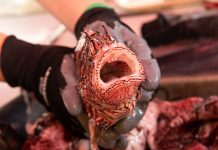
As well as selling the lionfish for their meat, the fishermen may also have an option of selling the fish for secondary markets, such as for items like jewellery made from the spines and fins of the fish, and leather from their skin.
How the trap works
- Once deployed from a boat on the surface, the trap drops to the ocean floor and lies open
- A piece of plastic lattice fencing stands upright in the middle of the open trap.
- Netting, attached to a hinged circular metal frame, lies flat beneath the trellis fencing.
- Lionfish gather near the plastic fencing, which resembles a reef.
- When the trap is brought up, the hinges close, trapping the lionfish inside.
- The trap is pulled to the surface.
Related Videos