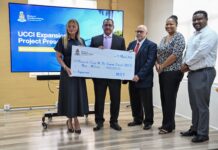
The University College of the Cayman Islands is inviting 50 unemployed or underemployed Caymanians to sign up this month for free full-time courses and internships in four sustainable trades.
Funded by a European Union grant of €432,000 (CI$405,000), the year-long training is due to begin in early July, with registration currently under way.
Places for eligible candidates ages 18 to 45 are available in four sectors – sustainable construction, renewable energy, information communication technology and tourism – in the year-long course, which will include placements in three-month paid internships.
Partnerships

UCCI is working with the government’s labour agency WORC and the Chamber of Commerce, as well as with other partners, to determine what kind of training is needed, and to try to ensure that, once participants complete the course, they can find employment in their relevant fields, project officer Cleveland Julien told the Cayman Compass.
“Collaboration is key to this,” Julien said.
He said there are three important elements to the process – to ensure the training is relevant; internships; and mentors.
“We’ve asked ourselves, can we provide timely, relevant, in-demand training? … We are carrying out a labour market assessment with the help of WORC, and a consultant we have hired, as well as the Chamber of Commerce,” Julien said. “The entire purpose here is really to inform ourselves on where the gaps are, what is needed and what is the developmental path for the students as it relates to these four sectors.
“The second piece is really the internships. When they finish with this programme, the goal then is to get the students in an internship opportunity that will last at least three months. Once again, that’s where we’ll be pulling back in the collaborative partners. WORC will come back in play here again and we will be looking at existing internship programmes that they have, specifically ones that incentivise employees.”
Every student in the programme and every employer listed for potential internships will be required to register with WORC, Julien said, adding, “The hope here is that we can do one-on-one matching.”
While the programme itself does not provide for a paid internship, he said, “employers are willing to compensate”.
In an approach he describes as a “reverse carrot”, he said, “What we are trying to do is set up a scenario where we can say to students, ‘At the beginning of this programme, you’re going to be eligible for X sum of money at the successful completion of your internship. You’re going to have an opportunity within this period of time to move between three internships… However, to quality for it, you have to spend a minimum of X amount of time in your internship.”
For example, in a company that pays weekly, bi-weekly or monthly for the internship, if the intern fails to show up or does not put in the required hours or effort, then that intern would not receive the full sum, Julien said. “So, to be eligible for this sum… you will have had to check the boxes successfully on having completed certain requirements.”
Ultimately, once the training is over, the goal is to place the trainees in jobs that will suit their skills and needs, he said.
“Social support is important, and so that’s where we get to the third piece of it, which is partnerships with networks, mentors and organisational mentors,” Julien said.
He explained that the programme was liaising with groups such as Michael Myles’s Inspire Cayman Training and the Sunrise Adult Training Centre, as well as some churches, to both get recommendations for who would be interested in joining the courses and to act as mentors to those who do.
Julien said, following talks with the Prison Service, the courses and training would also be open to newly-released prisoners who were trying to find a trade.
UCCI is looking to keep the programme gender balanced, with all four of the courses, including construction which has traditionally been a male-dominated industry, having a relatively equal number of male and female students.
There will be places for 15 students in the Solar Photovoltaic Technology and Systems course; 10 students in the ICT course; 15 in the Sustainable Building Technology (Construction) course; and 10 in the Tourism/Hospitality Management course.
As part of the Solar Photovoltaic Technology and Systems course, which will be led by GreenTech, the students will be involved in developing a solar project on campus that will be used to power the university’s water heating system. “There is an actual, real-life deliverable that we are aiming for,” Julien said.
“This becomes now the place where, as an institution in government, we are beginning to make investments in growing our knowledge and competency around this area, and hopefully partner with other government agencies to do similar work with them,” he added.
For example, he said, he’d had a conversation with the Prison Service that, if the UCCI solar project is successful, perhaps it could be repeated in the prisons, with former inmates working on providing solar power there.
“Certainly, if the prison provides us with employees, we’d love to be able to send the employees back to the prisons to work,” he said. “This is such a great project.”
Funding
The grant funding the training comes from the Caribbean Overseas Countries and Territories Resilience, Sustainable Energy and Marine Biodiversity Programme, known as RESEMBID, which is injecting $12.7 million to support sustainable human development efforts and to address the impact of COVID in 12 Caribbean overseas countries and territories, including Cayman.
RESEMBID Programme Director Fabian McKinnon, in a press release announcing the funding for UCCI, said, “One of the areas RESEMBID is most proud to support is the sustainable development and upskilling of the people of this unique, beautiful region. UCCI’s project to empower 50 Caymanians in four critical areas to give them the tools to chart new paths in the next year and beyond speaks to the heart of this programme and we were happy to support”.
Dean of Professional and Technical Education and Training Paul Puckerin said in the release that UCCI has existing courses in tourism and ICT that will likely provide training for those two prongs of the programme, while a module in photovoltaic technology that is part of the electro-technology certificate curriculum will be expanded to a full course for the renewable energy component. Courses will also be added to create a sustainable construction curriculum.
In addition to the cost of tuition and training personnel, the grant will pay for tools and equipment. The funds will also be used for the labour market assessment, curriculum development, an after-programme assessment, and the graduation ceremony.
Volunteers and mentors wanted
As well as inviting local companies to provide mentors for the students, to keep them motivated and to inspire them to keep moving forward, UCCI is also asking for volunteers to help organise certain elements of the programme.
“This is a job that we cannot undertake on our own,” Julien said, “so what we are looking for is volunteers and mentors. … If you are on island looking for a place to volunteer… then I want those individuals to come forward for this opportunity.”
He said mentors do not necessarily have to work in the fields that are covered by the four courses. “You don’t have to work in construction to be able to sit and listen to some of the challenges that someone else is going through and share their own experiences,” he said.
Mentors will be asked to commit to meet a student twice a month and provide a brief online feedback form to UCCI, as well as attend occasional ceremonies and events.
The college is also seeking volunteers to take on the roles of events coordinator, mentorship coordinator and internship coordinator.
How to sign up
UCCI has launched a registration portal for potential students, corporate partners, and mentors and volunteers to sign up for the programme.
Julien said the deadline for registration has been extended until 25 May.
After registering on the website, candidates who meet the criteria will be called for interviews, which are expected to begin next week.
The criteria are:
- Caymanian
- 18-45 years old
- unemployed or underemployed
- Applicants must be registered with WORC’s JobsCayman portal.
For more information, visit UCCI’s RESEMBID Programme web page.
Related Videos