

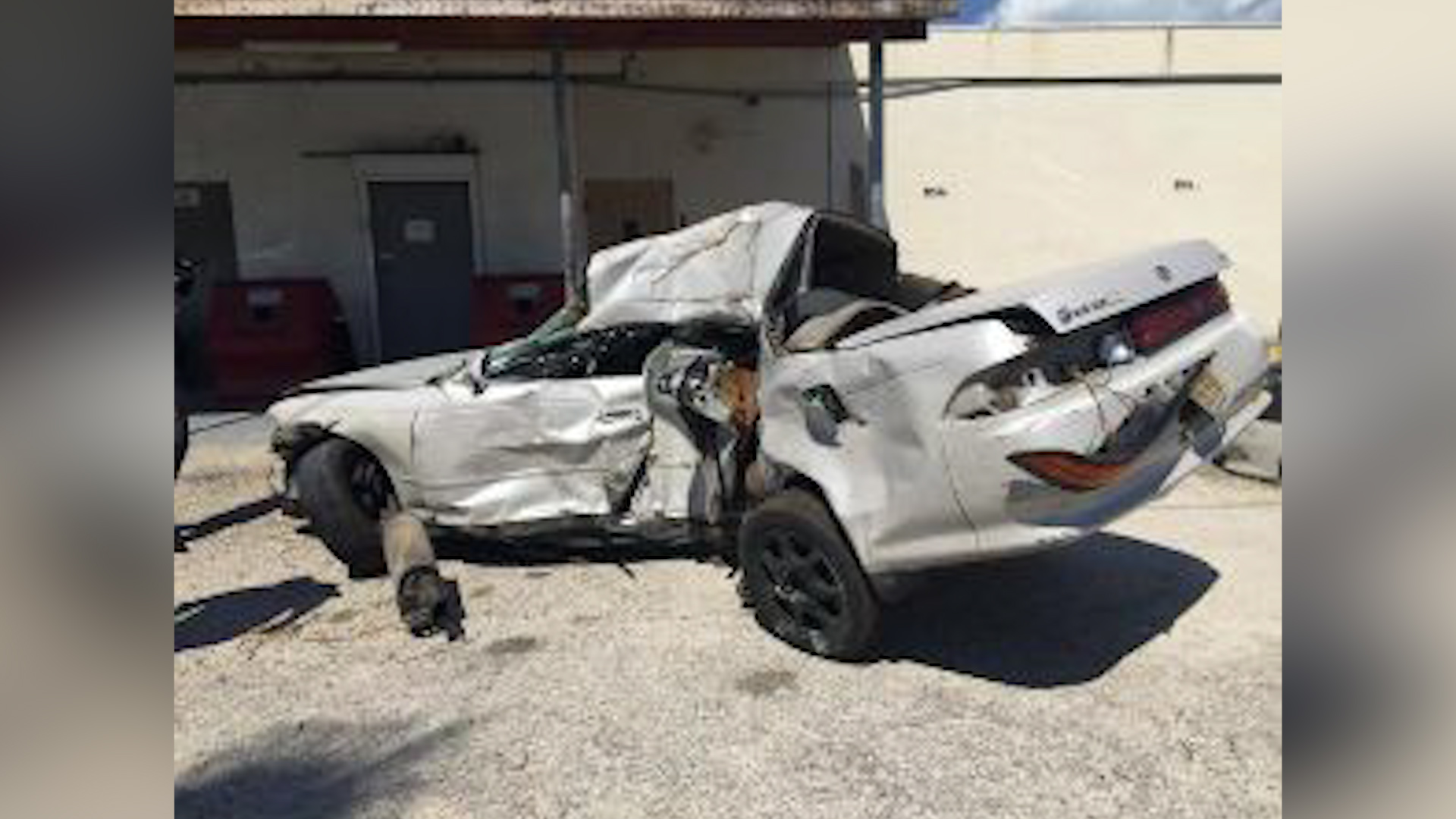
The death of Chris Ollen McLaughlin, who crashed his car into a concrete utility pole at 97 miles per hour while more than twice over the drink-drive alcohol limit, was a result of misadventure, a Coroners Court jury has ruled.
McLaughlin, 30, died in the early morning hours of 11 March 2016, when the Toyota Mark II he was driving left the roadway while navigating a corner along Seaview Road, East End, a quarter-mile west of the Blow Holes, and collided with the utility pole.
“The impact was so great that not only did it expose the steel rebar in the base of the concrete pole, but it also shifted the pole by 10 inches from where it was originally planted,” said Police Sergeant Linford Butler who gave evidence at McLaughlin’s inquest on Thursday 23 June.

A toxicology report of McLaughlin’s body revealed a blood-alcohol reading of 237%, more than double the legal limit of 100mg of alcohol per ml of blood.
“Most people would find it difficult to stand, let alone drive in such a condition,” pathologist Dr. Shravana Jyoti said. “There is no question that his ability to control the vehicle with that level of alcohol would have been greatly reduced.”
Police say, from their investigation, that McLaughlin had spent the majority of the day drinking at a bar not far from the accident scene, and minutes before his death he was doing “burnouts” before speeding off.
Jyoti’s findings of reduced cognitive control were further supported by the two separate accident reconstructionist reports which showed that McLaughlin was not wearing a seat belt, nor did he try to brake while going around the corner.
The jury heard that the collision was so loud that it was heard as far away as Frank Sound, some 5.5 kilometres (3.4 miles) away.
“The best way to describe the impact is that the vehicle was wrapped around the utility pole,” said Collin Redden, an accident reconstructionist.
Redden explained that a four-door vehicle typically features two columns, one on either side that is used to mount the rear doors, as well as latch the front doors.
“The space between these columns, for a sedan like the Mark II, is five feet. But when we measured the distance between the [columns in this] vehicle in this accident, there were only 12 inches,” said Reddin. “That is to show you how much the car crashed in on itself.”
The Coroners Court was told that, at the time of his death, McLaughlin’s driver’s licence was expired, after having been suspended. Additionally, the vehicle, which was not in his name, was neither licensed nor insured and did not have a valid inspection to allow it to be driven on the road.
When responding to a question from a juror as to whether the condition of the tyres played a role in his death, Redden responded, “There is no question that the tyres on the vehicle were severely depleted, and should have been replaced. However, based on the speed he was travelling, no matter how good the tyres were, they would have likely not made much of a difference.”
He added, “This was a clear case of the consequences of mixing speeding and alcohol, both of which are dangerous by themselves, but as in this case, potentially fatal when combined.”
Related Videos











Why has this case taken more than 6 years to reach the Coroner’s Court?.