

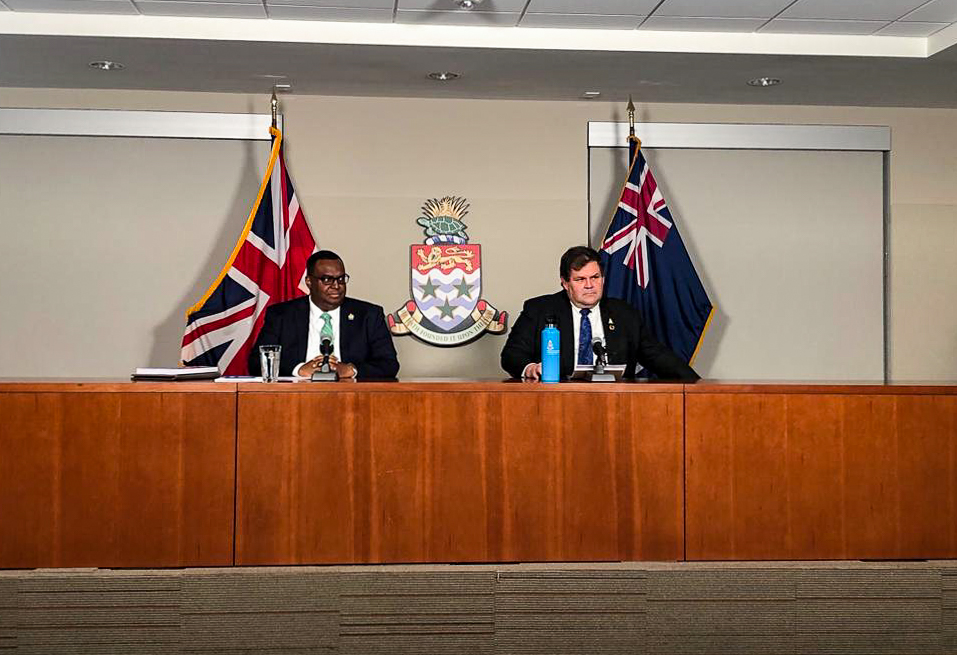
Population growth numbers, revealed by the final 2021 census results, indicate that Cayman needs to move away from unplanned and unrestrained growth, Premier Wayne Panton said at a press conference on Thursday, 28 July.
Based on the report’s figures, Cayman’s population of 71,432 as of October 2021 has grown by 29.2% since the last census in 2010 and was 70% larger than just 25 years ago.
Population growth as the direct result of the islands’ open immigration policy to support economic growth has brought much prosperity but also led to many concerns, Panton said, for instance about the inability of Caymanians to find affordable housing.
While it has brought many economic opportunities for both the public and the private sector, the premier said ad hoc, unplanned growth had left the country without proper systems and structures to optimise development amid “infrastructure struggling to keep up and the lack of a proper development plan to ensure our sustainable future”.
Panton said, “We as a country have to decide what is an appropriate rate of growth and have to design policies that are in line with that.”
However, he conceded that there is not necessarily a static answer to the question about what Cayman’s desirable population size should be.
“If our population is static, to maintain economic growth we are going to have to have an increase in productivity. That has either got to come through technology or people just working harder.
“This is all a challenge to suggest you can have a static population and continue to have opportunities to attract economic growth to be the engine to create new jobs.”
The premier said, “Moving forward, we need, as a government and as a country, to have more careful managed growth that is paced to allow us to leverage the opportunities of growth while addressing the negative consequences of neglect, which may have occurred over a period of decades.”
Minister of Finance and Economic Development Chris Saunders said the census data will be essential to plan for government services in education, healthcare and infrastructure.
The trends gleaned from the data will, among other things, determine the number of school places and how many teachers, doctors and nurses are needed in the future.
The 2021 census also included several new metrics ranging from transportation, environmentally-friendly activities of households and from disabilities to food insecurity, which will help inform specific policies, Saunders said.
Population
About half of the population lives in George Town (49.1%), followed by West Bay (21.6%), Bodden Town (20.9%), the Sister Islands (3.2%), North Side (2.7%) and East End (2.5%).
Bodden Town’s population grew the most since the last census, by 40.8%, followed by West Bay with 26.6%. The Sister Islands was the only district that saw its population drop during that time by 1.7%.
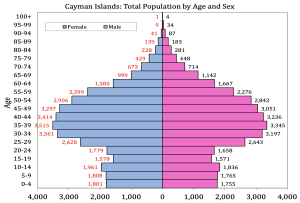
In a reversal of the last census results, 50.6% of the population were men and 49.4% were women.
The average age of Cayman’s population is 44 years.
Unemployment is declining
Saunders said Cayman’s literacy rate of 98.6% among those who are 10 years or older is well above the global and regional average in the Caribbean and Latin America.
Caymanians make up 50.7% of the working age population of 57,216 and 45.2% of the labour force of 47,120.
However, the top five industries, which include financial services, scientific and technical activities and public administration, all employed more Caymanians than non-Caymanians, Saunders said.
At the time of the census, 2,679 people, 5.7% of the labour force, were unemployed and Caymanian unemployment amounted to 8.5%.
However, Saunders said, at the end of June 2022, the overall unemployment rate had dropped to 3%, while Caymanian unemployment had declined to 5.1%.
“This shows that while we are trending in the right direction, we still have more work to do.”
Median salary is $36,000
The average worker in Cayman earned $49,611, with Caymanians earning on average more ($55,220) than non-Caymanians ($45,594).
Men were, on average, in higher paid positions than women with average annual salaries of $51,724 compared with $47,241.
The more representative median salary was $35,994, which means that half the population earns more than this amount and the other half less.
Food insecurity an issue
Food insecurity, the interruption of food intake because of a lack of money or other resources, was covered for the first time by the census.
652 households, or 2.2%, confirmed that at least one family member did not have enough food to eat during the four weeks prior to the census, due to a lack of money. Another 673 households did not respond.
“Naturally, this is a serious area of concern for this government and one of the reasons why we pushed the school meal programme from very early on,” Saunders said.
“However, there’s still work to be done. And we will be working with other private sector organisations to ensure that nobody who calls the Cayman Islands home should go to bed hungry.”
“While we accept that not everyone in the Cayman Islands can be rich, equally we do accept that nobody in the Cayman Islands needs to be poor,” the finance minister said.
He had previously stated that the government believes “there is a disconnect between the quality of our economy and the quality of life for our people.”
Related Videos










It’s time to take a deep breath and look around. I Appauld you that at least this is being addressed. While I realize property values, you need to look at your needs in affordable housing. Maybe looking at some property to the east end versus George Town. This says it all. “He had previously stated that the government believes “there is a disconnect between the quality of our economy and the quality of life for our people.” Again, thank you for recognizing this important need and bringing it to the forefront.
So how many M.P’s do we have for the sister islands, Northside and East End who collectively boast less than 81/2 % of the population?.