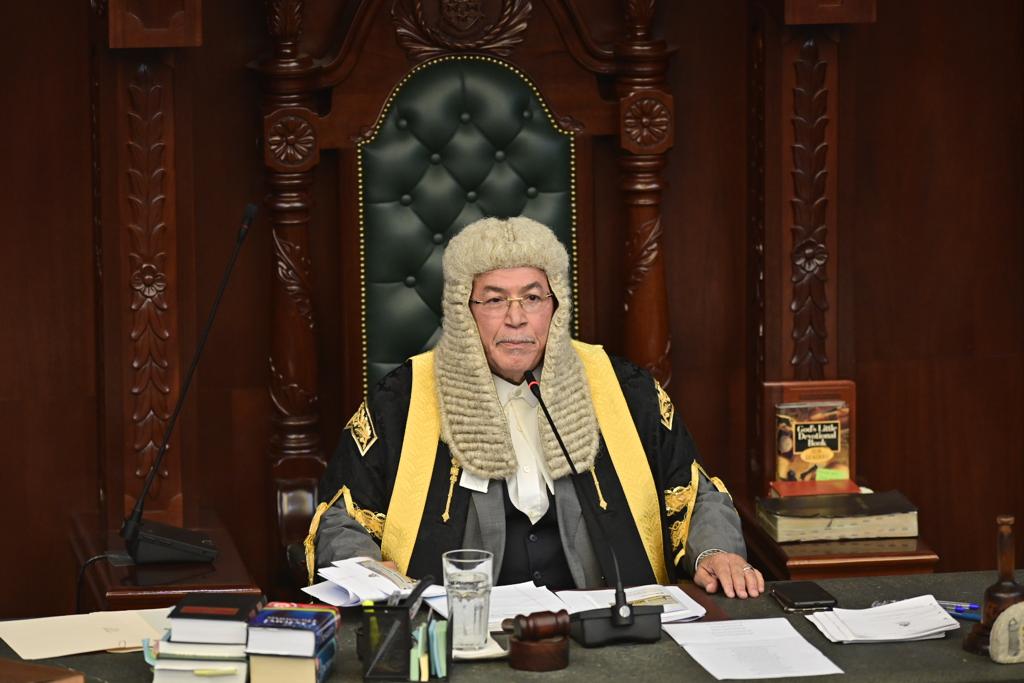
While multiple reports say that Speaker McKeeva Bush has indicated to his colleagues that he intends to resign, the West Bay West MP remains in his post for now.
Governor Martyn Roper, Premier Wayne Panton and the Opposition are among those who have asked him to step down, following allegations of an assault on two women.
It is not the first time Bush has faced calls to step down as Speaker. He refused to resign following his conviction for assaulting a female employee at the Coral Beach Club in 2020.
The Progressives-led government opted to call an early general election last year, stymying then-Opposition calls for a vote of no-confidence. Bush was subsequently re-elected and re-installed as Speaker by Wayne Panton’s new PACT coalition.
Following the latest incident, there appears to be momentum on all sides to replace Bush in the prestigious role, presiding over Parliament. But it is not a simple matter to dismiss him.
Here’s how the process works according to the Cayman Islands’ Constitution and what we can expect to happen over the coming days.
Has McKeeva Bush resigned as Speaker?
At the time of writing, Bush had not formally resigned as Speaker. Premier Wayne Panton has asked him to step down and both Panton and Infrastructure Minister Jay Ebanks have reported that he has agreed to do so.
Bush himself has confirmed his willingness to leave the Speaker’s chair, telling the Compass he had expressed “willingness for reasons given to both the premier and minister Jay Ebanks to resign as Speaker”.
He added, “We are currently discussing those details.”
He has not commented on the allegations against him.
How does he formally step down?
To officially vacate the post, Bush must submit a written letter of resignation, through the clerk of Parliament. As of Tuesday afternoon, no such letter had been submitted, the Compass understands.
What happens if he does not resign?
If Bush, despite his remarks, decides not to resign, it is open to his fellow parliamentarians to call for a vote of no-confidence. In those circumstances, it would require a two-thirds majority of Members to vote in favour of deposing him. If that bar is not achieved, he would remain as Speaker.
What happens next?
It appears likely that Deputy Speaker Katherine Ebanks-Wilks would be called on to oversee proceedings of Parliament in the short term. Deputy Speakers have filled the chair in the past, including when Bush last took a leave of absence following the Coral Beach assault.
Who will be the next Speaker?
While Ebanks-Wilks would be a contender for the role, it is by no means certain that she would automatically replace Bush as Speaker on a permanent basis. It would be open to the PACT government to nominate any MP for the role. The Opposition, or any MPs, are also entitled to nominate a prospective Speaker.
There is then a ballot in Parliament with a new Speaker elected by majority vote. The Constitution also allows for a Speaker to be nominated from outside of the elected members. Any Caymanian that is eligible to vote could be put up for the role.
There are political factors to consider and PACT may wish to keep Ebanks-Wilks out of the role, so she could bolster the government’s majority on the floor of the House.
Will Bush remain an MP?
Yes. If he resigns from the Speaker’s role, it won’t impact his elected position as the MP for West Bay West. It is open to Bush to resign from this position as well and for a by-election to be held to replace him, but there are no indications he plans to do that and no-one has yet called for him to do so.
Will Bush remain part of the government?
The political fall-out from the allegations concerning the Speaker and from his expected resignation remains to be seen. In comments published by Loop Cayman, made through Jay Ebanks, he indicated continued support for the PACT government.
However, having called for him to resign as Speaker and publicly published his letter admonishing Bush, it is not clear if Premier Wayne Panton will want him as part of PACT, where he would arguably have a bigger role in government – attending caucus and being unbound from the requirement to remain neutral in debates that comes with the Speaker’s office.
However, exiling Bush, who has allies in Parliament, would also be a risky political move.
Another alternative is for Bush to continue as an unaffiliated independent legislator, representing his constituency but unattached to either political group.
What are the consequences for the government?
It is likely that the machinations and behind-the-scenes entreaties are already under way and Bush’s departure will need to be deftly handled for the PACT coalition to maintain a stable government.
With the rival coalition groups locked at 9-9 after the general election last year, Panton’s decision to work with Bush was the pivotal moment that swung things in his favour and allowed the newly formed PACT to take the government.
PACT was subsequently able to tempt several others grouped with the Progressives to join the government benches and Bush’s influence as the ‘kingmaker’ has since waned. Even without him, there are 12 MPs on the government side, to the Progressives’ six.
However, as a coalition of independents that includes two defectors from the Progressives’ front bench, PACT members will no doubt face overtures from the rival camp.
Regardless of affiliations, PACT needs support from at least 10 members every time it wants to get a motion or piece of legislation passed, so Bush’s support could still be needed at times when there is not consensus among the other MPs. The numbers remain in its favour but the situation will likely test the stability of the group.
Related Videos