


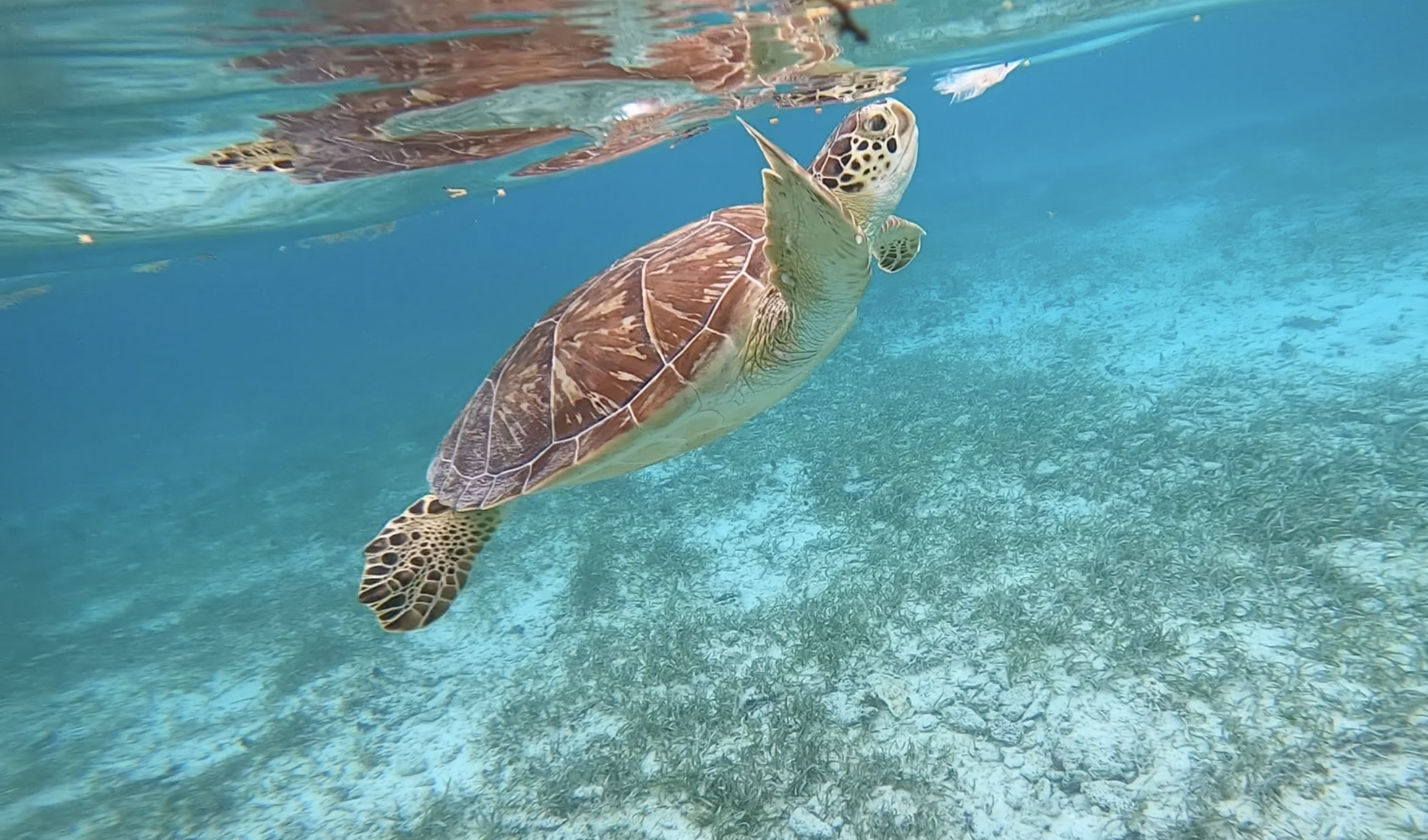
An image of a green sea turtle eating plastic wrap at Spotts Public Beach has sparked anger among Cayman’s environmental activists who say government action is well overdue.
Stronger legislation, environmental wardens, fines for littering, enforcement of critical habitat and a ban on single-use plastic are among the measures that they want government to take immediately.
“Failing to act now will have dire consequences,” Melanie Carmichael from Sustainable Cayman told the Compass.
‘A death sentence’
The green sea turtle, once abundant in the waters surrounding the Cayman Islands, was hunted to near extinction in the early-20th century.
But conservation efforts, including the ban of hunting wild turtles, have helped the population to increase since records began 25 years ago – and in 2022 there were 538 nests.
Spotts Public Beach, a popular snorkelling spot, is home to several families of green sea turtle who feed on the seagrass.
This May, the Compass captured an image of a turtle about 50 feet from shore as it darted towards a piece of plastic wrap floating on the surface of the water and swallowed it whole.
On its website, the World Wildlife Fund said the outlook for turtles that eat plastic is bleak, and that for 22% “ingesting just one plastic item can be a death sentence”.
“Sharp plastics can rupture internal organs and bags can cause intestinal blockages leaving turtles unable to feed, resulting in starvation,” the global animal protection group said.
“Even if they survive, consuming plastic can make turtles unnaturally buoyant, which can stunt their growth and lead to slow reproduction rates.”
Bella Rooney, of Plastic Free Cayman, said, “This is heartbreaking for us to see but sadly not a surprising or uncommon sight.”
“Our oceans and beaches are so littered with single-use plastics it is almost impossible to get away from them.”
The picture was taken the same week as that of a juvenile green turtle found on a beach in Cayman Brac which had died after becoming entangled in fishing line.
“One can only imagine how much this turtle suffered before choking or drowning to death,” the Department of Environment said on its social media pages on 18 May.

The WWF explained that entanglement in abandoned fishing equipment can easily kill turtles through drowning or preventing their escape from predators or poachers.
“Tragically, the accumulation of plastics at key nesting beaches means that baby turtles are among the most at risk from plastic entanglement,” it added.
A ‘critical’ species
Carmichael from Sustainable Cayman told the Compass urgent efforts are needed to secure Cayman’s wildlife, aid the recovery of populations and halt the threat of extinctions.
Green sea turtles are “critical to our blue ocean as they maintain the health of seagrass beds and coral reefs and are an important cultural aspect of Caymanian heritage”, she said.
There have been committed efforts from organisations like Plastic Free Cayman and volunteers who collect litter to keep the oceans and beaches clean, she added.
But despite this, “it is disturbing to observe the threat to this species from a variety of plastics including discarded fishing line”, Carmichael said.
The environmental activist said she would like to see stronger fines for littering, and enforcement of critical habitat as proposed by the 2021 government policy commitments.
There should also be environmental wardens from each district working alongside the Department of Environment and supported by the government through legislation, she said.
Carmichael questioned if key objectives set out in the Cayman Islands National Tourism Plan 2019-2023 had been met.
And she said tourism industry partners should fund and support action to obtain Blue Flag certification for “prioritised and vulnerable habitat beaches”.
‘Last piece of the puzzle’
Carmichael also supports the work of Rooney of Plastic Free Cayman who is pushing the government to implement a single-use plastics ban.
Rooney told the Compass, “Turtles are such an important species on our islands, both culturally and environmentally.
“Our turtle conservation programmes are quite a success story, but yet we still cannot complete the last piece of the puzzle and implement a single-use plastic ban.”
She said that while some of the plastic comes from overseas, “What happens to the plastics that enters the water here? Whose beaches and turtle populations are we impacting?”
She wants to see action from the government towards a single-use plastic ban.
“It doesn’t have to be every single kind of plastic, but starting with something like the plastic bag would help and maybe save an extra turtle or two out there.”
A proposal
After viewing the image, a Ministry of Sustainability and Climate Resiliency spokesperson revealed that the government is a step closer to implementing a single-use plastic ban.
It is in the process of submitting a proposal to Cabinet for the ban of eight single-use plastic products, the spokesperson said.
“We look forward to being able to share more information on this proposal in the coming weeks.”
The spokesperson agreed that the government has an important role to play in regulating single-use plastics and incentivising sustainable alternatives, but added that individuals and organisations can choose reusable items instead of single-use products, use existing recycling programmes, and dispose of waste responsibly and lawfully.
Gina Ebanks-Petrie, director of the Department of Environment, said photos of any wildlife ingesting plastic are “obviously very concerning”.
She said the department has in the past led initiatives to reduce the use of single-use plastics, and continues to support others in regulating the use and disposal of plastics.
The Compass reached out to the Public Works Department, which is responsible for maintaining Cayman’s public beaches, and is awaiting a response.
Related Videos









The litter is not just on the beach. It is pervasive throughout this Island. I walk everywhere as I don’t have a car. Each time I go out I take a large trash bag and fill it with trash discarded on the roads and intentionally tossed into the bushes:
Plastic bags filled w/ fast food remains, beer bottles, water bottles, cigarette boxes, straws, wrappers, cans … This beautiful Island is destined to become a Caribbean Dump.
Anne Evans
Spouse of Subscriber