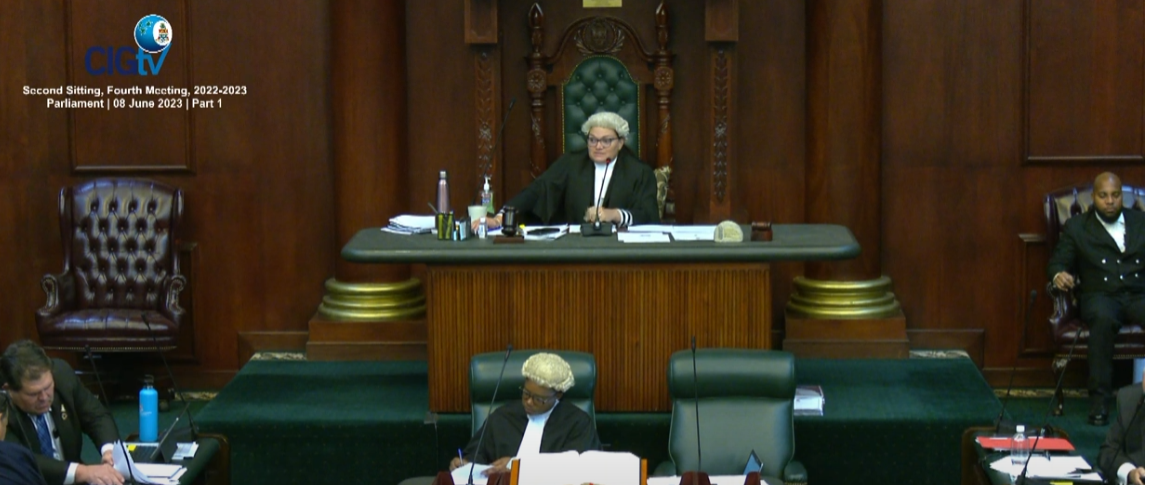
Lawmakers voted overwhelmingly on Thursday evening for government to continue discussions with local banks for interest rates to be cut, and pause further increases.
This came after government backbencher McKeeva Bush brought the issue of high bank rates to Parliament through a private member’s motion, which 16 MPs supported.

Tourism Minister Kenneth Bryan and Planning Minister Jay Ebanks were absent for the vote.
Bush, in his contribution to the debate, said it is time for “action” on the rising interest rates as many Caymanians are facing the prospect of foreclosure if nothing is done.
The West Bay West MP did not mince words as he took Premier Wayne Panton to task over his recent statement on bank rates, declaring that “our people are hurting” and the “excuses” have to stop.
“We can’t come here and be bereft of ideas and the gumption to utilise our money for our people,” Bush argued, saying that he does not accept that nothing can be done to rein in rising rates in Cayman.
Last month Premier Wayne Panton, in a statement, said his appeal to Cayman’s bankers to slow down increases in interest rates was rejected.
Panton said he had asked local retail banks to delay implementing interest rate hikes in tandem with rate increases by the US Federal Reserve, which sets the prime interest rates for borrowing.
Bush, pointing to the premier’s statement, said basically he saw Panton as saying there is nothing he can do about the banks, instead offering ideas to help people with the cost of living.
“I believe he’s trying, he wants to do something. But I don’t think I can agree with him that there is not something that can be done. In representing our people, we must find ways. We must take the bull by the horns,” he said.
Bush said, as elected representatives, they have a responsibility to take action to protect their community and, as leaders, hands cannot be “thrown up into the air”.
Bush made the case that the Cayman Islands Development Bank can be utilised and accept deposits as a measure to assist with combating the high rates.
Panton did not agree, pointing to past problems at CIDB, saying that ultimately government would end up being responsible for dealing with that as well.
Mortgage reform under consideration
Though criticised by Bush, Panton voted in favour of the MP’s amended motion, which also called for government to consider changes to legislation to establish an interest-rate-setting body and other relevant banking-reform measures.
Panton agreed they have to keep the pressure on.
Government, he said, has under consideration reform of the residential mortgage provisions under the Lands Act, which is being discussed with the banks.
“We have one opportunity with that in that we could build in a three-month requirement for notice in terms of a change in the rate. Now, that hasn’t been specifically discussed with the banks in terms of mandating it. But we can certainly do that. I would like to have this reform in place as soon as possible,” he said.
Panton said there were indications from one bank that it was prepared to freeze the rate going forward, but that would not translate into a reduction in the current rate.
The premier argued that there was no incentive for banks to halt increases for 24 months, and if government could tell them to decrease the rate to 2%, the knock-on effect would be a drop in the rates paid on deposits.
Panton defended his and his government’s efforts to bring relief to the community, pointing to the duty waiver on more than 25 items, the school meals programme and the electricity relief programme as examples of his effort to assist in these challenging times.
The premier suggested that Cayman’s rate of foreclosures “though very painful, has not been something that’s been overwhelming. Thank God for that.”
However, Panton said he was not convinced that this is going to be the long-term picture.
He agreed that lawmakers have to continue the pressure on behalf of the people and “for the banks to recognise that everybody can assist in some way”.
Panton said the government is challenged to assist, but it has been helping.
The rates issue, he said, involved “complex factors”, but added they are expected to drop.
“The projection for interest rates over the next year, one which I understand, is that it will likely be declining…[but] I do not know what rate,” he said, adding that there have been periods where the rates fluctuate and then drop.
Describing the existing climate as a “cycle,” Panton said the situation is likely to improve.
In a veiled jab at Bush, Panton questioned what action was taken in 2001 when rates were high, or in the 1980s when rates reached a record 20%.
Opposition Leader Roy McTaggart, speaking on behalf of his team, said he supported the spirit of the motion, but shared some of the premier’s concerns.
He said there needs to be a face-to-face conversation with the banks.
McTaggart suggested that part of that conversation can include either reducing or removing some of the bank fees being charged.
“That I think is perfectly reasonable. There is a need for banks to ensure that as interest rates rise, they not only increase loan rates but deposit rates must rise accordingly,” he suggested.
Time for action
Bodden Town West MP Chris Saunders, in his contribution to the debate, reminded lawmakers that in 2021 the profitability of the banking sector was US$3.5 billion, with $228 million from Class A retail banks and the remaining $3.3 billion from Class B banks.
“We have to start thinking outside the box,” he said, suggesting that if government is not getting cooperation from the Class A banks, then it should look to the Class B banks as an option.
He suggested reaching out to the Caribbean Development Bank for the $100 million line of credit on offer at 4.75%.
“We can even lend [that out] at 5.15%. It is still way less than what a lot of people are paying and I would say earmark that money for people above the age of 55 or 60, [depending] on how much room we may have,” Saunders said, adding that the risk would be low at that age based on the equity they have built.
Minister for Financial Services André Ebanks, in his contribution, pointed to reverse mortgages and Saunders said that this measure should be moved forward.
Related Videos