For the latest information on storm activity in the Cayman Islands, as well as information on how to prepare for hurricane season, visit Storm Centre.
A tropical storm which has formed in the Atlantic Ocean is forecast to become the first hurricane of the season within the next few days.
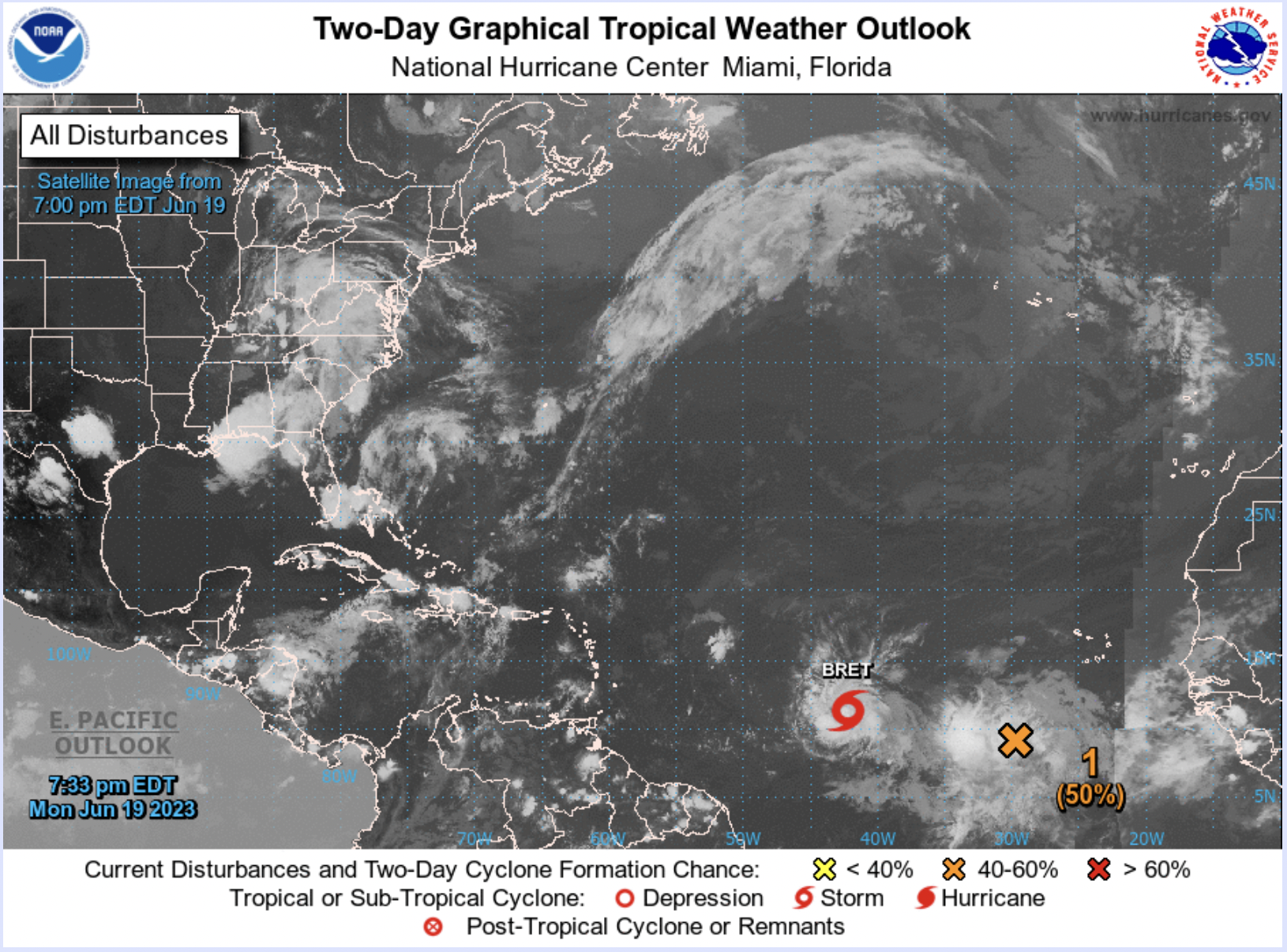
During Sunday and Monday, 18 and 19 June, the weather disturbance quickly increased in strength to become a depression and then a tropical storm, which has been named Bret.
“Satellite imagery continues to show that the system is becoming better organised,” the US National Hurricane Center said during its forecast at 5pm on Monday.
“Environmental conditions appear conducive for further strengthening over the next few days.”
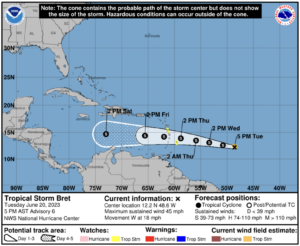
At the time of the forecast, the storm was moving at a speed of 18 knots (21 mph) with maximum sustained wind speeds of 35 knots (40 mph) and gusts to 45 knots (52 mph).
It is predicted to move across the Lesser Antilles in the eastern Caribbean as a hurricane on Thursday and Friday.
This will bring a risk of flooding from heavy rainfall, hurricane-force winds, and dangerous storm surge and waves.
The centre said it is too early to specify the location and magnitude of where these hazards could occur because of a “larger than usual uncertainty in the track forecast”.
However, it warned people in the Lesser Antilles, Puerto Rico and the Virgin Islands to closely monitor updates and have hurricane plans in place.
Contrary to an earlier forecast, the potential hurricane is now expected to weaken to a tropical storm before reaching the central Caribbean sea.
The Cayman Islands National Weather Service in its Monday afternoon forecast said the storm poses no immediate threat to the Cayman Islands.
Tropical storm Bret is followed closely by a second disturbance which has a 50% chance of forming into a cyclone in the next two days or 60% in the next seven days.
The Cayman Islands government advises residents to prepare early for storms by doing the following:
- Come to a decision about where you will shelter during a storm.
- Ensure that travel documents and insurance policies are up to date.
- Place all vital documents in a waterproof ‘grab and go’ container.
- Service your generator if you have one.
- Check your hurricane shutters.
- Remove debris from the yard and trim back trees.
- Store non-perishable food and water.
More details on what to do in the event of a storm can be found on the government’s website along with details of shelters in your area.
The Compass will publish updates on this weather disturbance as more information becomes available.
Related Videos