

For the first time in recorded history, Caymanians find themselves outnumbered in their homeland, with the total population topping 83,000.
Data from the Cayman Islands Labour Force Survey Report Spring 2023 reveals that expatriates now make up 53.5% of the total population. Meanwhile, Caymanians account for 46.5% of the population, but only 30.6% of the total are Caymanian by birth.
This significant demographic shift has profound implications, especially for Caymanian millennials, who are most affected by these changes.
Rise of the expatriates: A 30-year perspective
For three decades, the expatriate population in the Cayman Islands has risen steadily. However, the interval from 2021 to 2022 marked a pivotal moment. During this year, the expatriate count surged by 30%.
Over the same period, the Caymanian population increased by less than 2%, meaning for about every two additional Caymanians, 30 expatriates moved to the jurisdiction.
Millennials at the heart of the shift
Millennials are central to this demographic shift. They are defined as individuals aged 27 to 42, according to Beresford Research’s Age Range by Generation, which sources both the Pew Research Center and the US Census Bureau in its calculation.
According to the 2022 Labour Force Survey, conducted by the Economics and Statistics Office, millennials in the workforce account for more than half of the employed population.
In this age bracket, expatriates constitute a significant 75%. This statistic is even more noteworthy when considering data from the US Bureau of Labor Statistics, which suggests individuals in this age range should be approaching their peak earning years, with older millennials already in it, at ages 35 to 54.
Dissecting the income landscape
On average, Caymanians earn more than expatriates. According to the ESO 2023 labour force spring survey, “a higher proportion of Caymanians (74.4%) earned CI$2,400 or more per month compared to Permanent Residents WRW (68.3%) and Non-Caymanians (56.2%)”.
However, when exploring specific sectors, a more nuanced disparity emerges.
Data from the Cayman Islands Compendium of Statistics 2022 points to an ‘income ceiling’ for Caymanians in industries that begins at median salaries over $51,000. For instance, in the ‘professional, scientific, and technical activities’ sector, which, according to the 2021 Census, carries a total median salary of $79,194, Caymanians earn 20% less than expatriates.
In ‘financial and insurance activities’, this disparity reaches 39%, despite Caymanians making up nearly 70% of the employees in the industry.
Conversely, in one high-income sector, real estate, Caymanians outpace expatriate earnings. Alternatively, in one low-income industry, accommodation, expats outpace Caymanians. These two industries are the exception.
In real estate, Caymanians earned a median of $64,794, which is notably more than the expatriate median of $40,794. Meanwhile, in the accommodation sector, Caymanian incomes lag behind expatriates. They earn an average of $21,594, less than the expatriate median of $26,394.
Education: A divergent path
The Labour Force Survey underscores the importance of education in shaping these dynamics. While 60% of employed Caymanians have completed secondary education, 32% have advanced to tertiary studies. This contrasts with expatriates, of whom 68% have finished secondary education, and a notable 38% possess tertiary qualifications.
Meanwhile, 67% of employed Caymanians have received occupational training in contrast with 61% of expats.
Occupational trends: A closer look
In roles such as clerical support workers, Caymanians comprise 68% of the workforce. They also earn 10% more than their expatriate peers. However, these jobs pay a median of only $35,994.
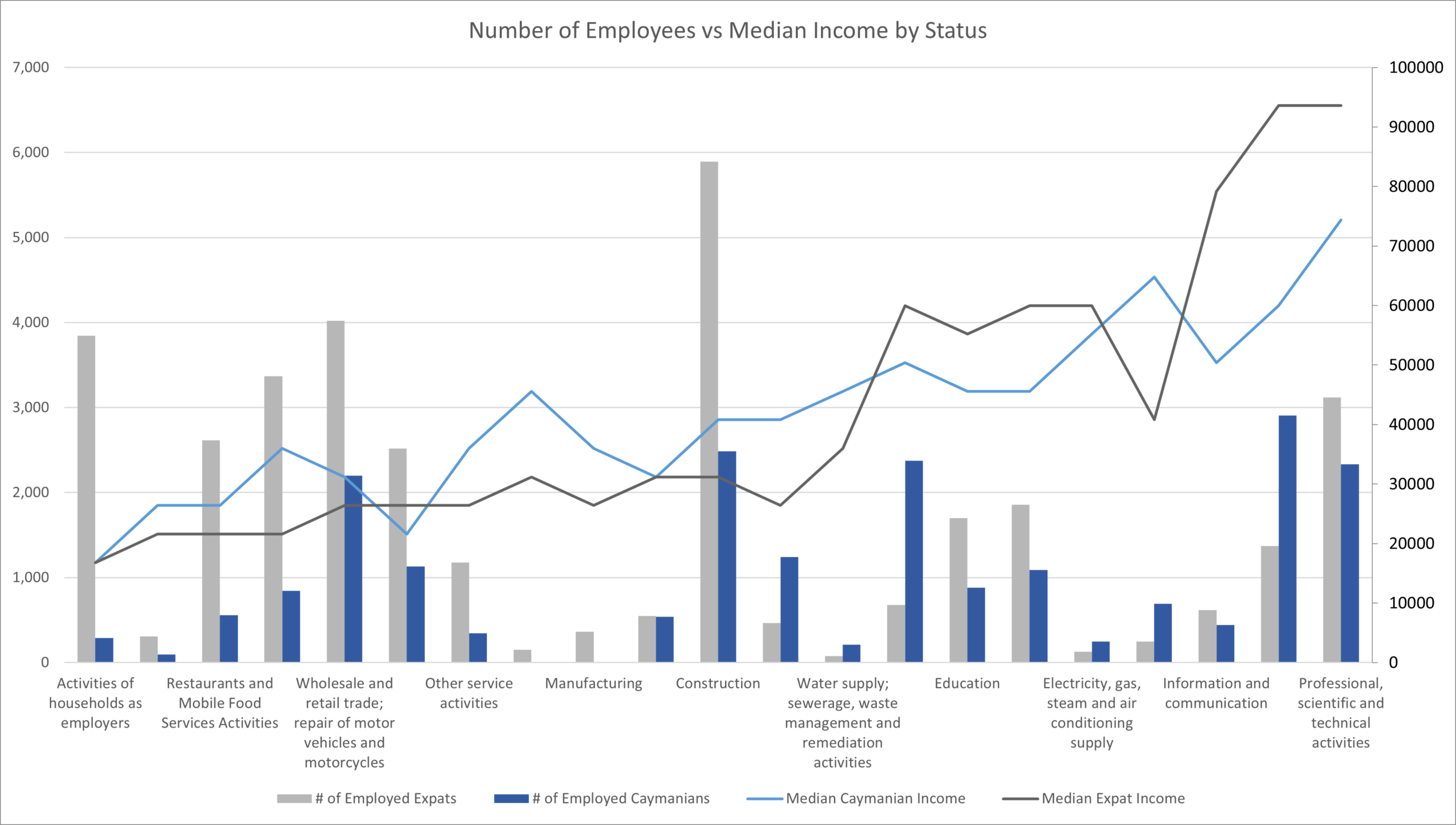
There are noticeable differences in salaries between Caymanians and expats across various occupations. For instance, in ‘service and sales workers’, Caymanians have a mean salary that is 20% higher than that of expats, and a median salary that is 31% higher. This trend is also noticeable in ‘skilled agricultural, forestry and fishery workers’ and ‘elementary occupations’, where Caymanians tend to earn significantly more on average. However, in high-skill occupations like ‘managers’ and ‘professionals’, expats earn more on average.
While Caymanians are listed as representing the majority of the highest paying occupation, ‘managers’, at 62%, one must also consider self-employed individuals, who are included in that number. Approximately 16.4% of Caymanians are self-employed (with or without employees), contrasted with about 3.28% of expats. This is congruent with local immigration laws. If self-employed persons were extracted from the data, Caymanians would constitute a minority of managers.
Implications of the income ceiling
The ‘income ceiling’ phenomenon has broad ramifications, restricting upward economic mobility for Caymanians, especially in sectors that traditionally offer lucrative opportunities.
Given the Cayman Islands’ limited land area and scarce resources, wage disparities can influence property prices, cost of living, and even reshape social dynamics. With expatriates earning more in key sectors, they inadvertently drive up prices across various sectors, affecting affordability for many locals.
This could make it harder for many Caymanians, especially millennials who are in the age of the average first-time home buyer. According to a Financial Times article on COVID’s effect on the first-time home buyer, the average home buyer’s age is now 34 instead of 32, as it was before the pandemic.
Data from the 2022 Compendium of Statistics display the effect of expats on each district, indicating that Bodden Town and North Side are the only districts where expatriates don’t outnumber or closely rival Caymanians in numbers, with the vast majority outnumbering them in George Town and approximately equalling Caymanians in West Bay.
The Cayman Islands are at a socioeconomic crossroads. The expanding expatriate population, coupled with wage disparities and the looming income ceiling for Caymanians, particularly millennials, creates a complex landscape. As the islands navigate this new reality, understanding these dynamics is pivotal for both policymakers and the population.
Infographics created by Stephanie Ditta
Related Videos













Many of these milennial expat workers are here on short-term work permits doing jobs that have little attraction for Caymanians: such as landscaping, maids, servers, cooks, construction work etc. They aren’t voters and are never likely to be granted Caymanian status.
My wife and I were in Dubai recently, which also has more expat workers than Emiratis. It was not a problem. The government there provides excellent benefits for Emratis, including free land on which to build a home, and a low interest mortgage to do so and free education, including free scholarships to study abroad.
Incidentally there is almost zero crime and criminals are severely punished.