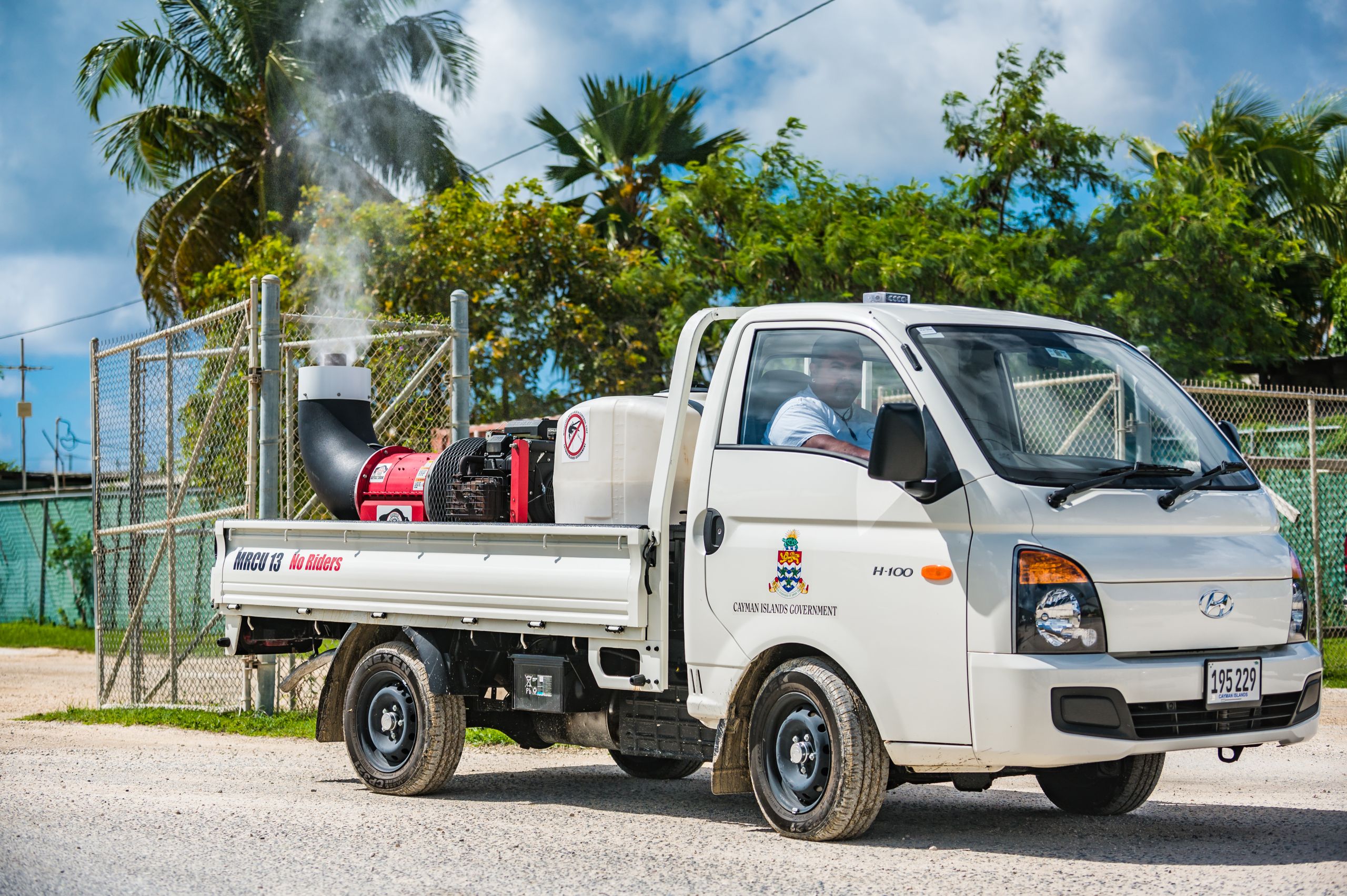
A fruity scent that has recently emerged in neighbourhoods around Cayman is from chemicals sprayed by the Mosquito Control and Research Unit, which some residents say are making them feel unwell.
MRCU director Alan Wheeler told members of Parliament’s Finance Committee last week that an insecticide, approved by the US Environmental Protection Agency, is being used to target dengue-carrying Aedes Aegypti mosquitos. The spray is different to the one used for other types of mosquitos, he said, and has a distinct smell of guava.
He was responding to questions from George Town South MP Barbara Conolly, who said she had received reports of local residents of Windsor Park, including children, feeling unwell after areas were fogged by the MRCU.
One of those residents is Esther Lewis, who lives with her family on Hawkins Drive.
Headaches and coughing
She told the Compass that the last time the fogger came by, she suffered a headache that lasted three days, and the children in the house, including a young baby, had been coughing and sneezing.
She said the fogger comes along roads on two sides of her yard, so her property seems to be sprayed at least twice as it’s passing.
“It lets out its smoke and it comes into my backyard from all sides. Everyone is coughing,” she said.
“The last time it came here, I was out in my backyard and had to go inside. After that, I had a headache for three days. I’m not one to get headaches, so I know it was that,” she said.
She described the latest fogging as smelling like rotten guavas.
Lewis said whenever the fogging truck passes, her yard seems to get inundated, and the chemicals leave her and the children in the house coughing and sneezing. “It’s every time,” she said.
She said she’s worried that the fogging chemicals being used may lead to worse illnesses than the dengue it is meant to prevent.
Local cases
Cayman’s health officials first confirmed locally spread cases of dengue in November.
The Health Services Authority told the Compass that, as of 18 Dec., 23 cases of locally acquired dengue cases had been confirmed in Cayman so far this year. Another 12 cases had been imported, the HSA said.
This year has proven to be the worst year on record for dengue cases in the Caribbean and the Americas, with more than 4 million cases being reported, according to the Pan American Health Organisation.
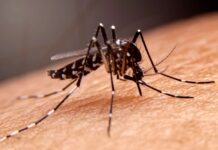
Dengue is spread through the bites of Aedes aegypti mosquitos.
In a statement issued on November, when the first local cases came to light, Cayman’s Medical Officer of Health Dr. Samuel Williams-Rodriguez explained, “For Aedes mosquitoes to transmit dengue, they must bite infected persons; otherwise, they can’t become infectious and transmit the disease.”
“Dengue fever is caused by a virus, but a mosquito biting a person with dengue can spread the virus to another person.”
Responding to local dengue reports
Wheeler on Thursday, 14 Dec., told lawmakers at a Finance Committee meeting – where funding for the MRCU for 2024/25 was signed off – that once Public Health notifies the unit of a cluster of dengue cases in an area, the MRCU sends staff to spray the area.
Some of these treatments to limit the spread of dengue are carried out manually by MRCU staffers, or via the fogging truck or the mosquito plane, he said.
“We are responding to all potential and confirmed cases of dengue virus,” he said. “We’re using a combination of different insecticides. The larvicides we’re using are called bio-rational chemicals; we use BTI and Methoprene. For our adulticide operations, we use an organophosphate called Malathion, and we’re using a new chemical called Remoa Tri, which is a synthetic pyrethroid.”
Conolly told him that she had received several complaints from residents in Windsor Park regarding the fogging truck.
“Some of my constituents are getting sick,” she said, “because when the truck traverses that area, they would stay in one area and the constituent [said] her children were getting sick. The question was what type of chemicals were being used and if they are hazardous to humans.”
Wheeler responded that the chemicals used by the MRCU against the dengue-carrying mosquitos are different from what the unit usually uses.
“The reason for this is that the Aedes aegpti mosquito is resistant across the Caribbean to most effective synthetic pyrethroids. Now, the Malathion we use is approved by the US Environmental Protection Agency. We use it only at the doses labelled on the product for ground ULV [ultra-low volume] fogging operations, and we keep records of all our treatments, to show there is no over-treatment in any area.”
He added that this product is effective, “but it does have a distinct smell, and I think that’s what is causing a lot of complaints about this product. It smells like guava.”
He told the Compass on Tuesday, 19 Dec., that this insecticide is named Fyfanon ULV and has malathion as its active ingredient.
“It is approved by the US Environmental Protection Agency for mosquito control,” he said. “It has been used for many years by MRCU and can in no way be considered a new insecticide. It does have a strong smell but is not known to make people ill.
“We have to use this insecticide as part of a rotation strategy to prevent insecticide resistance. It is one of the few insecticides we have that is effective against Aedes aegypti. The new chemical we are currently evaluating for mosquito control is named Remoa Tri. This does not have a strong smell, and has two active ingredients; Fenpropathrin and Abamectin. This product has proven to be effective against the Aedes aegypti mosquito that is a vector of dengue.”
Related Videos