

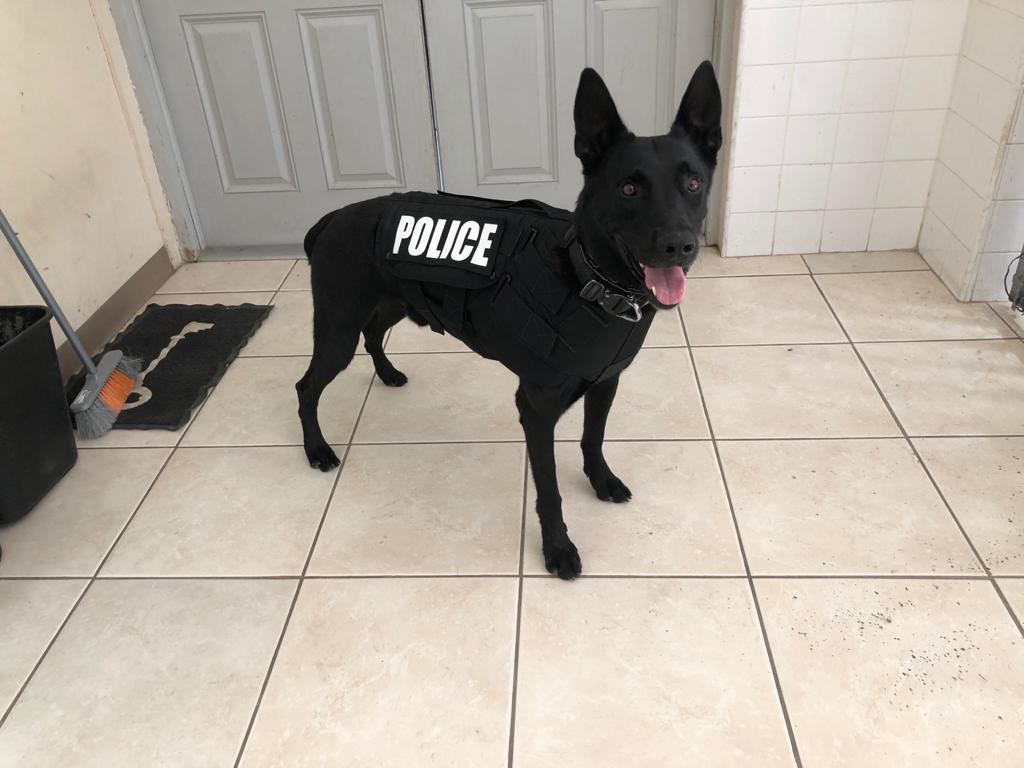
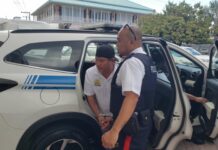
Police Constable Timothy Munroe has been acquitted of a charge of animal cruelty in relation to the death of a police dog.
K9 Baron died in July 2022, after suffering heat stroke due to prolonged exposure to the sun.
Munroe, who denied the charge, was accused of having caused the dog unnecessary pain and suffering.
When returning her ruling on Monday, 5 Feb., Magistrate Vanessa Allard said the relevant section of the Animals Act required the prosecution to prove that Munroe had denied Baron access to food and water with ill intent.
The case against Munroe
Throughout the trial, Munroe accepted that on the day in question he had failed to raise a sliding metal gate which separates the inner and outer kennels at the George Town Police Station and, by doing so, Baron was left in the sun without access to food or water.
A necropsy report conducted by Dr. Olivia Benjamin found that Baron died of hyperthermia – having been left in the sun on a day recording temperatures ranging from 94 to 104 degrees Fahrenheit.
When giving evidence, she noted that Baron, as a black Belgian Malinois shepherd mix, had a thick coat of fur and therefore absorbed and retained more heat than a normal dog would. According to Benjamin, the extreme conditions of the day meant Baron would have died within two hours of exposure.
Initially, the charge against Munroe alleged that by failing to raise the gate, his actions prevented Baron from accessing food or water which, in turn, led to the animal’s death. However, in an amended version of the charge, which was presented in February 2023, the particulars stated that Munroe’s actions did not lead to Baron’s death, but instead caused the animal unnecessary pain and suffering.
When arriving at her decision, Allard highlighted the change in the details of the charge and the inevitable changes to the prosecution’s case.
“The prosecution says that based on the amended particulars as charged, the element of mens rea (guilty intention) is not a matter for this Court to take into account,” noted Allard, who disagreed with the prosecution’s assertions.
Section 70(1)(b) of the Animals Act states a person who “wantonly or unreasonably doing or omitting to do any act, or causing or procuring the commission or omission of any act, causes any unnecessary suffering or, being the owner, permits any unnecessary suffering to be so caused to any animal”, is guilty of the offence of cruelty to an animal.
No ill intent
When arriving at her decision, Allard stated that the words, “wantonly or unreasonably” were to be viewed as a clear requirement for the prosecution to prove the defendant had some degree of a guilty state of mind at the time of the offence.
According to Allard, she was able to determine that Munroe had no ill intentions when he failed to raise the gate separating the kennels, based on facts that came to light during the case.
These facts include that Munroe was the junior officer on the K9 team and had only been in the unit for a month when he was left in charge of the operations because the senior officers were either on vacation, or sick leave. In addition, he had followed the unit’s policy of twice-daily welfare checks by cleaning the kennels and replenishing food and water for all the animals. And, he did so having provided support for the firearms unit during a three-hour operation at the end of an eight-hour shift at the end of a four-day tour. All of this happened while he had COVID, though he did not know that until the day after the incident.
Allard noted that Munroe’s evidence of being exhausted leading up to Baron’s death was supported by the testimony given by other officers who were called to testify by the prosecution.
“PC Munroe’s description of the state of exhaustion, feeling ill, the implication being that by then he was already ill with COVID, has a ring of truth to it in light of all the evidence,” Allard said.
The magistrate concluded by saying, “The prosecution has not satisfied the required standard that PC Munroe had the necessary mens rea as required by section 70(1)(b) of the appropriate law.”
Relieved but saddened
Following the not-guilty verdict, Munroe told the Compass while he was relieved by the ruling, he was still sadden by Baron’s death.
“[I am] definitely relieved to know that this is the outcome that we have all been looking and hoping for, [which] will allow me to further pursue betterment not just in my career but in my life,” he said. “I also feel saddened the K9 did die; he was, if not is still, my favourite K9 to work with and, at any point in time, if possible, I would have done anything to help him.”
Munroe, who remains employed with the RCIPS, says he is looking forward to returning to work.
Related Videos







Just another case of justice denied. It is obvious that the Animal Cruelty law needs to be revised to remove the “ill intent” requirement as this type of crime often results from, as apparently in this case, criminal negligence. What a shame that this could have been a case to set a standard for Cayman, but yet again animals will have to wait for legal protections against inhumane treatment and general abuse with impunity.