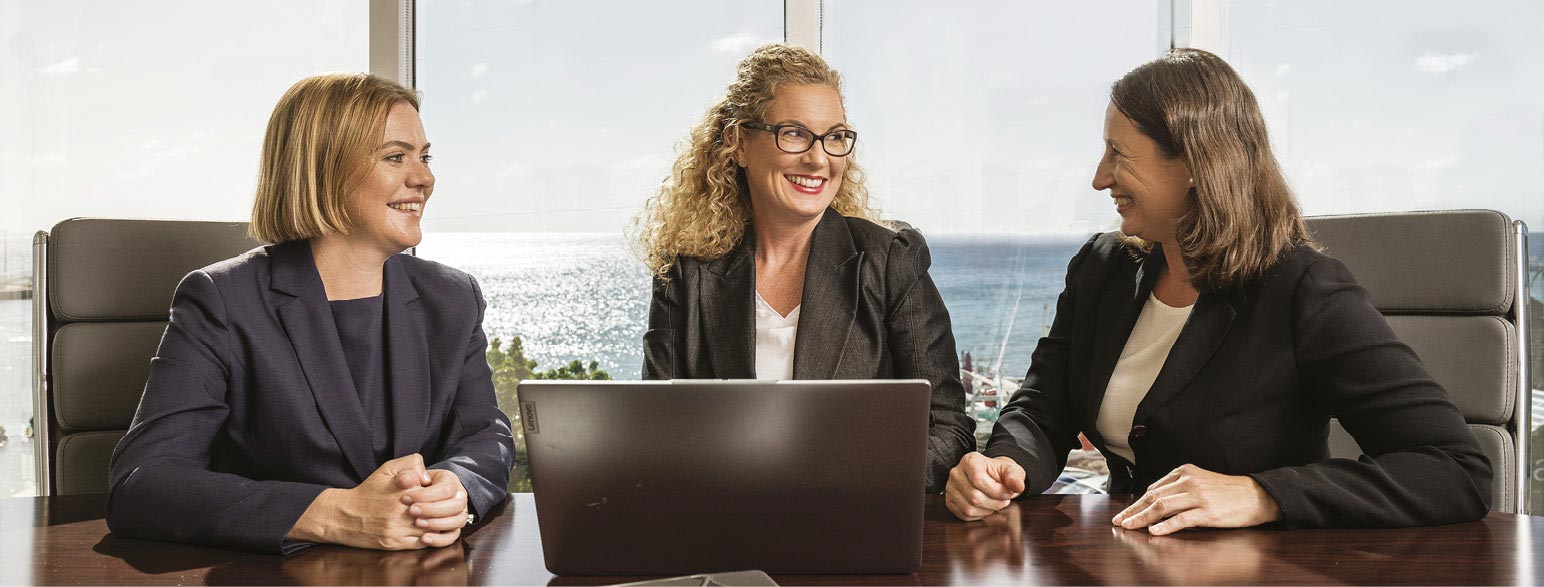
A female-founded law firm is unique in Cayman’s well-populated legal landscape.
However, the ladies of Claritas Legal Limited did not let that deter them when they launched in 2022 off the back of sister firm Claritas Compliance Limited.
The legal arm offers litigation, insolvency and regulatory legal advice, while the compliance arm offers regulatory compliance advice, largely, but not only, relating to anti-money laundering compliance.
The fact that Claritas was spearheaded by three already accomplished women – Elisabeth Lees, Katie Pearson and Justine Plenkiewicz – is only one reason the ladies believe the law firm is set apart from others in Cayman.
BOUTIQUE BENEFITS
Katie, previously partner in the litigation and insolvency department of global offshore law firm Harneys, saw the benefits for clients in approaching more boutique firms.
“There are a lot of benefits to being part of a global organisation, but for litigators there are downsides as well,” says Katie. “For example, because those firms have so many clients you have to turn down a lot of work due to conflicts of interest and often can’t act against large financial institutions.”
It is for this reason Katie says, that partners in London and the US often leave big firms to set up litigation boutique firms.
“No one had done that in Cayman,” she continues. “And, given the volume of high-profile litigation that is heard in the Grand Court here, I thought there was an obvious gap in the market for an independent, conflict-free litigation firm.”
Co-founder Elisabeth also values the personal benefits that shaping a boutique firm from conception has afforded her and the others who started the company.
“I decided that I wanted to be in control of the type of work I undertook and to provide excellent and tailored services,” she explains. “I wanted to ensure that the work and the company ethics were aligned with my own values and also with a more modern approach. Additionally, I wanted the flexibility to be able to work from home or from other countries, as required.”

BARRIERS
As with most industries, there are still barriers for women in the legal profession, particularly those balancing careers with child-rearing or caregiving, notes Katie.
“Law firms are very conservative, and many of the structures and processes they follow have been in place for decades, and date from a time when there were few, if any, women at the senior levels of the profession, and when there was certainly no expectation that you would be a lawyer and also have significant caregiving responsibilities (because you would have a wife at home to handle all of that),” she says.
“They were literally designed ‘by men for men’. While progress is being made, I think this can still be seen in expectations around billable hours, attitudes towards remote and flexible working, and partner compensation models.”
While Elisabeth says that for the most part she has been treated fairly and equally, she does notice the inequality in the profession.
“The challenges manifest themselves in more subtle ways,” she says. “For example, at the International Bar Association Women Lawyers’ Committee it was shocking how many female lawyers, often partners at top firms, had been subject to some form of inappropriate comment or touching during their careers.”
Progress is evident, however. “I am delighted that we have very recently had our first female Court of Appeal judge appointed and, of course, our first female chief justice,” Elisabeth points out. “In the Cayman Islands, we also have lots of female role models. The first director of public prosecutions was female and my previous boss Cheryll Richards K.C. now sits as a judge of the Grand Court.”
BALANCE
Alongside their regular work days is time spent with family and community involvement. One of the firm’s core values is inclusion and, as such, it has sponsored organisations with a focus on this, including Inclusion Cayman and the Cayman Youth Choir (which is open to children for free), as well as a women empowerment conference, encouraging adolescent females with their career paths.
Katie also sits on the education committee of Cayman’s Restructuring and Insolvency Specialists Association, while Elisabeth does the same for the Cayman Islands Compliance Association, as well as being deputy chair of the Health Appeals Tribunal.
“These [positions] offer opportunities to give back, and to be involved in the community,” says Elisabeth, who admits that balance is something she strives for, but finds difficult to achieve.
“I think the key is to be present in whatever you are doing,” she says. “That is, to be present for work and not worrying about family responsibilities and, equally, to be present with my two young children when I am with them.”
Katie also has the challenge of balancing work and family life with two primary-school aged daughters.
“I am absolutely ruthless with my time and say no to a lot of things because I hate the stress of being over-committed,” she says.
This article originally appeared in Compass Media’s CayWoman newspaper supplement.
Related Videos