Earlier this month, Carrie Harding of the Cayman Islands Family Office Association caught up with Williams Racing F1 driver, Alex Albon.
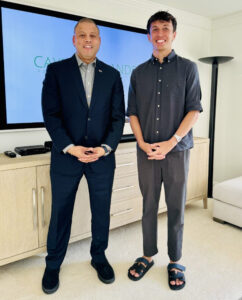
During a reception for members of the association held at The Ritz-Carlton, Grand Cayman, Carrie asked him about his career, aspirations, investment strategy and precious downtime.
Albon was visiting the Cayman Islands with his girlfriend and LPGA Tour player, Lily Muni He, for a few days of R&R following the Miami F1 Grand Prix, before returning to Europe to continue the race season.
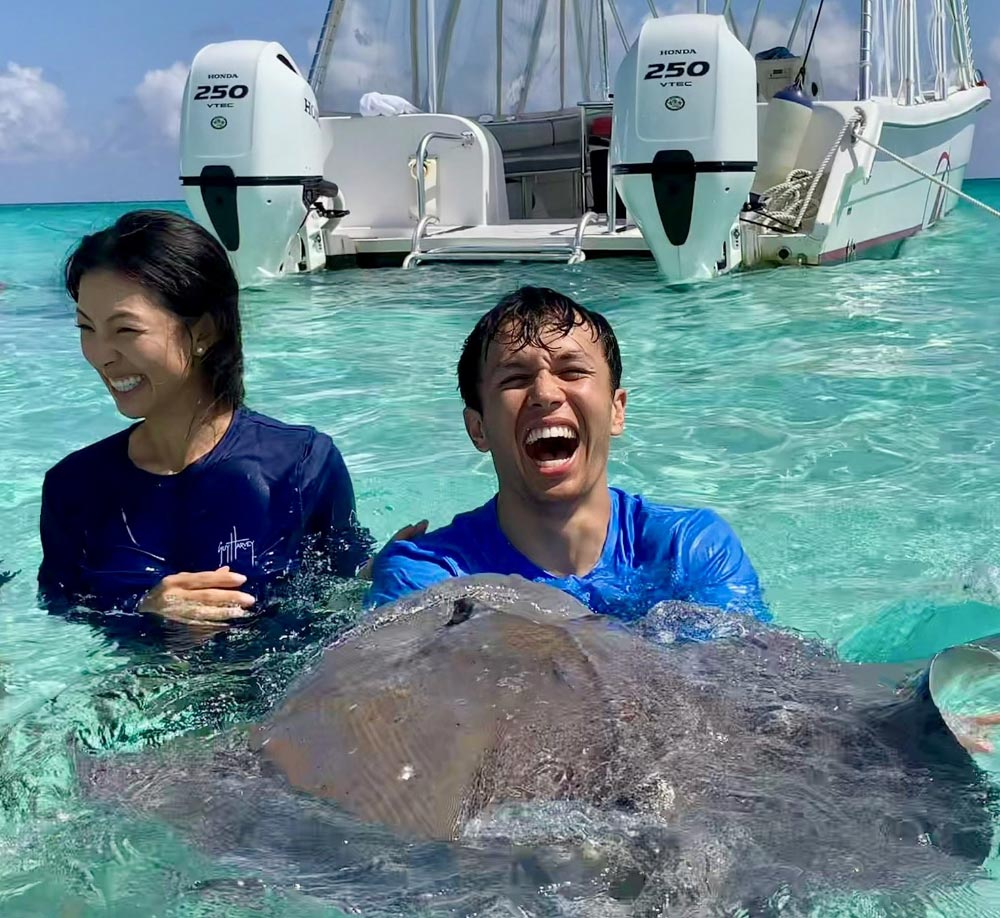
During his visit, he kissed four stingrays, reportedly bringing him 28 years of good luck.
He also signed a multi-year contract extension with Williams, taking their partnership into the new era of Formula 1 regulations.
Carrie: Can you share with us a bit about your early life and how your upbringing influenced your passion for racing?
Alex: My Dad was passionate about motor racing and got me into the sport, firstly as a hobby. He was my engineer, my driving coach, my mechanic. In the very beginning, it was very much a father and son racing, and quite pure. I was about 7-years-old when he bought me my first go-kart and we lived by a farm, so the farmer would let us use the concrete barn, and after school my dad would lay some bricks out and I would drive in a figure eight, constantly, doing 10 or 20 laps until I was dizzy and he would take my time with a stopwatch. That’s how it started. He was the guy who got it all started for me and by the time I was 12-years-old, well that is when you have to start thinking about getting into a racing team. And that’s when it starts to get expensive.
Carrie: We understand that Lando Norris has life-size posters of you in his home. He does this to inspire him and clearly it worked in Miami. Can you share with us, other than your Dad, who has inspired you during your race career?
Alex: Michael Schumacher. He was my poster child growing up. It got to a scary level. I had a red bedroom, I got my Dad to paint it red, and I had a red bed, red pyjamas, red alarm clock, my carpet was even red. The whole place looked like a crime scene. I was a huge fan of Ferrari and of Michael, and he was clearly my inspiration. I remember going to Silverstone, that was my first F1 race that I went to and there was a circuit competition. You had to give the predicted results of the first three drivers in the race and so I put my three favourite drivers down, as I didn’t know any better. Two of the three drivers I chose were starting from the pit lane because they qualified badly the day before. Somehow, the three drivers I picked finished in the top three. I think I was 6-years-old at the time and I got to go on stage in front of this huge crowd and meet Michael; that was my introduction to following him.
Carrie: Talk us through a typical race day routine for you and how you physically and mentally prepare for a race weekend.
Alex: It’s all about routine and consistency. I have been in F1 for six years, so long enough to understand what works for me and what doesn’t, and I’ve learnt this over time. So, the mornings are simple. You try to eat a very bland simple breakfast, as obviously when you are driving around in fast cars you don’t want your breakfast sloshing around. So, usually, we eat something like mashed sweet potato, or scrambled eggs; nothing too hard on your body. My trainer measures my hydration, so we do my osmosis in the morning each day, and that’s because we sweat so much during our sessions. Weight is also very important; we are trying to be as light as we can while still being hydrated, so for qualifying days, we’re a bit like boxers, we’ll try to lose all the water weight so we can shave off about a kilo ready for the qualifying session, and then on Saturday night, after qualifying, we will hydrate and then go into the race as hydrated as possible. We will then go to the track and run through the normal warm-up drills. We start at feet level to keep moving and work our way up towards the neck, which is one of the most important parts of our body due to the physical stresses the F1 cars put us under. Trying to keep your neck mobilised and strong is key. If you don’t warm up your neck in an F1 car, and just go out and drive, though it won’t snap, you will have some serious issues.
Carrie: What aspects of being an F1 driver do you find the most challenging?
Alex: I think it differs from driver to driver, but for me it’s the spotlight of Formula 1. It depends on what motivates you and the reasons you enjoy being a racing driver, but the spotlight and attention hasn’t been something I enjoy or feel comfortable with. The driving is the easiest part, it’s the part we have all done from 6 or 7 years of age. Speed is easy, so driving an F1 car for the first time never felt scary, but it was actually the noise around being an F1 driver that was unexpected. I have a strong memory of my first F1 test and driving the car for the first time. I was in Barcelona. I did half a lap and I spun. I thought, “oh no”, but a simple mistake like this, we’ve all done a million times before, it’s ok. But as I came back to the garage, there were 40 or so photographers waiting for me and that was the difference right there. You are under a microscope, and you have to be able to deal with that, and still perform. When you race in Formula 2 it is much lower key, you are only speaking to your mechanic and your engineers. Formula 1 is very different. The structure of Formula 1 and having a team around you is awesome to safeguard you from all the external factors within the sport.
Carrie: Could you share any behind-the-scenes anecdotes or experiences from your time in F1?
Alex: I would say the celebrities keep it interesting. We had Brad Pitt join us for a driver’s briefing one time. They are doing a movie right now, and he has been joining us quite a lot. It’s interesting. He showed us the trailer for the movie, a couple of races ago, and the first thing was a massive crash and explosion. It looks great, if very dramatic. Meeting the celebrities is obviously fun and interesting, it doesn’t bother me too much as I am so focused on my job at the track, but I can see how it’s easy for people to get blinded by that. Nothing crazy really happens in F1. It is seen as glamorous and fun, but on the inside and behind the scenes, it’s technology led and very serious.
Carrie: Did you get a selfie with Brad?
Alex: Yeah, I did. But this was a first, and it is Brad.
Carrie: What are your thoughts on people and companies sponsoring and investing in F1, and can you explain to us why it’s good business?
Alex: F1 is very appealing to the younger generation now. If you look at where F1 was 20 years ago, and before Drive to Survive, that Netflix series has really transformed the commercial side of F1 and broadened its audience. Nowadays, Lily and I find when we’re walking a street track, a lot of the fans treat us more like K-Pop stars. It’s very different to previous generations’ fan base. Formula 1 is so global, when you think about the technology we use, it has a huge reach, and sponsorship appeal is now truly global. For example, I have Thai heritage and there are Thai brands that want global reach, so it makes sense for them to partner with me and reap the rewards, especially whilst F1 is going through this massive growth phase.
Carrie: With the world’s private banks competing to take on F1 drivers, can you share why you chose a family office, and why you chose Cayman?
Alex: At the start, I was so caught up in the world of racing I wasn’t very good at managing my finances, which is probably true of most kids growing up. When I got into F1, I didn’t really know who to trust and what direction to go in. I remember a lot of banks approaching me and I didn’t know what to do. I heard about Panthera through a colleague of mine, and it became clear that this was a group I could trust, who weren’t going to sell to me, and would help me find a structure unique to me that works for me. I want to be able to focus entirely on racing and leave everything else in expert hands. Panthera having offices in London, Cayman and Singapore, and the way they can manage my investments and my day-to-day needs, is really important to me. It gives me peace of mind. I can race, knowing I am being taken care of.
Carrie: What are your first impressions of our beautiful island and can you see yourself living here?
Alex: Lily lives in Los Angeles and I live in Monaco, so a lot of how we live is long distance. We have been to a lot of hotels around Arkansas, and to middle-of-nowhere places, with maybe four connecting flights to get us there. Cayman is ideal from a logistics standpoint for us. Coming from the UK is direct and easy, and for Lily to travel back and forth to LA is a direct flight, too. We have discovered that the general consideration for health and wellness and food here is incredible and at the highest level. We struggle to find places to spend time where we can get down to some proper training and manage nutrition, but also relax. Lily was on the golf course yesterday and today, and we feel we’ve found a perfect place where we can focus on ourselves and enjoy great weather. The first thing I did after three hours here, was look at real estate websites. This is a place where we would consider spending a lot more time. I know George (Russell) was here a week or so ago, just before the race, so maybe we can split a property between us.
Carrie: Talk us through what has been the most memorable moment of your racing career so far.
Alex: I would say my first race in Formula 1. We were in Australia at the time, and I remember the lights going out and how nervous I was. In Formula 1 we have a hand clutch, and I remember holding my clutch and seeing the lights counting down. I was so nervous; my hand was shaking so much, and I was trying so hard to make sure I didn’t stall the car. To experience my first F1 race, that whole weekend, in fact, I remember it like it was yesterday because honestly it had always been a dream of mine. To live it was like a fairytale.
Carrie: Can you share what you enjoy doing in your free time, when you are away from the track?
Alex: It depends. After a race Sunday I’m actually very happy to lie on the couch and binge-watch Netflix for a day to help get my energy back. In some ways, I am so much in the spotlight it’s nice to get away from it. I love travelling and I love food, and I love travelling for food. Lily and I are big foodies. And we love photography, we share a lot of common interests. Of course, I love golf as well, but it’s really hard for me to enjoy it because of Lily. I get very frustrated, because, clearly, I am not as good as her.
Carrie: What are your aspirations for your career in F1 and beyond?
Alex: I want to become world champion, and it is a journey to achieve that. I know it won’t come instantly, so the focus is on creating a system and a plan to achieve it. That’s the goal. And before that, it’s to win my first Formula 1 race. As a kid I had this four-tier goal system, firstly to become a Formula 1 driver, secondly to score my first podium, then to win a race and to become a world champion. I’ve achieved two of those goals so far. The other two are still to come.
I also want to give back and establish a way to create opportunities for Thai youth in the world of motorsport; not just drivers, but create opportunities for mechanics and crew. Asia isn’t currently a great training ground for this. This is the reason you don’t really see any Southeast Asian drivers in F1 because the only way you can achieve that is to be schooled at boarding school in Europe and become ‘European’. To be the best, you need to be where the best are, and that’s in Europe right now.
In wrapping up the conversation, Alex shared some memorable insights from the recent visit, including kissing Cayman’s southern stingrays, walks on Seven Mile Beach, nine rounds at The Ritz-Carlton Golf Club, working out at the REC Room, and discovering two favourite dining spots on island: Tillies and Chicken-Chicken. Cayman’s crystal-clear waters, vibrant marine life, and welcoming community provided the perfect setting for the couple to relax and rejuvenate. As Alex gears up for the challenges ahead in the Formula 1 season, we hope it’s not long before we see him back on our beautiful shores, enjoying all that the Cayman Islands has to offer.
Thank you, Alex, for sharing your experiences, and best of luck on the track.

Related Videos