It sounds like the opening of a Steven Spielberg movie: Two young boys, exploring the mangroves near their home, stumble on the sunken wreckage of an aircraft, dragging up a long-forgotten mystery.
Stained with sediment, the rusting pieces of machinery – likely from a small prop plane – could have lain untouched for decades until they were pulled from the brackish water by Felix Feik, 9, and his friend, Chad Franklin, 10, earlier this month.
But where did the plane come from and who was in the cockpit when it went down?
The Compass trawled through the archives and consulted with local aviators to help the young explorers investigate the origins of their mysterious find.
The wreckage in the swamp
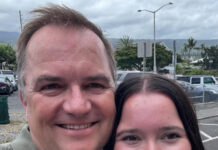
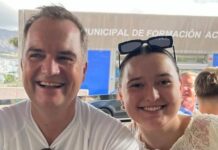
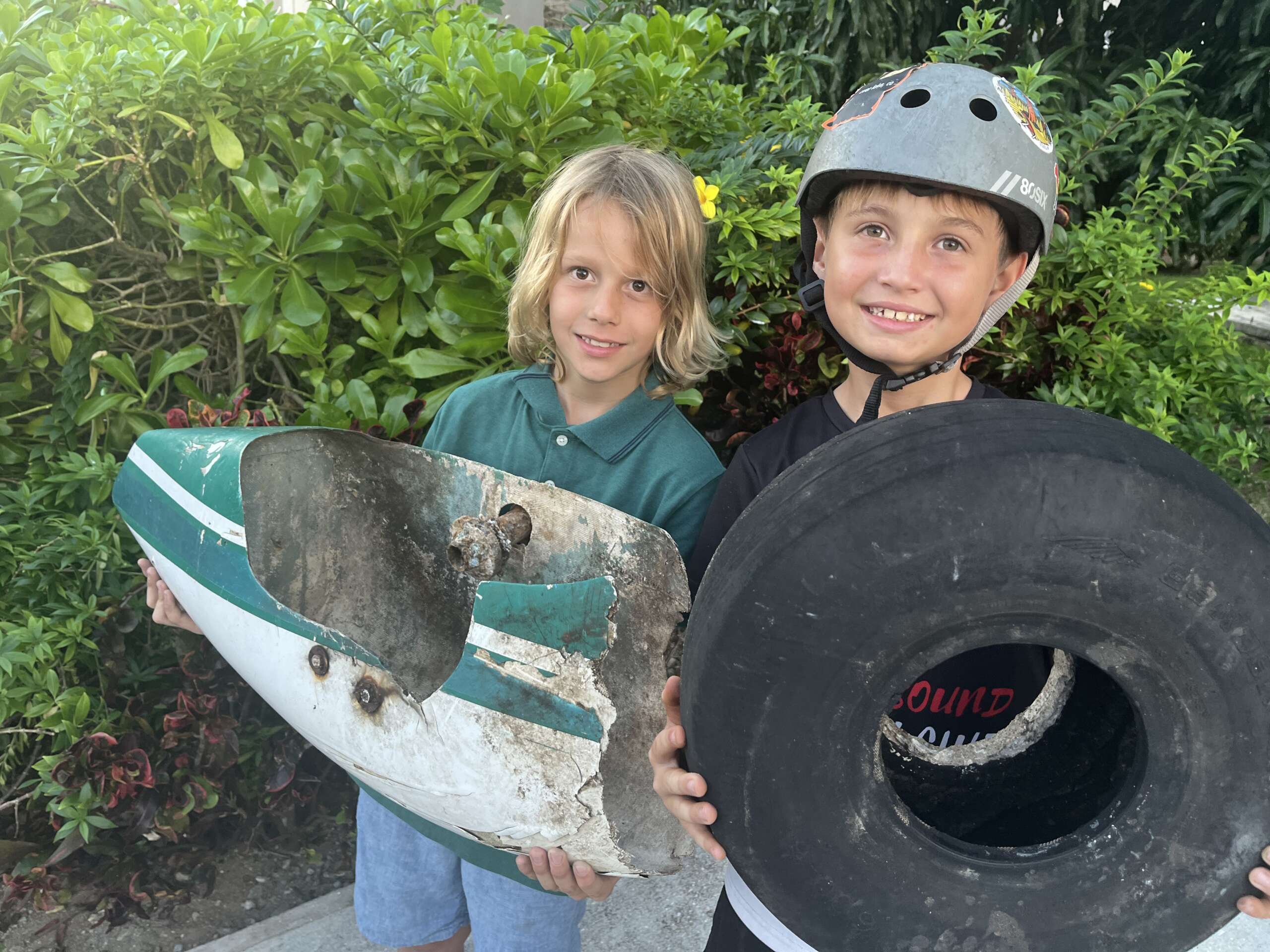
Felix and Chad, who live in an apartment complex in George Town near the mangrove swamp, discovered the remnants of what they assumed was a plane.
“It is a wheel, it looks like it must be from a plane because I actually got to fly on one in real life,” Felix told the Compass.
Chad stood next to him, as they proudly showed off what are almost certainly parts of an aircraft, including a wheel cover, a wheel and possibly a steering assembly.
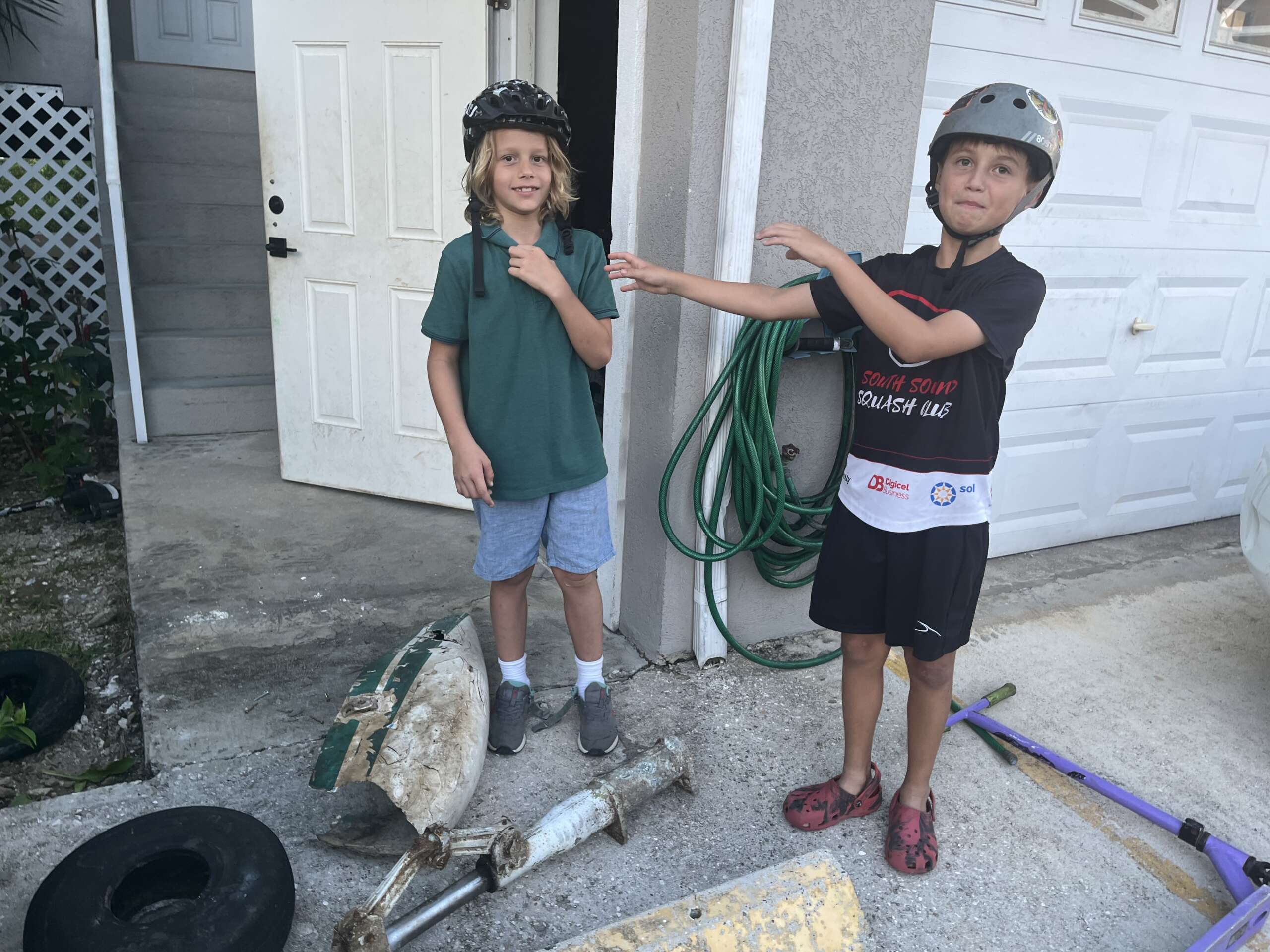
“We weren’t that far back in there,” said Chad, “but I lost one of my shoes in the swamp and my friend Felix went up to his waist in the mud. So while we are pretty sure there are still more parts back there, our parents have told us we now have to wait until dry season before we can go back there any further to locate the wings and other parts of the plane.”
Felix’s mother Melanie laughed as she said, “I told them that if they find a suitcase with cash, they have to report it to their parents immediately.”
Early theories
So where did the mystery plane come from, who did it belong to, and how did it end up in a mangrove swamp off Old Crewe Road in George Town?
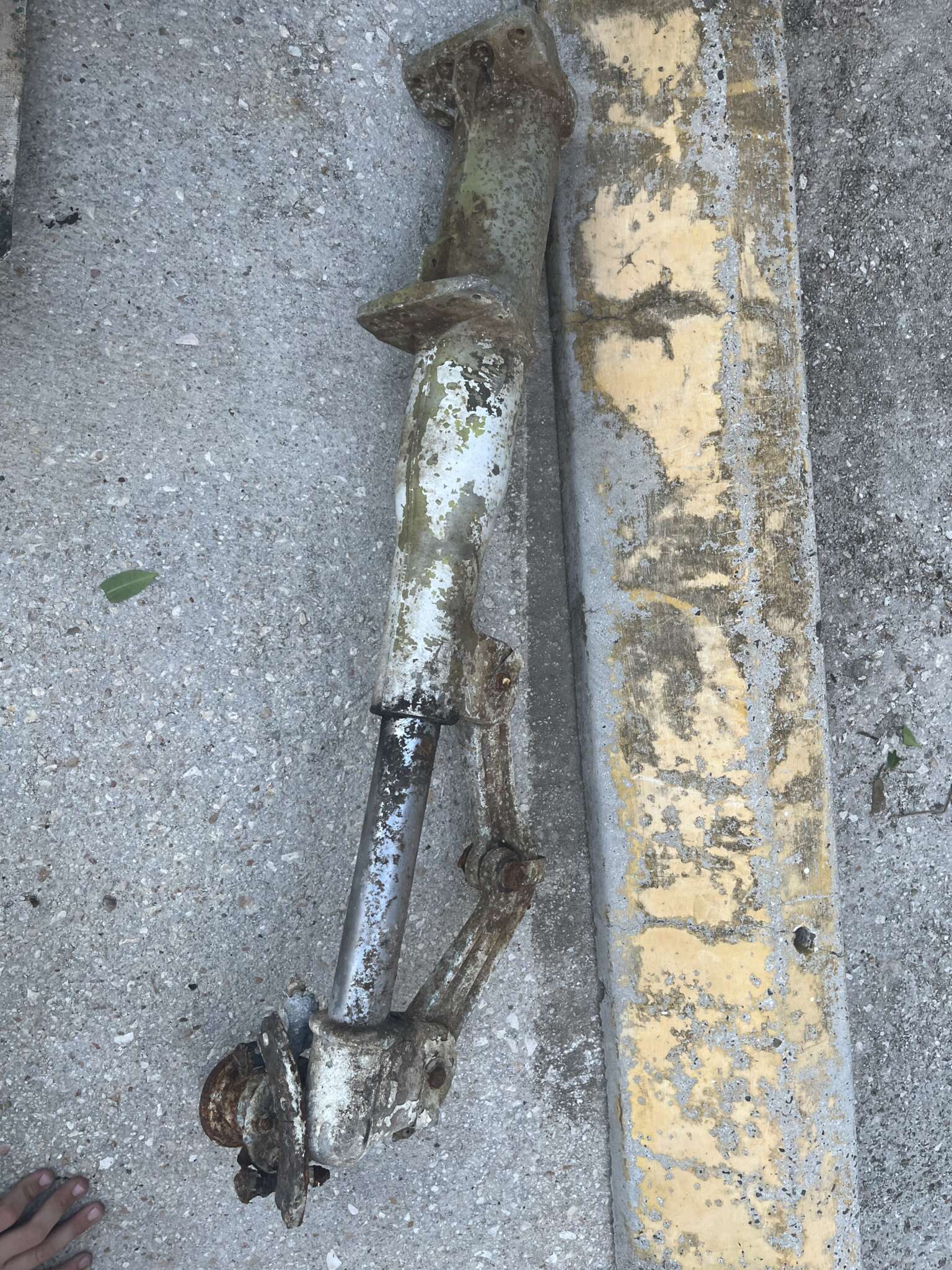
Cayman Islands aviation pioneer Richard Arch suggested the parts originated from a small plane like a Cessna.
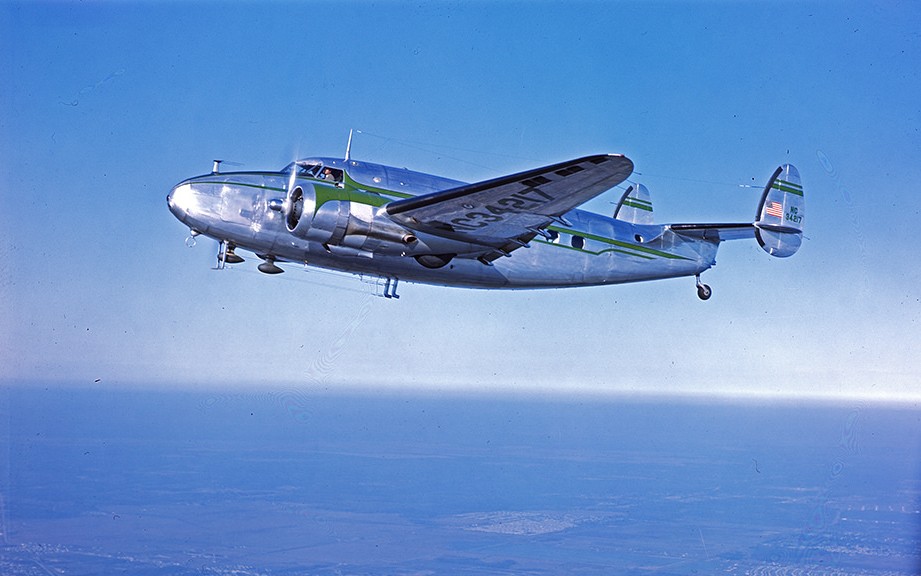
Based on the visual evidence he was shown, he ruled out the possibility that the parts came from the Lockheed Lodestar plane that departed Grand Cayman on Good Friday, 1975, bound for Fort Lauderdale, and vanished without a trace, with Captain Bill Kronick, co-pilot Carlton Bodden and two other Caymanians, Mark Cox, 18, and Steve Miller, 20 on board.
“Also, I am almost certain that the parts of the aircraft they found are not from the Cessna that crashed at the airport about 30 years ago, resulting in the first air fatality in the Cayman Islands history,” Arch said. “That aircraft was a Cessna and Tom Hubble died in the crash, but the landing gear sustained far more damage so it cannot be from that tragic accident.”
He did have another theory.
“About 30 years ago, the maintenance area at our airport in George Town was cleaned up for the construction of the Cayman Airways hangar, and someone might have taken those parts from that area,” he suggested, and he referred the Compass to a pilot to continue our investigation into the mystery plane discovery.
Other plane crashes
Captain Joey Jackson said there have been other small-aircraft crashes in the past, and while he thought the parts could have come from one of those planes, he could not explain how the pieces might have ended up in a George Town swamp.
“I recall that on 23 April, 1996, Wayne Hasson left Owen Roberts in a Cessna 182 heading for Cuba, and shortly after taking off, the aircraft lost power, but he was able to land the plane in Cayman Kai. He ended up in the backyard of Burns Rutty’s house on Finger Cay,” he said.
He added, “The plane subsequently caught fire after landing but Wayne Hasson and his passenger fortunately escaped with minor injuries.”
The Compass was able to confirm this account on the Aviation Safety Network website, where it states, “According to the Deputy Director of Civil Aviation, Cayman Islands, the pilot declared an emergency about 7 minutes after departure and advised of an imminent ditching. The airplane crashed on the north side of the island and the airplane was destroyed by a post crash fire.”
Several hundred feet out into the North Sound, in about 10 feet of water lie the remains of an old PBY sea plane. According to Arch, “the plane belonged to Caribbean International Airways. The PBY was lost on departure for Tampa in 1952, but no lives were lost. I have dived that site many times looking for lobsters.”
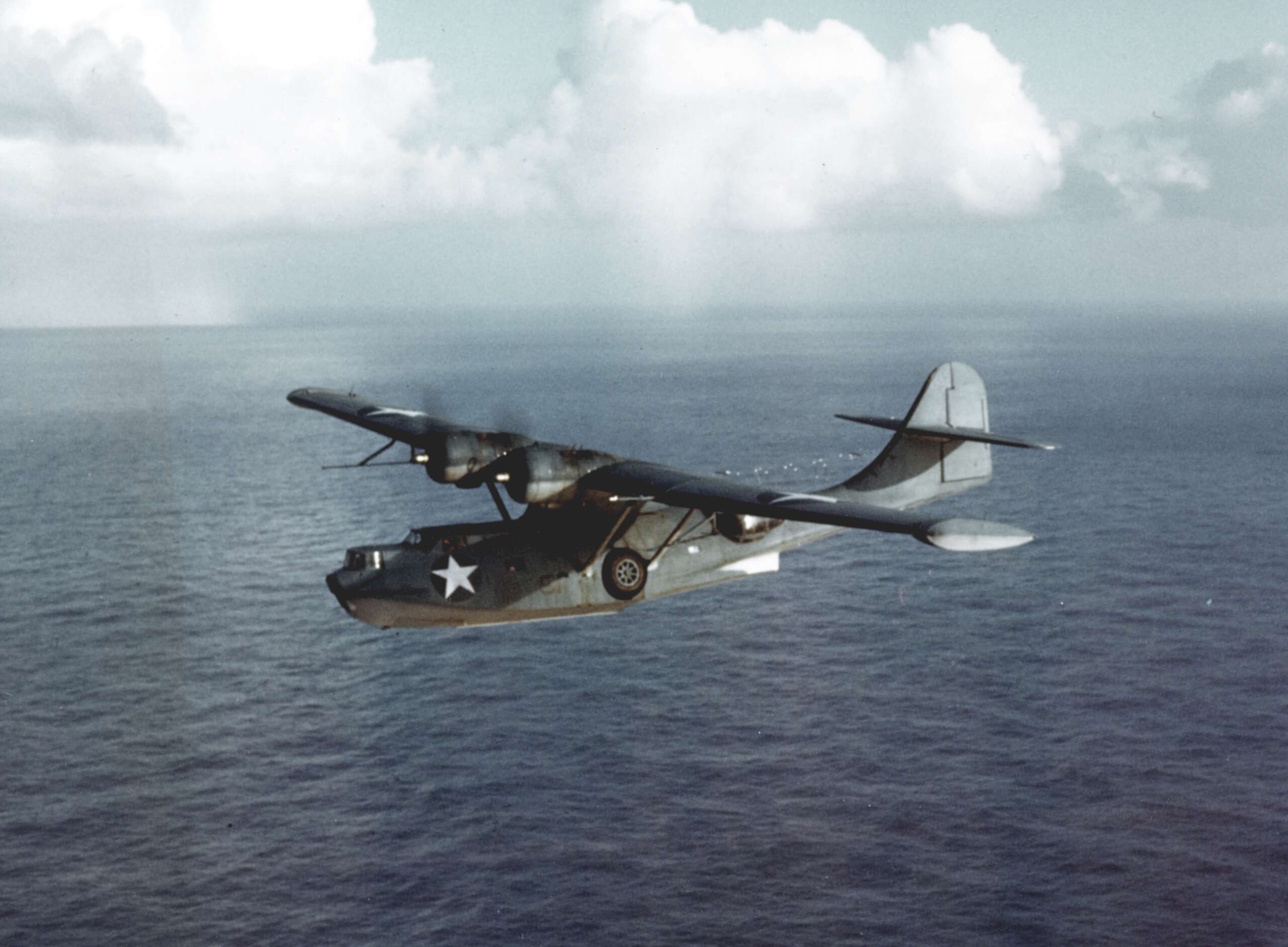
The founder of Caribbean International Airways, who owned the sea plane, was none other than Commander Owen Roberts, after whom the airport in George Town is named.
According to ‘Founded Upon the Seas’, the history book of the Cayman Islands written by Michael Craton, by 1950, Owen Roberts had established regular air service between Grand Cayman and locations in Kingston, Jamaica, Tampa, Florida and Belize. He then lobbied Cayman Islands Commissioners Ivor Smith and Andrew Gerrard to build airfields on all three of the Cayman Islands.
In 1952, construction started on the airstrip in George Town at an estimated cost of £93,000. On 28 Nov. 1952, with a crowd of several hundred onlookers in George Town, Owen Roberts piloted a PBY Catalina to a perfect landing on the partially completed airport runway, which now bears his name.
According to an article in the New York Times, during a CIA flight from Kingston to Grand Cayman on 10 April 1953, a Lodestar plane piloted by Roberts crashed on take-off in Kingston, killing 13 of the 14 people on board, including Roberts and his sister. The only survivor of the crash was Roberts’ brother-in-law, Lt.-Col. Edward Remington-Hobbs.
Missing off East End
Still trying to solve the mystery of the plane in the swamp, the Compass then got in touch with Captain Troy McCoy. When he saw the images of the pieces of the aircraft found by the boys, he too was uncertain of their origin.
However, he recalled working in the airport tower when another crash occurred.
“I was an air traffic controller and a private pilot, who I believe was named Mr. Smith, took off in a Cessna 210 on 23 May, 2002, and was headed for Edward Bodden Airfield, Little Cayman. When he was approximately 20 nautical miles east of Owens Roberts International Airport, he radioed in, saying that he had experienced a total loss of engine power and was going to ditch the airplane,” he said.
The pilot told McCoy that he thought he could see the reef line in East End.
“There was an extensive search in the area, but neither the pilot nor the plane was ever found.”
But, on seeing the images of the parts the boys recovered in the swamp, McCoy did not believe it was the same aircraft.
“The colour scheme was different, the plane that went down off East End had a burgundy and tan colour scheme,” he said.
Crash landing for a cartel
A Compass article from 2012 provides details of a crash of a Cessna 210 aircraft in November 2011 in which the pilots attempted to make an emergency landing on a road in Cayman Brac.
A senior officer in the RCIPS said at the time that the plane never intended to land in the Brac and flight data from the aircraft showed it had been regularly travelling from a farm near the Columbia/Venezuela border to Belize. The investigations led the police to the conclusion that the aircraft belonged to the Sinaloa cartel.
“The aircraft probably suffered an electrical failure which prevented use of the modified fuel system intended to provide additional [travelling] range,” investigators from the UK’s Air Accidents Investigation Branch concluded. “The aircraft then deviated from its original flight path, possibly because the crew intended to divert to Cuba, and its track passed over Cayman Brac.”
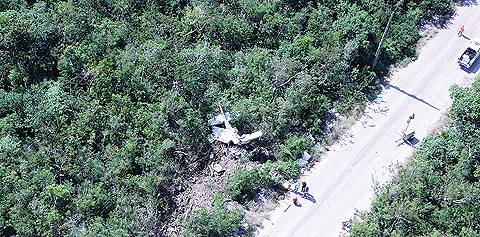
The two men piloting the small plane, one from Mexico and the other from Columbia, died when the craft collided with two light poles in a heavily wooded and largely undeveloped area of road about nine miles northeast of Charles Kirkconnell International Airport.
It is highly unlikely, however, that the debris from that plane crash was transported to Grand Cayman and then deposited in the mangrove forest off Old Crewe Road.
Two other unlikely contenders for the aircraft parts include two aircraft that came down in the sea.
One was a Cessna Agwagon operated by the Mosquito Research and Control Unit (MRCU) that crashed into the North Sound on 12 Aug. 1980 with the pilot unharmed.
The other was a Piper Navajo Chieftain that was heading to Cayman from Lakeland Florida on 17 May 1981. According to the accident report, the pilot miscalculated the fuel consumption, ran out of fuel and ditched in the sea seven miles from the Owen Roberts International Airport. Both the pilot and the passenger on board the Piper Navajo Chieftain were also unharmed.
Mystery solved
The mystery about the plane found in the mangrove thicket was finally solved by Chris McCoy, deputy maintenance manager of production at Cayman Airways.
When shown the images of the boys holding up parts of the plane, he instantly recognised it.
“That’s actually a wheel cover off of the Cherokee 6 that was flipped over and over again by the MRCU old hangar during Hurricane Ivan,” he said, adding, “That was her paint scheme.”
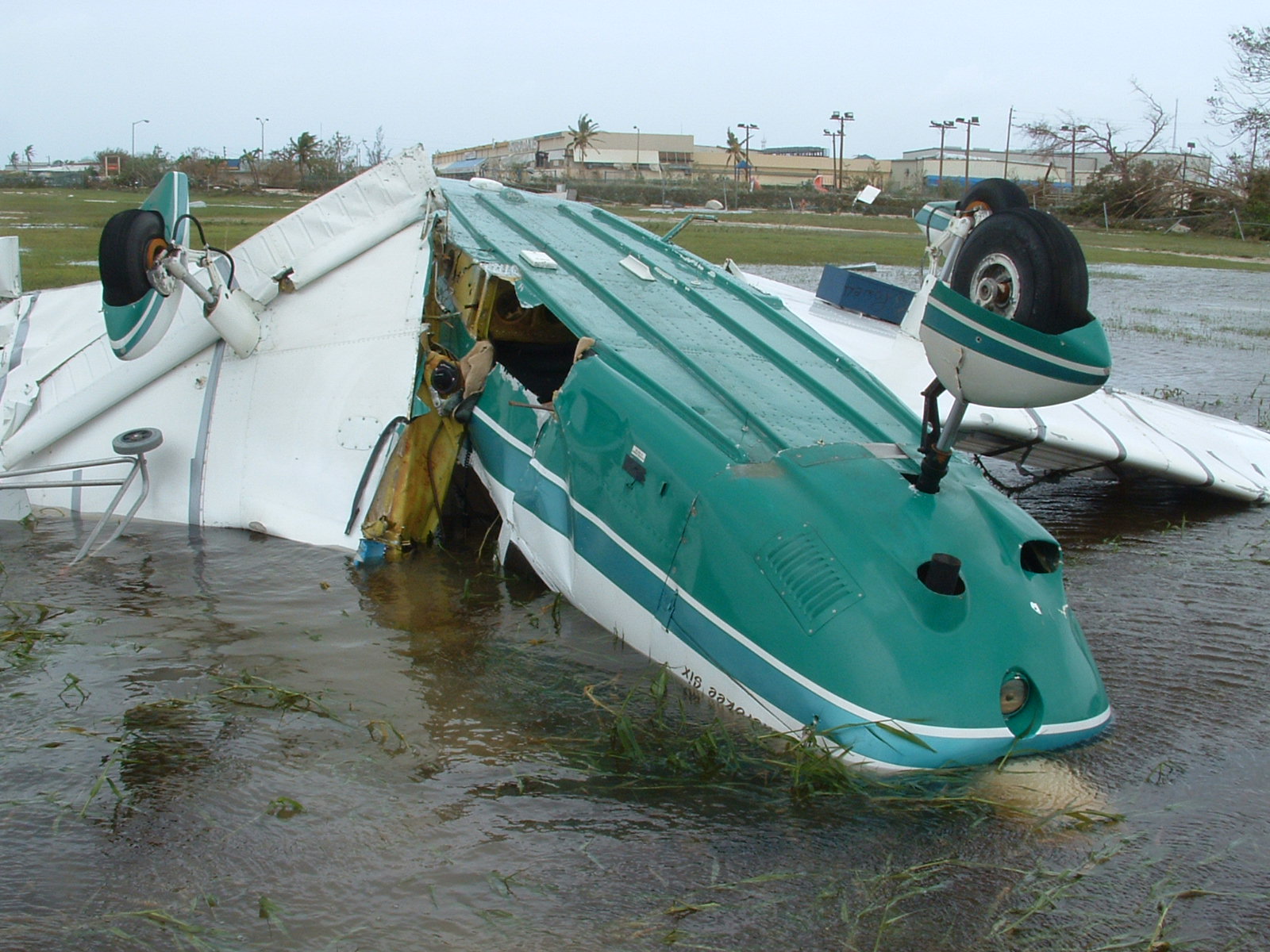
“Carl (Chris’s brother) and I purchased her (the Cherokee 6) for the Flying Club in 2000 and Ivan totalled her in September ’04,” he said.
However, he has no idea how parts of the plane ended up in the mangrove forest off Old Crewe Road.
“We had her fully insured, or so we thought, with a branch of Lloyd’s of London insurance company and, as it turned out, the insurance company was fake and used Lloyd’s emblem and logo.
“We never got a penny for her, and she was insured for $80,000. They just disappeared and would not contact anyone, and nobody could contact them. It was a terrible experience, but we were all concerned more about survival and getting our houses, cars and lives back to normal after the hurricane,” he said.
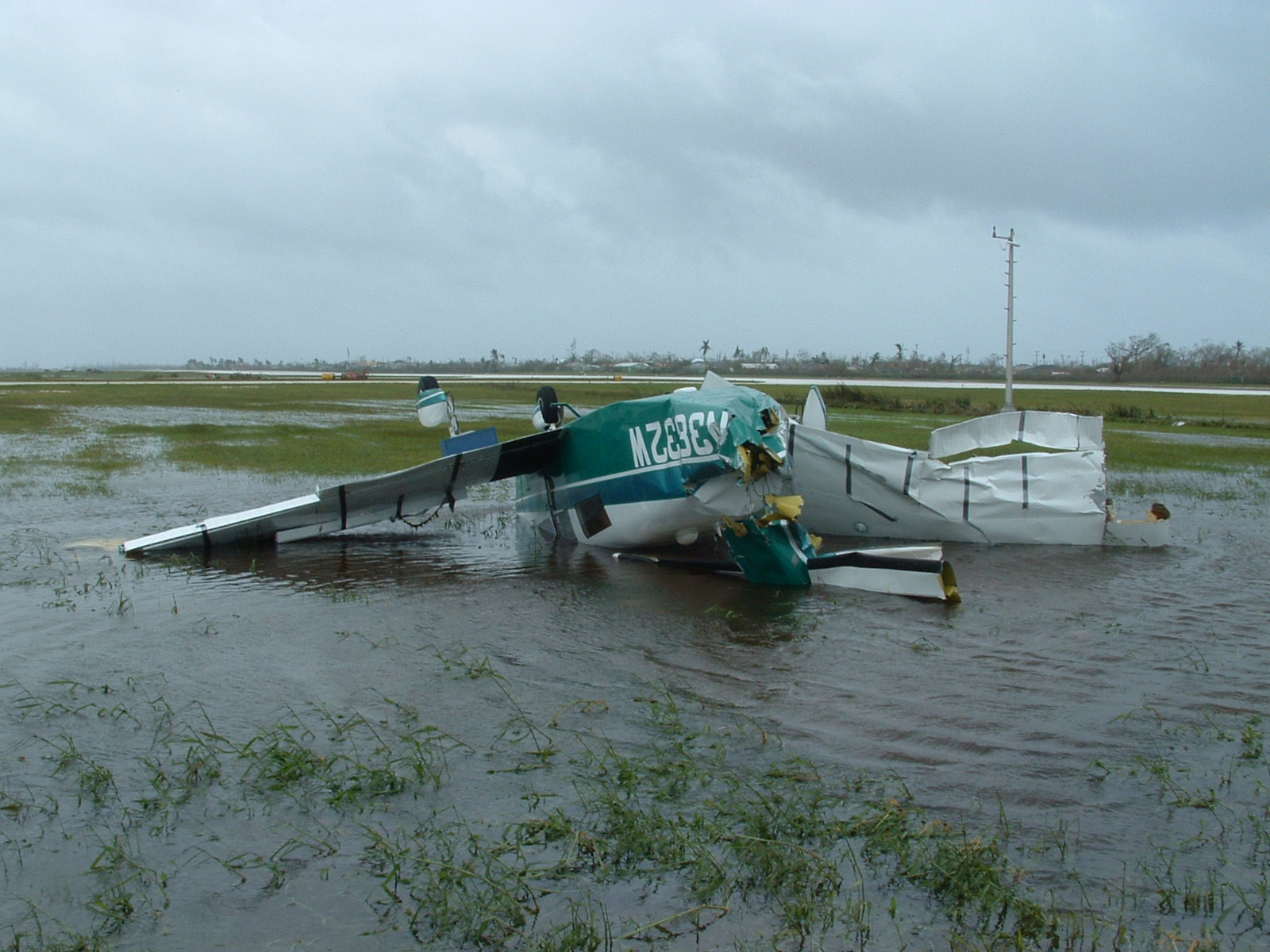
He explained that, in addition to the Piper Cherokee 6, Hurricane Ivan destroyed his own Tomahawk aircraft and several other planes.
“There was a Cessna 172 that had the wing torn off right there in front of the hangar,” he recalled. “There was also a push and pull Cessna Skymaster that flipped over on its back and that was totalled.”
He said the helicopter owned by Cayman Islands Helicopter was another victim of Ivan.
“All the windows got blown out and they decided to ship it back to Canada to get her overhauled. Turns out they couldn’t find her when they shipped her to Canada via Miami.
“They found her. I think, about six months later. Somehow the container got transshipped to Africa, and by the time they found her, she was upside down on her spinner, totalled. So, insurance paid them off for that fully, but that was the original Cayman Islands helicopter, the gold one.
“What Ivan didn’t do, they certainly destroyed her by the time she got to Africa. How in the world she got upside down in the container, I have no clue.”
Meanwhile, with the mystery now solved, Felix and Chad are biding their time until the weather gets better.
“We hope to find more parts of the plane maybe in the dry season, when there is less water,” said Felix.
Related Videos