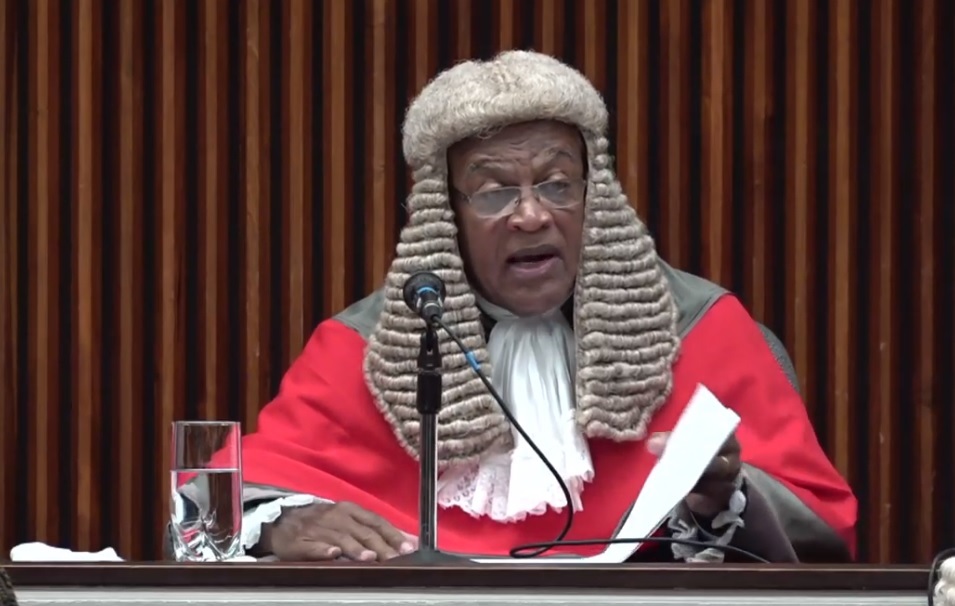
As he takes up his new role on the Judicial Committee of the Privy Council, Cayman’s former chief justice, Sir Anthony Smellie, said his decades of experience could help inform the body’s decisions.
Smellie explained the Privy Council hears appeals from a string of countries with links to the UK, including Cayman and his homeland of Jamaica, saying his years of work in the Caribbean would be useful on that court.
“It’s a wonderful opportunity and I hope my participation in their deliberations will be meaningful,” he said.
Smellie, speaking exclusively to the Compass, added, “It’s experience more than skills, I would think – any long-serving judge in the English-speaking world such as myself has acquired a significant amount of experience in the sort of cases that end up at the Privy Council.
“I do hope that my experience there is of benefit to the deliberations of the court.”
Smellie was speaking after it was announced last week that he was to be elevated to the Privy Council, which sits primarily in London, but also elsewhere, including in Cayman in 2022.
He retired as chief justice in 2022 after almost 25 years in the job, but has continued to sit as a Court of Appeal judge in Cayman and in Bermuda.
Smellie will commute from Cayman, where he continues to live, to London to sit on cases.
He said the role of the Privy Council was important because appellate courts “strive for consensus” which was likely to encourage confidence in its judgments.
Smellie added that Cayman’s common law system was a crucial part of its appeal to international business.
“Cayman is not just about tax – it’s not just a tax haven. In many respects, the outcome can be tax neutral,” he said.
Smellie highlighted that people who earned dividends in Cayman would pay tax on them in the jurisdictions in which they lived.
But he said Cayman remained an attractive destination for capital because of “competent judges, competent laws, a stable government and a predictable environment”.
The Judicial Committee of the Privy Council was set up in 1833 and remains the highest court for the 14 UK overseas territories, as well as three Crown dependencies and some Commonwealth countries.
Its judges are drawn mostly from the UK Supreme Court, but appellate judges from other places are also asked to sit.
Related Videos