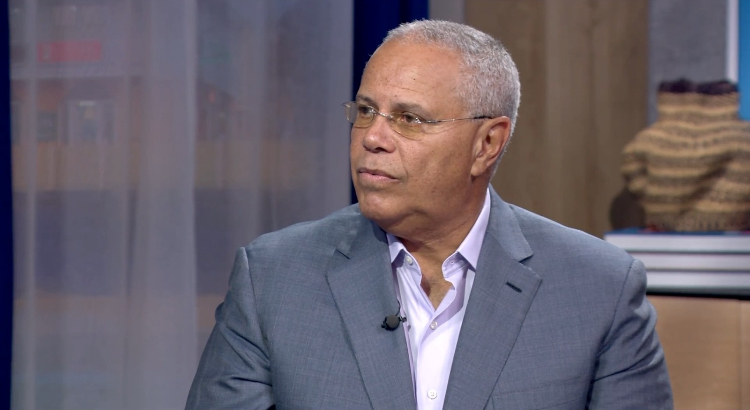
Cayman Islands National Party leader Dan Scott sat down with Compass Media’s Tammi Sulliman recently to outline his and his political party’s stances on a diverse range of topics, including education, immigration, workforce development and cost of living.
Addressing the argument levelled often by his party’s opponents, that he leads a group of neophytes with no political experience, Scott, a former partner at the EY accountancy firm, stated, “What we say to that is that’s a good thing, because I think, unfortunately, when you look at those who claim to have all this experience, the results have been abhorrent.”
He added that even members of the civil service had found working with recently serving politicians “difficult”, as policies were confusing and hard to implement, and ultimately the civil servants themselves ended up being blamed for the government’s failures, which he said was “completely unfair”.
“These are people who have committed their lifetime or career to doing good work, and politicians just simply turn and blame them, as opposed to engaging, understanding, taking advice, taking guidance. … You’re not a leader because you’ve got a title. You’re a leader because people will follow you. They will follow your vision. Our team understands that.”
He added that members of his team have run successful businesses across a broad spectrum of industries, “leading people, making people-centric decisions” – an approach they would bring with him into Parliament if elected.
Scott also revealed that, though he is currently the leader of the CINP as the fledgling party seeks seats in its first election, following the poll on 30 April, regardless of how many seats are won, its members will take their own vote to determine if he, or someone else, would take up the mantle as its leader. This approach, he said, would ensure the party’s own democracy and transparency.
Fiscal responsibility
With a recent pre-election economic forecast showing Cayman facing a $26.2 million deficit by the end of this year, whichever party gains power will have some tough economic decisions ahead.
Scott, when asked what the CINP plans to do on that front, told Sulliman, “I think the whole country should be concerned about what we’re walking into. But as with anything, the only way to fix it is to roll up the sleeves, do surgery and start over.”
What his government would not be doing, he said, was laying off civil servants in a bid to cut headcount. “We have to preserve what we have. We look at our Caymanians and the civil servants, and in spite of where we’re at, we have to make sure we’re also taking care of them,” he said.
However, he said, if elected, his party would roll back salary increases for elected officials and take away their government-supplied vehicles. “People are going to drive their own cars to work,” he said.
Education
Addressing the issue of education in Cayman, Scott, a former chairman of the Education Council – a body that advises the Ministry of Education – acknowledged that what happens in Cayman’s classrooms is perhaps one of the biggest issues for the islands.
Recalling his dad, teacher Layman E. Scott Snr., after whom the Cayman Brac high school is named, he said when he was growing up, at the family’s dining room table, there were often some of his father’s pupils there.
“He was working with them because teachers matter. Teachers matter a great deal. We can all think back which teacher inspired us, or, frankly, which teacher deflated us. We have to get back to focusing on teachers who care and care deeply about the results and provide the support and infrastructure for that.”
He added that it was important to give schools more authority so that they can perform. “The principal is your CEO,” he said. “They need to be able to pick their team.”
Scott says he also wants to see many more Caymanian teachers in schools, stating that not enough was being done to recruit and retain local educators. Ensuring adequate salary increases for teachers was vital, he said, as well as not promoting talented educators out of the classroom “where they were so desperately needed and they loved”.
Focusing on teacher quality was fundamental to tackling the fact that “60% of our graduates are below the required standard”.
Workforce development
Inextricably linked to education is future-proofing Cayman’s workforce, ensuring that the students and graduates of today are prepared with the skills and qualifications needed for the jobs they will be applying for.
“We are a knowledge-based economy, top to bottom, whatever you’re doing, even if it is working with your hands, whether you’re an electrician; it is all about knowledge and technology, and how do you harness that?” he said.
He added that children are already using technology, so “we need to be more focused on having that in our curriculum at a much earlier stage”. Stating that while many students may not be interested in academics, “you give them a computer and they’re whizzes”.
“The world is not going to wait on us,” he said. “We need to be front-footed on this. … We need to be at the spot before the ball is passed so we can score the goal.”
Ensuring that scholarships that are awarded to youngsters align with future job market opportunities, and that relevant mentorships and internships are available, are other avenues Scott says he and the CINP plan to address.
“All too often, we’re hearing young people come back, they’ve gotten a good education, but there are no jobs, and then the final part of that is training and mentorship,” he said.
He cited two recent examples of young Caymanians graduating from UK universities with teaching degrees, after receiving government scholarships, who were unable to secure a position in any of Cayman’s government schools, so instead went to the private sector.
Cost of living
Scott acknowledged that while there was no fast and easy solution to the cost-of-living crisis, assistance could be provided quickly to help alleviate financial hardship for some of Cayman’s most vulnerable, including the elderly.
He said his party would begin working on tackling the issue “on day one”.
“In the short term, it’s probably going to mean relief around the [import] duty, relief around essential food items, because at the core of it, which is really sad, … as I talk to people – people in the Brac in particular – we are reaching the stage where people are struggling to have food on their table,” he said.
“The reality is there are a number of our people, including the elderly, who are really struggling, and so we are going to have to find a way … to have targeted relief for those people.”
The next steps, he said, would be to figure out short- and medium-term plans to sourcing food and pharmaceuticals directly from different markets that may offer better pricing, and then, in the long term to “look at how we better support our farmers, as well as using technology, whether it’s hydroponics, aquaponics, or indeed, container farming, to try and become more self sufficient”.
Increasing Cayman’s $6-an-hour minimum wage would also be addressed early in the CINP’s term, if elected, Scott said.
He said his government would consider industry-specific minimum wages, rather than one that applies across the board.
“The other thing that we need to be mindful of is we’re now putting ourselves in a position that we’re focused on just importing cheap labour, which, again, is a problem because it’s overcrowding, but it is also meaning that these jobs will never be filled by Caymanians, because they simply can’t afford to work for those numbers,” he said.
Immigration
That discussion naturally segued into a conversation about immigration reform in Cayman.
Scott noted that, as well as a low minimum wage, another challenge for Caymanians in certain industries, such as hospitality where work is often seasonal, is underemployment, with some working fewer than 40 hours a week.
“Those are things that we’re going to explore and engage with industry on,” Scott said, “but it has to change. Caymanians need to be able to have, in a country that is nearing 40,000 work permits, … full-time work, that they can plan their future on that basis.”
He said this would require amendments to the existing immigration laws.
Referring to a white paper released for public consultation in February this year by the Juliana O’Connor-Connolly-led United People’s Movement administration, which outlined several proposed amendments, Scott described it as “a rush job”, issued shortly before the election.
“It’s not a good job. It needs to be far more comprehensive, far more thoughtful,” he said, adding, “We at the CINP have been spending a lot of time on it, and will be prepared to deal with that very, very early.”
Related Videos