

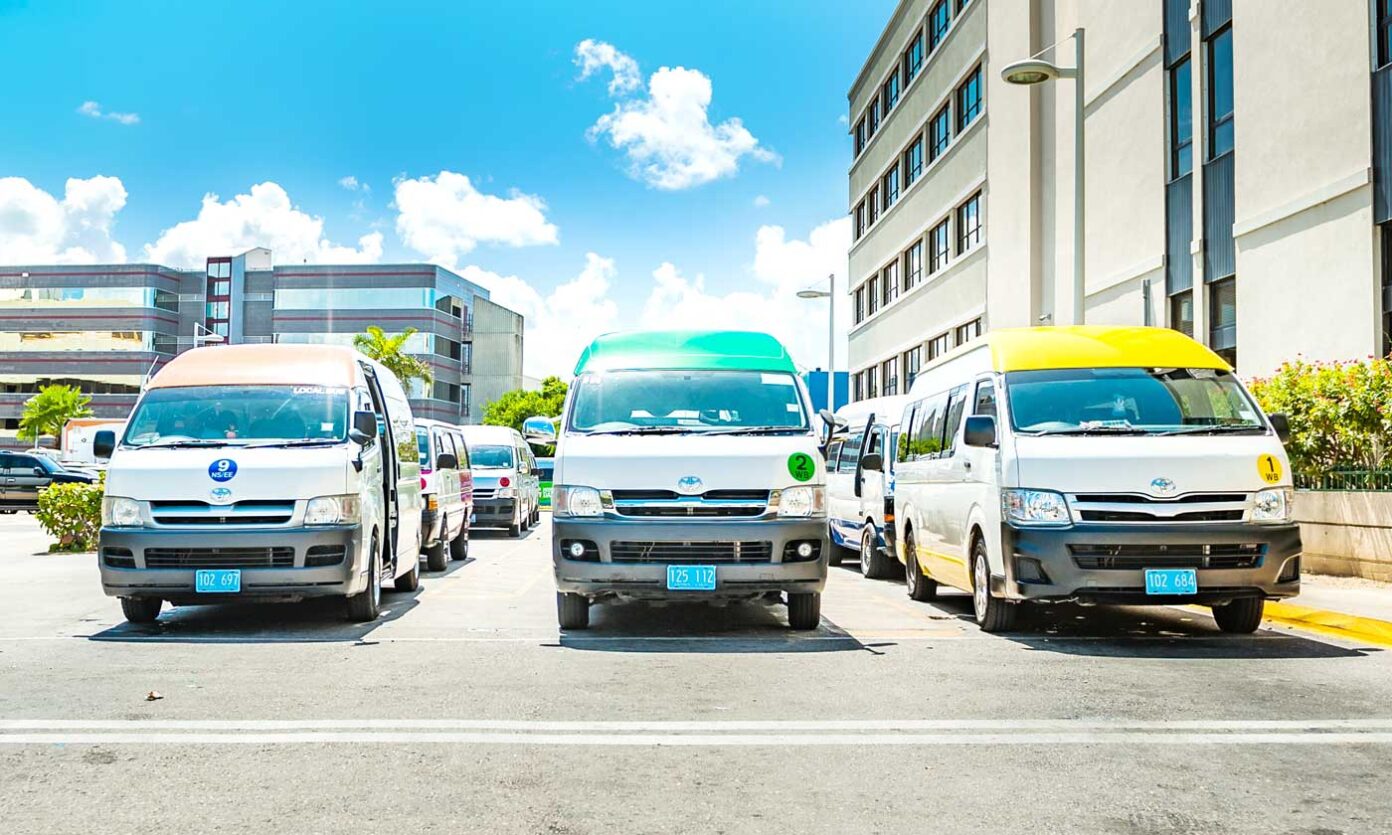
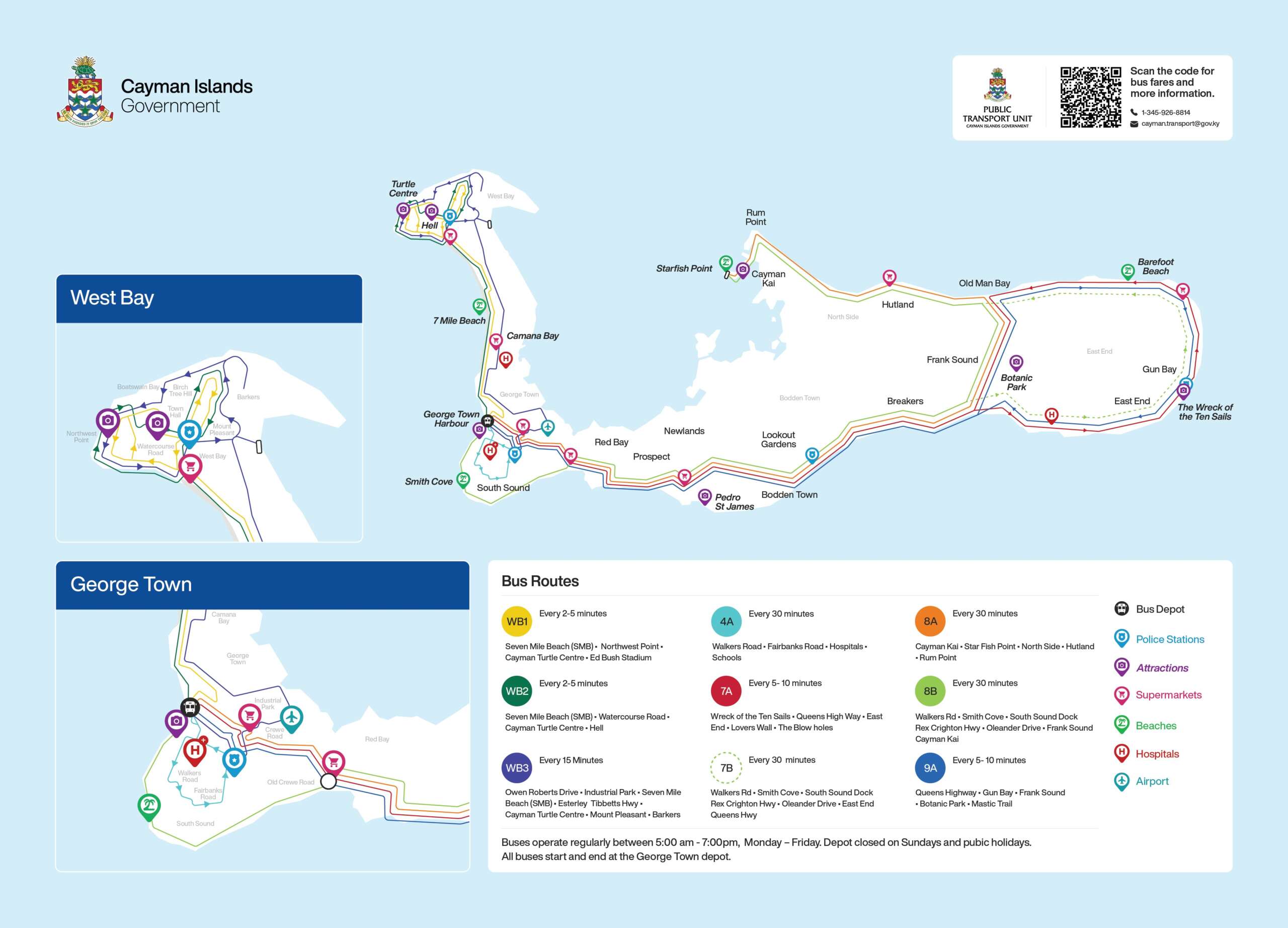
New easy-to-read bus route maps have been installed at bus stops across Grand Cayman to make it easier for residents and visitors to travel around the island by public transport.
The maps, installed at 25 bus shelters across the island by the Ministry of Planning and the Public Transport Unit (PTU), display route numbers, major stops and PTU contact details for enquiries, complaints and feedback.
The initiative, the ministry said, is designed to improve public awareness of bus routes, encourage bus drivers to stick to their assigned routes and promote public transport as a reliable and affordable travel option.
Commuters can also scan the QR code featured on each map to access a digital version instantly on their phone or visit www.caymantransport.ky.
Connecting Cayman
Planning Minister Jay Ebanks said, “We are committed to building a modern, reliable public transport system that works for everyone, from our daily commuters to visitors experiencing Cayman for the first time. These new maps are more than just signs; they’re a symbol of our pledge to make public transport accessible, user-friendly, and a preferred choice for getting around. This launch is another step towards a more connected, sustainable Cayman.”
The ministry and PTU will also distribute printed maps to a wide range of public access points, including community centres, government reception areas, schools, tourist welcome centres, healthcare facilities and popular visitor locations to ensure maximum reach and visibility.
Speaking about public transport at government’s 100 days celebration earlier this month, Ebanks said that a range of improvements were planned for next year, including live-tracking buses via a phone app and having cashless payments on the network.
“What we want to do is to make sure that nobody is actually waiting … longer than 15 minutes for a bus, no matter if you’re at East End, North Side, West Bay, wherever you’re at,” he said.
“We also want to look at how do we get a bus transportation that runs, not maybe 24/7, but at least late nights and early mornings, so if individuals need to get to work in East End at 4 o’clock in the morning, they can take a bus.”
He said that once budgets are decided, then government will know how much is available to spend and whether government subsidies or a public-private partnership will be needed to update the bus network. It is understood that some of recommendations from the 2023 report from consultancy firm Deloitte, entitled ‘Assessment of a Public Transport Strategy’, are to be implemented.
Cabinet approval
Minutes released on Monday for the 13 Aug. meeting of Cabinet show that Cabinet approved the Strategic Outline Case (SOC) on public transport in the Cayman Islands and approved for the ministry to proceed with the Outline Business Case stage.
In reply to a question asked by MP Roy Tatum in the recent parliamentary session, Ebanks said a consultant from the UK Department for Transport had been supporting the ministry in preparing the SOC for a modern public transport system in the Cayman Islands, offering a “high-level assessment of transport challenges, options and delivery models, serving as the foundation for future decision-making”.
Related Videos











I don’t know if they will ever get this done. It’s a bigger issue than immigration because people need to be able to get to work.
Thanks! Good move! ? And long overdue!
No buses after 7pm.
No buses at the weekend.
No way for people who drink too much to get home, except an expensive taxi.
No wonder we have so many accidents.
An above ground skytrain loop around the island would be revolutionary and a great tourist attraction. Pay for itself in record time and could be an income stream for those that invest in it.
The only thing in this release from Government which may begin to address one part of the public transportation problem is the use of tracking apps, as proposed. That is, if the regulator tracks the operators. The rest is complete waffle, as it’s been for years! New bus routes maps is pointless because many operators do not stick to routes nor to any form of schedule. Everyone in the halls of power states what “we would like”, no one has stated how to fix the system. Deloitte presented a costly report two years ago (the second one) and it’s not been implemented as yet. Of course, the general public doesn’t know what Deloitte recommended, whether or not its a “be all” solution. Now an “expert” (to quote the release) from the UK has been consulted. What does the PTU Director do? Isn’t that post the primary adviser to Government on these matters? Has the Director presented any recommendations to address the problem….ever?
Cayman’s bus routes are generally “serviced” by individual bus owners who may own one, a few or dozens of buses. They are NOT contractually answerable to the public (through the PTU) to provide scheduled service and a proper system for a minimum of 18 hours per day. Their operations are not monitored for timeliness or sticking to routes. Therefore, Mr. Individual Owner and his drivers start when they wish (maybe by 6 am) and go home when they’re tired, often by 7 pm. He’s accountable to no one. That’s not a bus system, it’s barely a service.
Operators claim there are no customers on certain routes and PTU buys that lame excuse. Customers do not stand out on certain routes to wait on buses which will never come. If operators plied their assigned routes regardless, customers would soon realize that service exists and operators would soon have customers. Operators must show reliability before the customer base builds.
A fully Govt-owned service a la Bermuda’s excellent system is grossly expensive and could never be run by the current PTU Director. To start, Govt would have to buy out every current individual operator and shut them down….start a firestorm. It gets costlier after that.
Alternate options, in light of the individual-run mess which we call a bus service. As a first step:
1. Govt could form a solid cooperative of current operators and their vehicles. Establish a leadership committee of that collective which would be contractually bound to provide reliable service and full coverage, under strictly enforced conditions. Establish within such cooperative, operator pools who focus on certain parts of the island. The CoOp leadership would be accountable to Govt, not each individual driver. Internally, the CoOp would be responsible for addressing non-performance, penalties include being exiled from the CoOp.
If it’s well managed and monitored, this approach could take the disjointedness out of the current situation without massive Govt fiscal outlay. It could be a vast improvement to the present situation.
Alternately and ultimately:
2. Put out a public tender for public transport services a la any modern city, proper scheduling, established stops (no stopping every few yards for every hail), 18-20 hour services (reduced and increased as needed). Have three contracts, one for eastern GC, one for western GC and one for all around GT. Have 3 private sector contractors accountable. Establish contractual performance standards and penalties. Breach of contract penalties could include losing the contract.
This may not necessarily require a massive gear-up by any potential contractor. They could simply implement Option 1 and corral enough operators under 3 umbrellas.
Option 1 is relatively simple to implement and could achieve the same results of the more complex Option 2.
There you go Minister Jay, no consultant fees. You’re welcome! Perhaps Director Banks could cut and paste these suggestions and present to Government, it may be the only time he’s presented anything in his almost 20 year tenure.
BTW, I’ve been a member representative on the PTB and have had direct exposure to everything on which I’ve commented. Also, I’ve operated a successful transportation company for over 40 years.