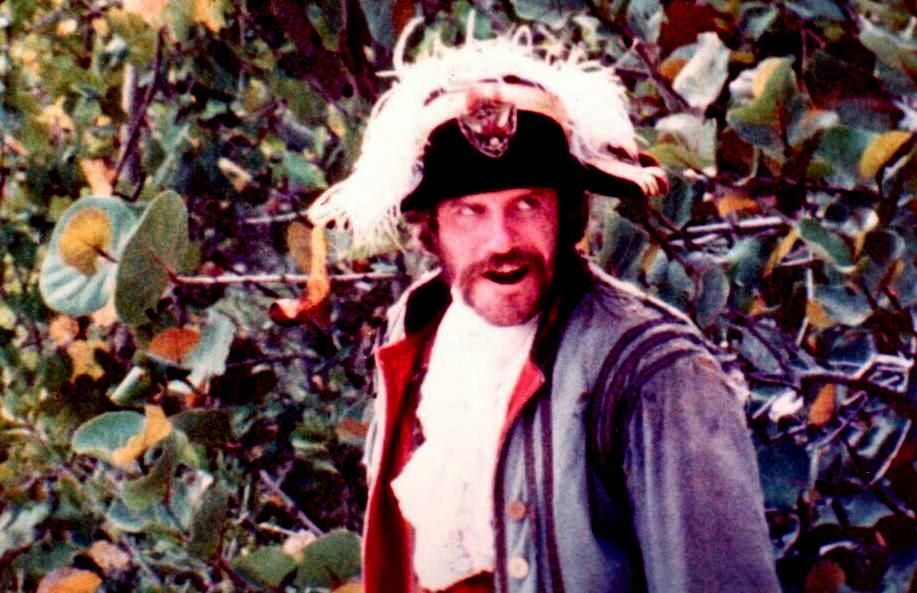
Fifty years ago this fall, Grand Cayman – with a population of about 12,000 – was the centre of a swashbuckling satire film called ‘The Cayman Triangle’.
Watching it today on YouTube feels like travelling back to a simpler Cayman, before traffic lights, before television, when the loudest sound on a Sunday morning was the sea breaking on the ironshore.
In 1975, Anderson ‘Andy’ Humphries, a Memphis filmmaker and part-owner of the old Holiday Inn on Seven Mile Beach, decided to make a parody of the Bermuda Triangle, but with a distinctly Caymanian twist. Filming took place during the fall of 1975.
He called his company Heffalump Pictures. The result, which premiered in October 1977, was part pirate spoof, part Cold War farce, and certainly an unusual look back into a Cayman of long ago.
Humphries’ leading man was the late Reid Dennis, one-time editor of the Cayman Compass and proprietor of Durty Reid’s Bar & Grill. In the movie, he played Durty Reid Walker, a one-legged pirate cursed to return from the grave and sink all ships within the ‘Cayman Triangle’ a mythical area between Cayman Brac, George Town, and Kingston, Jamaica.
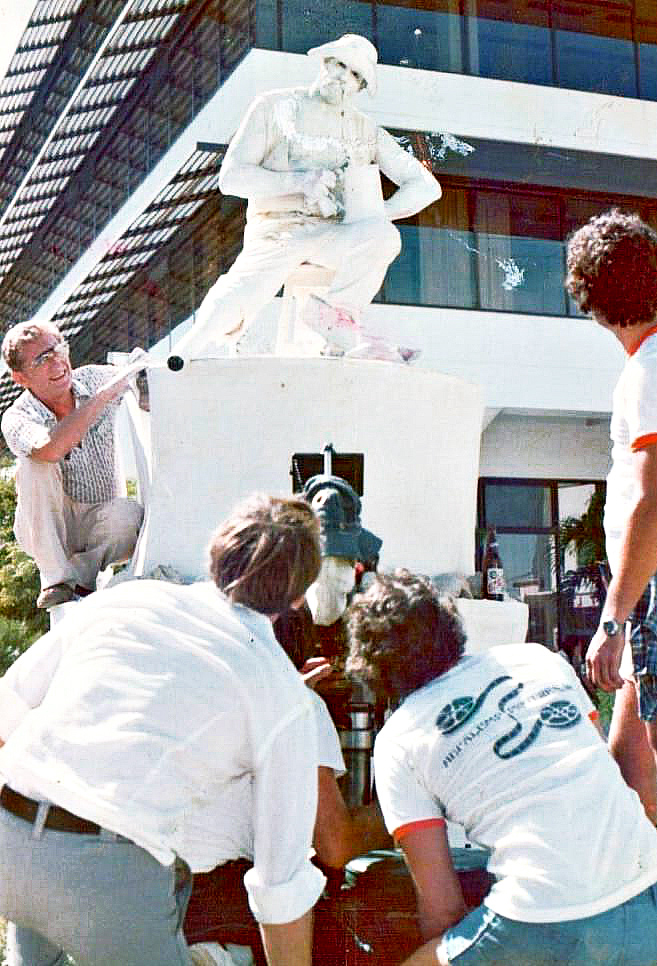
When Walker’s statue is disturbed, he comes back to life, drawing the attention of cigar-chomping American generals and a rival Russian fleet. There were no special effects – just Dennis himself hidden inside a plaster-of-Paris statue, sweating in the tropical heat.
“The only professionals were the cameraman and the sound people,” recalls Arek Joseph, who played Sir Neville Scott, an emissary from King George III. “Andy had been to film school, but he’d never done anything like this before. We were all amateurs, but we had fun.”
Most of the ‘actors’ were local residents who accepted payment in Heinekens – ‘greenies’ – and the chance to see themselves on the silver screen. Its ‘stars’ – according to the back of the 30th anniversary DVD – included, in addition to Joseph, local residents Brian Uzzell, Steve Foster, Mary Gillooly, Ryhal Gallagher, Desmond Seales, Mark Rice, Bernard Passman, and Rudy Seltzer. Others with parts included Andy Martin, Ian Boxall, Clarence Bothwell, Wendy Lauer and Martyn Bould.
Then director of tourism Eric Bergstrom even appeared as a newscaster. Singer-songwriter George ‘Barefoot Man’ Nowak, who wrote and performed the film’s soundtrack, ‘The Ballad of Durty Reid Walker’, remembers it well. “Back then we had no TV, radio or cinema,” he says. “So, to have a movie crew here and be part of it all was lots of fun. My payment? Free beer, rum and pretty wenches.”
Nowak, who also played the court jester, vividly recalls one early-morning scene outside the old George Town Post Office: “Across the street by Comart supermarket, there were a few inquisitive goats and chickens gawking at all the commotion. Grand Cayman was still the island that time forgot.”
The film’s humour was proudly homespun. A character named Major Limey wore limes on his uniform instead of grenades. Foster’s jungle hero was called ‘Nazrat’ – Tarzan spelled backwards. The turtle-shell-wearing ‘turtle rangers’ were Larry Cayasso, Attlee Bodden and Papie Conolly.
During one hanging scene filmed in front of the old Galleon Beach Hotel, Dennis, a Vietnam veteran who had lost a leg in combat, overheated in his harness and had to be revived by an ambulance crew.
‘The Cayman Triangle’ premiered in 1977 at the Orpheum Theatre in Memphis, followed by showings in Miami and Grand Cayman. It even won a Silver Medal for Best New Director at the Virgin Islands Film Festival and earned favourable reviews in Variety and Playboy magazines.
Today, the film survives as a quirky time capsule – a window into a Cayman that was still innocent, communal and deeply creative. “Everybody knew everybody,” says Joseph. “The island was friendlier, gentler. We all wanted to be part of something.”
Humphries, now retired in the US, says he never expected it to make money. “I financed most of it myself,” he laughs. “Did it make money? No. But it was a great experience and rarely do films like this ever get finished.”
Nowak agrees. “Anyone not around during that era could ever comprehend Cayman back then; cows and goats roamed George Town where the courthouse is now. It truly was paradise, the islands time forgot.”
Five decades later ‘The Cayman Triangle’ still makes Caymanians smile – a handmade film from a bygone era, when imagination, laughter and a few cases of ‘greenies’ were enough to make movie magic.
Related Videos