

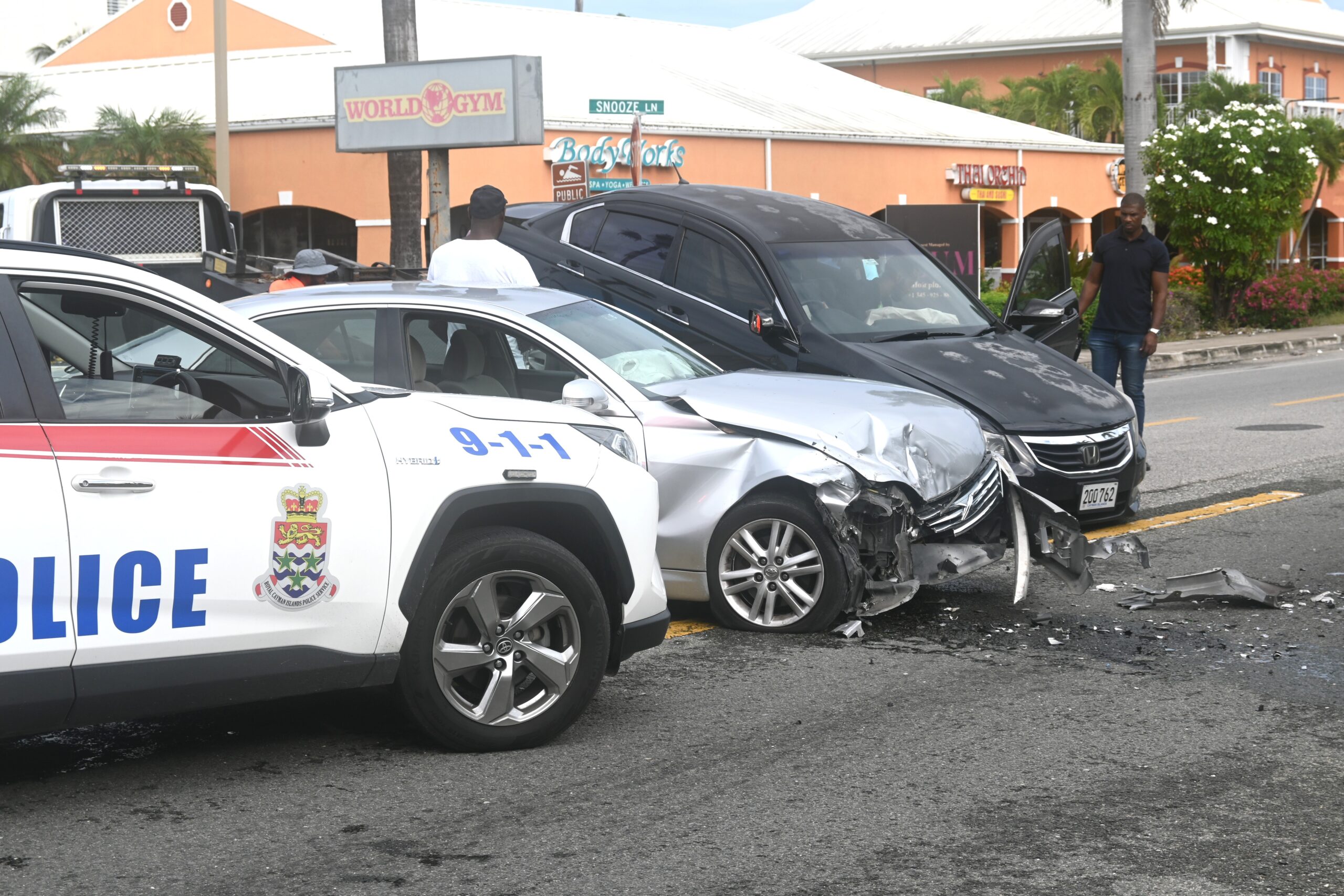
Efforts to cut the toll of death and injury on Cayman’s roads should start in primary schools, police have said.
Sergeant Jodi-Ann Powery explained that long-term reduction would require a multi-pronged approach, with better education being a major factor in changing behaviour on the roads.
“There are several things that need to be done – driving education needs to start in our schools, probably as early as elementary school.
“That also puts responsibility on parents. If children see their parents doing it, they’ll tell them that’s wrong.”
She highlighted that police had logged a total of 2,300 road traffic collisions up to October, up 4% year on year.
Officers made 23 arrests for drinking and driving in October alone, but Powery admitted the true figure would be much higher.
Powery said, “I am sure there are a lot more people who are driving under the influence than just 23.”
She added that the police traffic department was under-resourced, but emphasised the main remedy for the problem was in the public’s hands.
“We do do our best and our educational message is what we rely on to keep people in line and ensure they practise safe driving,” she said.
“I think what we need as a community throughout the Cayman Islands is an entire cultural shift – we need to be accountable for ourselves.”
She noted that drink driving and fatalities had cost more lives in Cayman than violent crime.
“At some point we have to take safe driving seriously because [road accidents are] the leading cause of accidental death in the Cayman Islands,” Powery said.
Risk of losing job
She said the 23 people caught drink driving last month faced potential consequences beyond a court appearance and media coverage of their case, because the mandatory ban could also affect their ability to earn a living.
“Potentially, that’s 23 people, if driving is part of their livelihood, they will lose their jobs and get a fine. Then they will be accountable to their family for losing their job,” Powery explained.
“There is a feeling that ‘it’s not going to be me’, but so many people have gone through it.”
She said the police service ran regular road-safety campaigns, coupled with enforcement drives.
The country cut the drink-driving limit to a 0.07% blood/alcohol content level (BAC) from 0.1% in 2022.
The new limit meant that the amount of alcohol a driver could have in their system was reduced from 100 milligrammes in 100 millilitres of blood to 70 milligrammes in 100 millilitres of blood.
The level is lower than Jamaica, Canada, Florida, and England and Wales, which have a limit of 0.08%, but higher than the permitted 0.05% in Scotland, Australia, France, Germany, Spain, Italy, Portugal and Argentina.
“The limit has decreased and individuals don’t know how alcohol is going to affect them on any given day,” Powery said.
“The message from us is, if you intend to drink, don’t drive at all.”
Mindset change
Powery said police work with the ‘Arrive Alive 345’ campaign, whose supporters include Compass Media. The Purple Ribbon Pledge campaign was designed to encourage drivers to promise not to drink and drive over the festive season and runs alongside a designated-driver scheme and a special Purple Ribbon New Year’s Eve bus service.
“That’s an organised safe driving initiative for New Year’s Eve,” she said. “What I would love to see, and what can be done, is that this initiative transfers to the rest of the year or, at least, the key points of the year – events like Heritage Week and the CayMAS carnival.”
She added, “If it can be expanded … that would be great, but would require community buy-in and sponsorship.”
The increasing toll of death and injuries, Powery said, caused a huge financial burden because of the cost of health care and, in many cases, the expense of specialist treatment overseas.
Tougher sentencing
Powery called for tougher deterrent sentences to be imposed on those convicted of driving offences.
The maximum penalty for causing death by dangerous driving is 10 years plus a minimum five-year ban after release.
But rarely is anyone given the maximum, Powery said.
“Potentially, we should look at increasing the penalties, which would go a long way to changing the mindset.”
The penalty for the same offence in the UK is up to life imprisonment and a minimum five-year ban, to start after release from prison, as well as a compulsory extended driving re-test.
It is understood, however, that the Cayman government is to examine the possibility of higher sentences for serious motoring offences.
Powery said that taxi services were available “24/7” and that people should always have to plan to get home safe if they were going to drink.
“Having a look at our bus services would help greatly, but we have to focus on what we have while our partners work to improve where they can.”
She added, “An increase in enforcement could be looked at, and we do try to do that throughout the year. But that’s not sustainable every day, particularly with the number of calls we have to deal with and the vast number of reports we have to respond to daily.
“Encouraging personal accountability is probably our best way forward.”
Related Videos











All relevant points, but there is such low hanging fruit that would make a significant impact:
1. Actual enforcement of traffic laws. Frustrating to see how many careless drivers are on our roads (speeding, driving on the shoulder, texting, drunk).
2. Improved taxi/Uber service
3. PUBLIC TRANSPORTATION
Until progress is made on the above, teaching kids about driving safely is a moot point.
Good try Sergeant Powery but in reality the same parents who fail to teach children basic life skills and precepts, like good manners, good work ethics, self respect and respect for others will fail to convey something like proper driving practices, even if those parents themselves know.
Adding driver awareness to a kindergarten curriculum is certainly a stretch but it is a good idea to be included in high schools, as is done in some countries.
But who would teach same, the same “Joe Browns” who now operate driving “schools”? Or the Tom, Dick and Harrys who we see coaching people on a Sunday afternoon? Our road capacity and designs have long outgrown that “country-style” process. Who has proven that such people are capable and competent drivers themselves, before they pass on their “skills”?
At the very least, properly regulated driver training is required, alongside an improved public transport system….which itself could keep many drivers and vehicles off the roads.
“First topic, class, is locating and using our indicators! Police officers present, please take note.”
Consistent traffic law enforcement! That alone will very significantly help with safety and learning of what driving behavior is legal, and acceptable! Unfortunately, there is a glaring absence of traffic police enforcing the laws, and the result is many people driving in whatever manner they want to!
Those in positions of power need to speak to this glaring lack of law enforcement!
The conversation about road safety starts at home, from the time children are toddlers, they’re learning through what they see, not just what they’re told. Young children, teenagers, and even young adults take cues from the adults around them. Are you respecting traffic laws? They notice when you speed. Are you drinking and driving? They know when you come home intoxicated behind the wheel.
Law enforcement exists for a reason, but it should never be the first teacher. We shouldn’t wait for penalties or tragedies to shape behaviour.
A great way to begin this conversation is through play. Try the locally created game “PullOver”, available at Book Nook and The Toy Box. PullOver is an exciting road game where players must obey road signs or face consequences—speeding included! It’s a fun, interactive way to help children and young people understand that safe driving isn’t optional; it’s essential.
Start the conversation early. Start it positively.